COMPANY
Home
Where We Build
About Us
Contact Us
Vendor Inquiry

By Fred Loucks, Owner & CEO, Dunn & Stone Builders
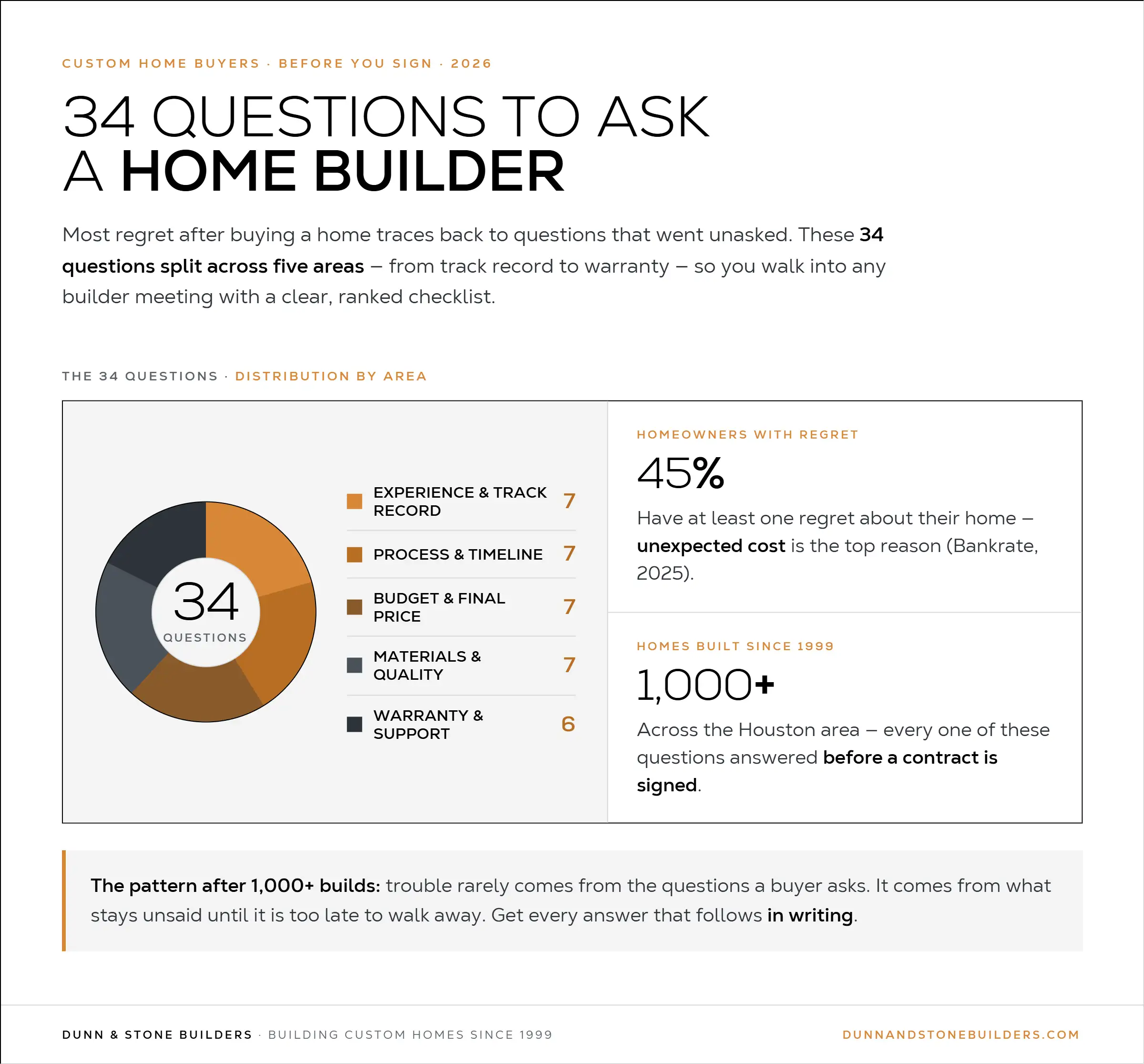
Most homeowners feel some regret after buying a home. Bankrate's 2025 survey found that 45 percent have at least one regret about their current home. Unexpected costs rank as the most common reason. See the full survey coverage here.
Asking the right questions early helps keep surprises out of your build. We have built homes across the Houston area since 1999. We completed over 1,000 of them. I joined the team in 2010 and bought the company in 2019. Projects run smoothly when buyers ask clear questions before they sign.
Here are 34 questions. They cover six areas. Each one includes what a strong answer sounds like.
Experience and track record
Build process, timeline, and communication
Budget, final price, and extra fees
Materials, subcontractors, and quality
Warranty, support, and long-term value
These questions show what a builder has done, how long they have done it, and whether their work matches what you want.
Ask how many homes like yours they have completed. A builder with that experience knows the common issues. We build from plans we refined across more than 1,000 homes. We face few problems for the first time.
Longevity shows a builder has worked through different markets and code changes. We carry more than 100 years of combined team experience. Our warranty lead has worked in the trade since 1984. We belong to the Greater Houston Builders Association and hold BBB accreditation.
Walk through a finished home if you can. Photos do not always capture the real quality of the work. Ask to see more than one. You can view our completed builds gallery before you visit.
A builder who stands behind the work shares recent client names without hesitation. Call them. Ask about communication, any surprises, and whether the builder followed up after move-in. We hold a 4.8 rating on Houzz. We connect you with families whose homes we finished.
Local experience means the builder knows the codes, permitting offices, and soil conditions. Houston soil, drainage, and flood zones reward preparation. We build throughout the Houston area. We engineer for clay soil movement and humidity from the start.
Match the builder's strengths to your taste. We build Modern Transitional, Traditional Texas, Modern Farmhouse, and Texas Mediterranean styles.
Listen for honest answers about setbacks. A builder who owns problems and explains the fix earns trust when issues arise on your job.
A custom build involves months of decisions. These questions reveal how the builder works and keeps you informed.
A clear answer includes a range and the factors that shift it, such as weather or material delays. Custom builds take longer than production homes because the plan is yours. We outline the full process in our how long it takes to build a home guide.
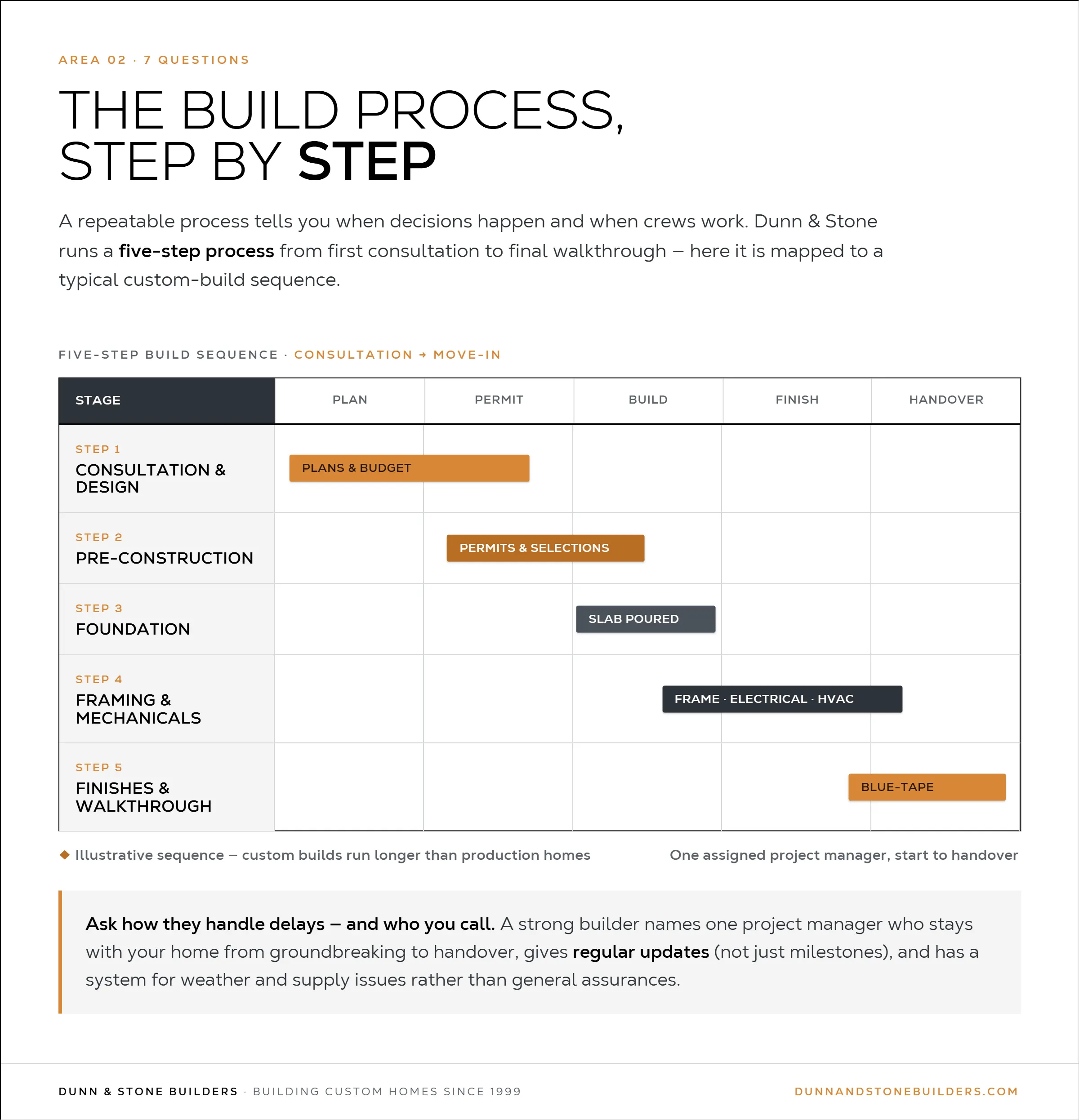
A repeatable process helps you know when decisions happen and when crews work. We follow a five-step process from first consultation through final walkthrough. See our steps to build a home.
Ask for their on-time rate and examples from recent jobs. Any builder can name a date. The real test is what they do when the schedule moves.
A builder with a system explains exactly how they manage weather and supply issues. Press for specifics rather than general assurances.
You want one project manager assigned to your home. We assign managers who have run jobs since the early 2000s. They stay with your project from groundbreaking to handover.
Ask whether updates arrive weekly or only at major milestones. Regular contact prevents confusion. Find out if they use phone, email, or an app, and how quickly they reply.
Ask what changes cost and how they affect the timeline. We aim for zero change orders. The contract you sign is the price you pay. When changes happen, they stay with the buyer, such as a granite upgrade that adds a few thousand dollars.
Builders quote and bill in different ways. These questions help you understand the real cost before you commit.

Get the full scope in writing. Some base prices cover only what sits inside the walls. Site work such as the driveway, power to the house, silt fence, dumpsters, and portable toilets can come later. We include more of those items upfront. You can read our guide to the hidden costs of building a house.
Find out whether the price is fixed, cost-plus, or hybrid. Material costs matter in 2026. Tariffs on steel, aluminum, copper, and appliances have raised expenses. NAHB estimates the impact adds thousands per home. We design rooms around full lumber lengths to reduce waste. Our current builds run about $173 to $250 per square foot.
Ask how changes get priced and whether every change goes in writing before work starts. Even small swaps can add more than you expect. Some builders charge a flat fee. Others use a percentage.
A good builder offers ways to bring the number back down. They might adjust materials, scope, or the order of upgrades. Ask for an example of how they handled it before.
A reputable builder provides a line-by-line breakdown with allowances for cabinets, flooring, and fixtures. Upfront transparent pricing is what many buyers say they could not get elsewhere. We hear that from people who spoke with several builders.
Ask whether you see live cost tracking or only updates on request. The more visibility you have, the fewer surprises you face.
We start from proven plans and engineer for material efficiency. That approach sits at the core of our semi-custom approach. You can run your numbers through our cost-to-build calculator before you set a budget.
These questions show what goes behind the walls, who does the work, and how much input you have.
Ask for a written list for roofing, framing, siding, and flooring. Standards matter most where you cannot see them. We start with a two-stage HVAC system built for Houston climate. Homes over 3,000 square feet receive two AC units.
This question shows how much freedom you have. We source finishes through trade partners rather than big-box stores. That keeps warranty, recall tracking, and repair stock intact. One buyer once pulled their flooring budget and hired their own crew with discount product. The result was poor enough that we could not photograph the home.
Find out who actually stands on your site. We keep design and build under one roof. One team stays accountable from first sketch to final walkthrough.
Ask whether they check licensing and references. Ask whether they keep the same trades or hire whoever is free. A builder who has worked with the same crews for years produces more consistent results. That consistency protects you later.
Ask how often the builder, project manager, or a third party inspects each phase. Frequent checks catch problems early at foundation, framing, electrical, and finish stages. The earlier an issue is found, the cheaper it is to fix.
Ask whether upgraded insulation, low-E windows, and high-efficiency HVAC come standard or cost extra. Efficient homes cost less to run and hold value better. We cover what actually moves the needle in this climate in our sustainable building materials guide.
Ask how flexible the layout and foundation are for changes in five or ten years. A smart plan today saves money down the road. A builder who thinks past move-in is worth keeping.
These questions show what support you receive when something goes wrong and how well the builder stands behind the work over time.
Get the warranty in writing. Note what it covers, for how long, and who to call. Most builders offer a one-year workmanship warranty and longer coverage on major systems. We service all of our own warranty work in-house. StrucSure provides a second layer of 10-year structural coverage. That differs from a consumer home warranty. We compare options in our guide to the best home warranty companies in Texas.
Ask exactly what happens if the HVAC fails, drywall cracks, or caulking separates. Coverage usually steps down over time. Here is how ours works:
You can find more on new construction warranties in our new construction home warranty guide and our breakdown of what a home warranty covers.
This question shows follow-through. Will they send someone, refer you out, or leave it to you? Our clients call, email, or text our field team directly. We handle it. No claim portal. No runaround.
Ask how they handle minor fixes and walkthroughs in the first year. Beyond warranty work, some builders offer punch-out visits and touch-ups. Our warranty lead looks for trouble early on purpose. We fix the build process, not just the symptom.
A real walkthrough covers everything from outlet testing to trim alignment. You build a punch list. This is your chance to catch issues before they become yours. A ten-minute glance does not count. Bring a checklist so nothing slips past you. We share a blue-tape walkthrough checklist.
Ask whether nearby projects, zoning changes, or commercial development might affect traffic, noise, or resale. A builder who knows the area can speak to it. Watch whether they engage or dodge the question. The good ones help you plan around it.
After more than 1,000 homes, certain patterns appear. Trouble rarely comes from the questions a buyer asks. It comes from what stays unsaid until it is too late to walk away.
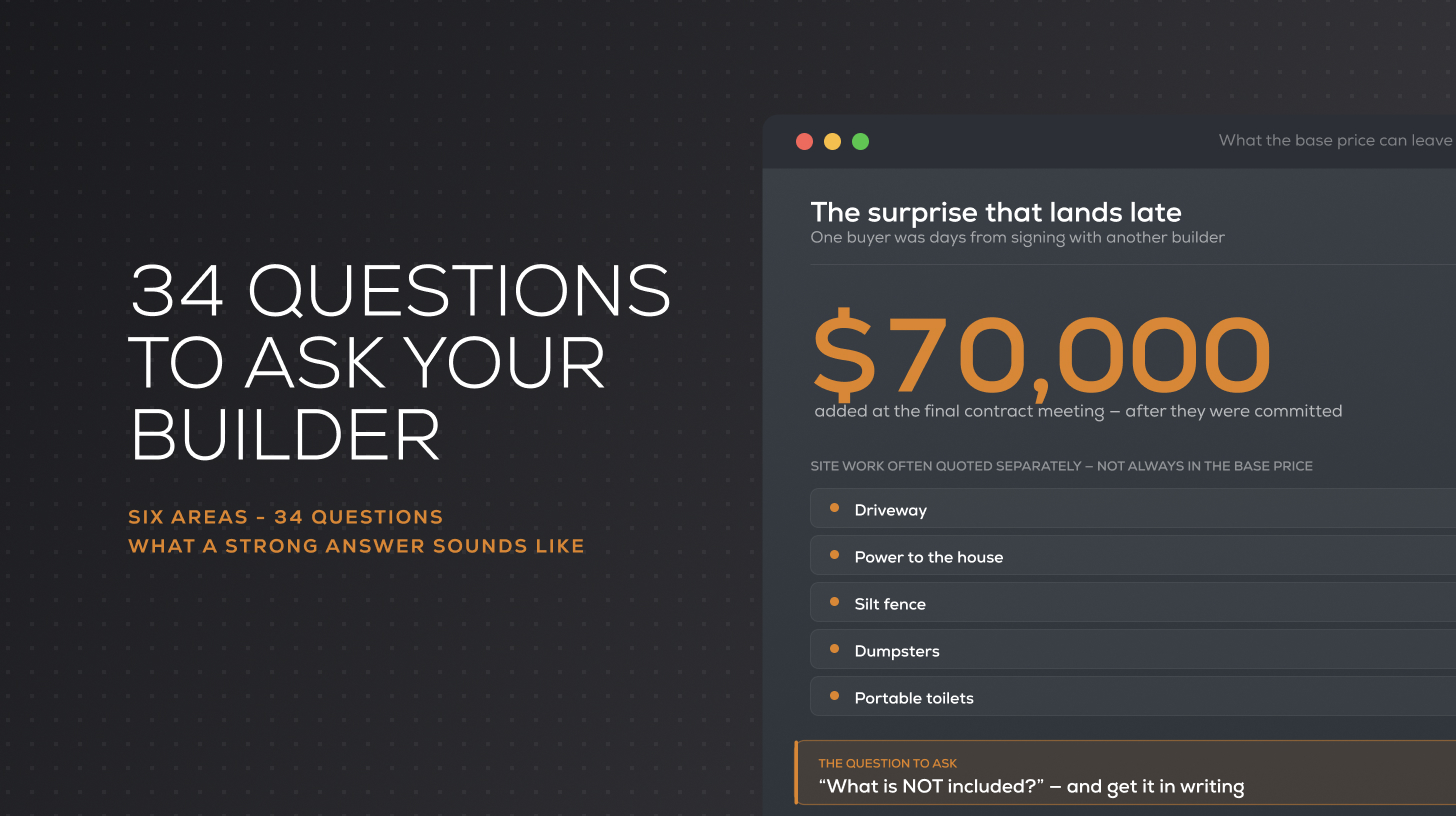
One common surprise is a price that is not complete. We once worked with a buyer who was days from starting with another builder. The final contract meeting added a $70,000 surprise. The site plan had no driveway and no power to the house. Those items got added after the buyer was emotionally committed.
Some builders price only what sits inside the walls. Site work such as the driveway, power, silt fence, dumpsters, and portable toilets is real money. If it stays off the contract, you find out after the loan closes. The extra then comes out of your pocket.
Vague pricing creates the same problem. Buyers tell us they spoke with several builders and none would give a clear number before the close. Holding back the real cost to win the deal, then revealing it late, is a tactic.
Not every surprise is a problem. Some are honest tradeoffs. Paint upgrades can cost more than people expect because a richer finish means painting the home twice rather than touching up a spot. Vertical siding can run close to brick once you count the labor. A good builder explains those before you choose. The number never moves on you after the fact.
If a builder cannot give you written, upfront pricing and a clear change-order process, that tells you what you need to know. For more on choosing a builder, read our guide on how to choose a new home builder.
These questions give you a tool. They help you slow down, speak up, and gain clarity most buyers do not reach until the walls are already going up.
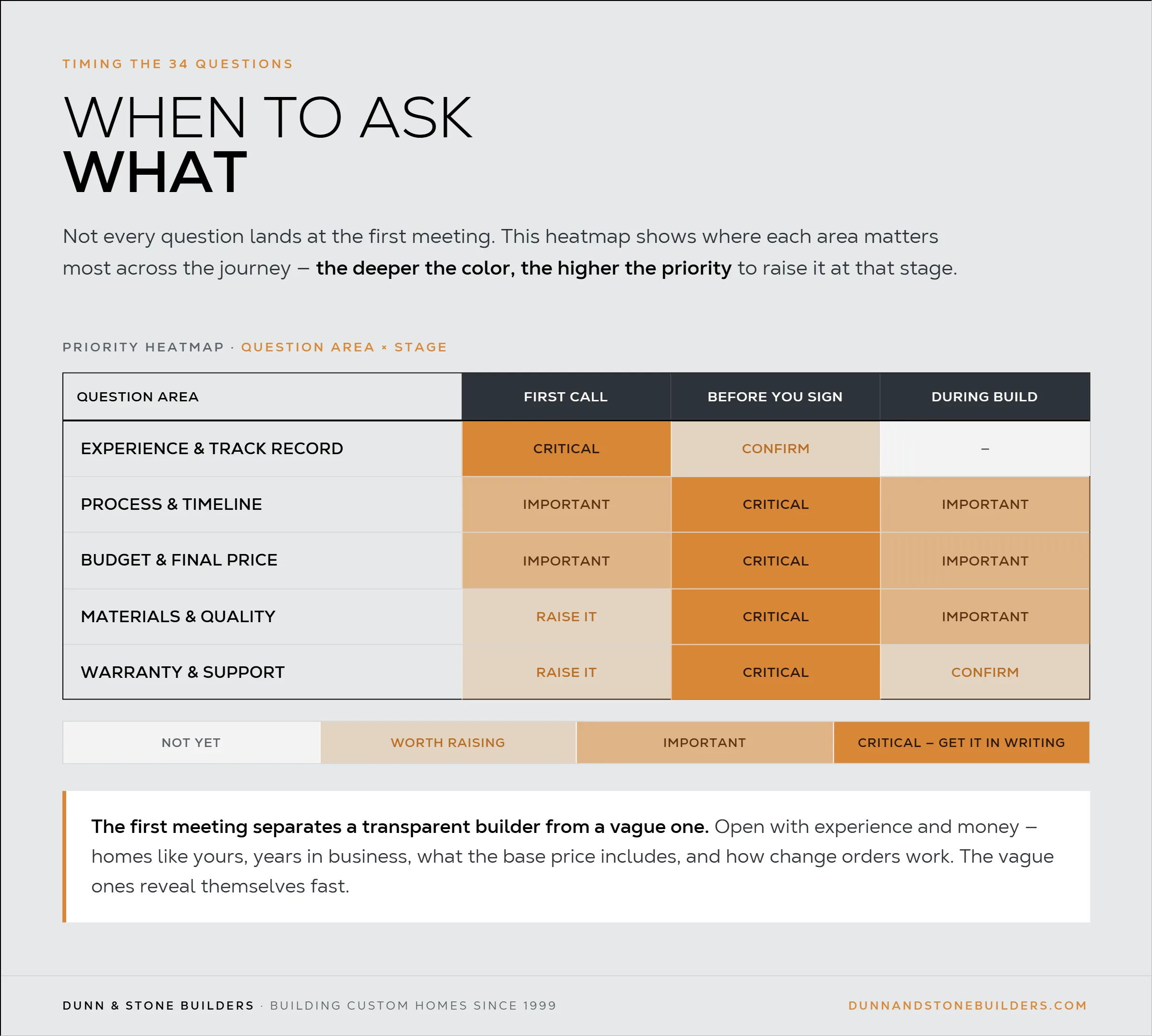
We built our process around answering every one of these questions before a contract gets signed. We listen. We price the whole job upfront. We build a plan that fits your life and your lot.
If that approach fits what you want, schedule a free consultation. Bring the questions. We will walk through all 34.
Ask across six areas: track record, the build process and timeline, the budget and final price, materials and quality, the warranty, and the contract itself. The highest-value questions cover what the base price includes, how the final price is set, what the warranty covers and for how long, and what happens when you want a change. Get every answer in writing before you sign.
Do not assume the base price includes site work. Items like the driveway, power to the house, and lot prep often get quoted separately. They can add tens of thousands of dollars. Do not assume standard features either. Things like gas or electric to the dryer can be priced as options. Ask for the full scope in writing.
Start with experience and money. Ask how many homes like yours they have built, how long they have been in business, and whether you can tour recent work. Then ask what the base price includes, whether pricing is fixed or cost-plus, and how they handle change orders. The first meeting is where a transparent builder separates from a vague one.
A trustworthy builder gives you upfront written pricing, a clear process, references you can call, and homes you can tour. They explain tradeoffs before you choose, not after. Watch for the opposite: a builder who holds back the real number, leaves site work off the contract, or cannot describe their process clearly.
Ask what is covered, for how long, and who handles claims. Most builders run a tiered warranty. Broad coverage applies in year one. Structural coverage stretches to ten years. Ask whether the builder services the warranty directly or routes you to a third party. Get the coverage ladder in writing.
Building in the Houston area runs about $150 to $300 per square foot. The number depends on size, finishes, and lot conditions. Our current builds fall between about $173 and $250 per square foot. Smaller homes tend to land at the higher end per foot because fixed costs spread across less space.
Print these questions and take them into any builder meeting. Enter your email below and we will send you the printable PDF. No obligation. Use it on us and on every other builder you are talking to.

.webp)


