COMPANY
Home
Where We Build
About Us
Contact Us
Vendor Inquiry


The hidden costs of building a house are the costs that are rarely thought about when imagining your dream home: site preparation, utility connections, permits and city building rules, temporary site items, changes you choose after signing, and the things you buy after move-in.
At Dunn & Stone Builders, we walk you through each of these during the design phase so you don't have any surprises at closing.
Building a custom home should feel exciting. You're creating the place your family will live for decades.
A base price can still leave out a long list of costs that only become visible once dirt starts moving. Most of our custom homes land between $500K and $1.5M, and across recent projects our portfolio average sits at $213 per square foot. The land, the city or county, and your own choices decide most of what lands on top of that.
Each category below follows the order you'll meet it, phase by phase, so you can budget with eyes open. If you'd like a starting number for your own plan first, the free cost-to-build calculator is a good place to begin.
I'm CEO of Dunn & Stone Builders. I joined the company in July 2010 as purchasing manager and purchased the company in 2019. I've been the primary client contact for plan design and turning buyer goals into buildable plans since 2010. The company has built more than 1,000 homes across Greater Houston since 1999.
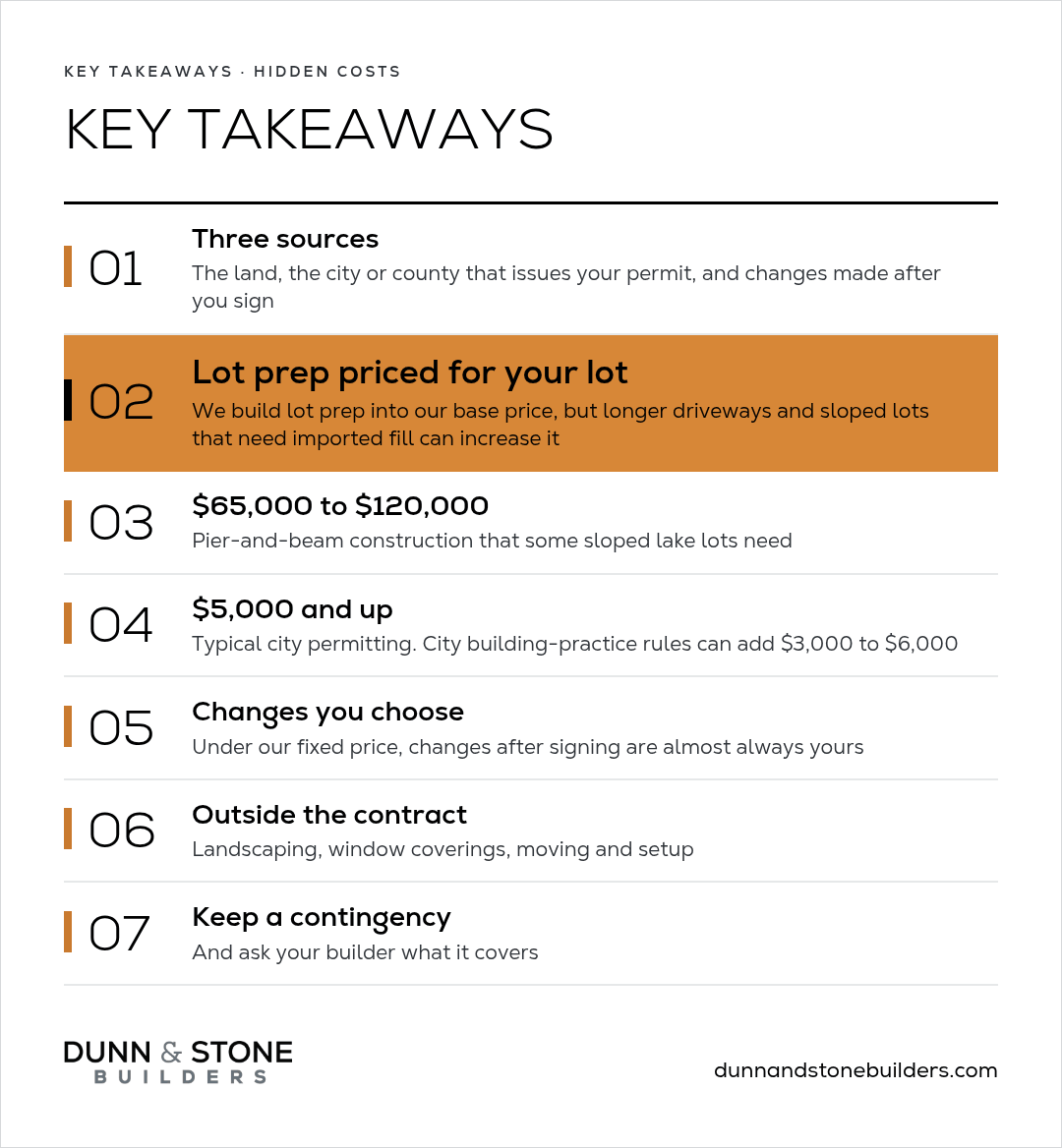
A base price covers the structure, the finishes inside the allowance package, and the mechanical systems that make the home livable. Everything outside that box is variable.
The biggest variables are the land itself, the municipality, the design process, and the market conditions when crews are on site. Clay soils, long utility runs, and flood-elevation rules across Greater Houston can all move the site-work line.
Most of these costs are familiar to anyone who builds for a living. They simply stay out of view for a first-time custom-home buyer until the soil report comes back or the utility company quotes the run. That's why we treat the homesite evaluation as the first real step, so every variable gets priced while there's still time to plan around it.

A fixed price is one construction number tied to dated plans and a written specification. It holds for the work those pages name, which is why the site plan and the exclusion list matter as much as the floor plan.
Some quotes cover only what sits inside the Sheetrock walls. Items buyers assume are included, like the gas line or electrical run to the dryer, can turn into options later.
Temporary site items are another common gap. Silt fence, orange safety fencing, dumpsters, and portable toilets are easy to assume and easy to leave off. When they show up at closing, buyers are often already at their maximum loan amount and have to pay out of pocket.
On Dunn & Stone contracts, the base price already covers silt fence, orange safety fencing, a dumpster, and a portable toilet. Our goal: no surprises.
The site plan itself deserves a careful read, so ask to see the driveway and the power run to the house drawn on it before you sign.
For a line-by-line look at inclusions and allowances, see what's included in a fixed-price custom home contract.
A few design-phase choices surprise buyers because they cost more than they look. Upgrading to a satin paint finish runs roughly double the base paint cost, because satin can't be spot-touched, so any mark means repainting the wall.
Vertical siding often costs about the same as brick. Brick pricing follows fuel costs, while vertical siding follows lumber and the labor of setting each strip. For more, see how exterior veneer changes custom home cost.
These are choices you make with the numbers in front of you, which is exactly where we want them.

If one category is responsible for the largest budget surprises, it's site preparation. The good news is that a careful walk of your lot can price most of it before you sign.
Sometimes we see a lot prep cost above our base price ranging $20K to $30K or more. That adds up for things like longer driveways and sloped lots that need imported fill.
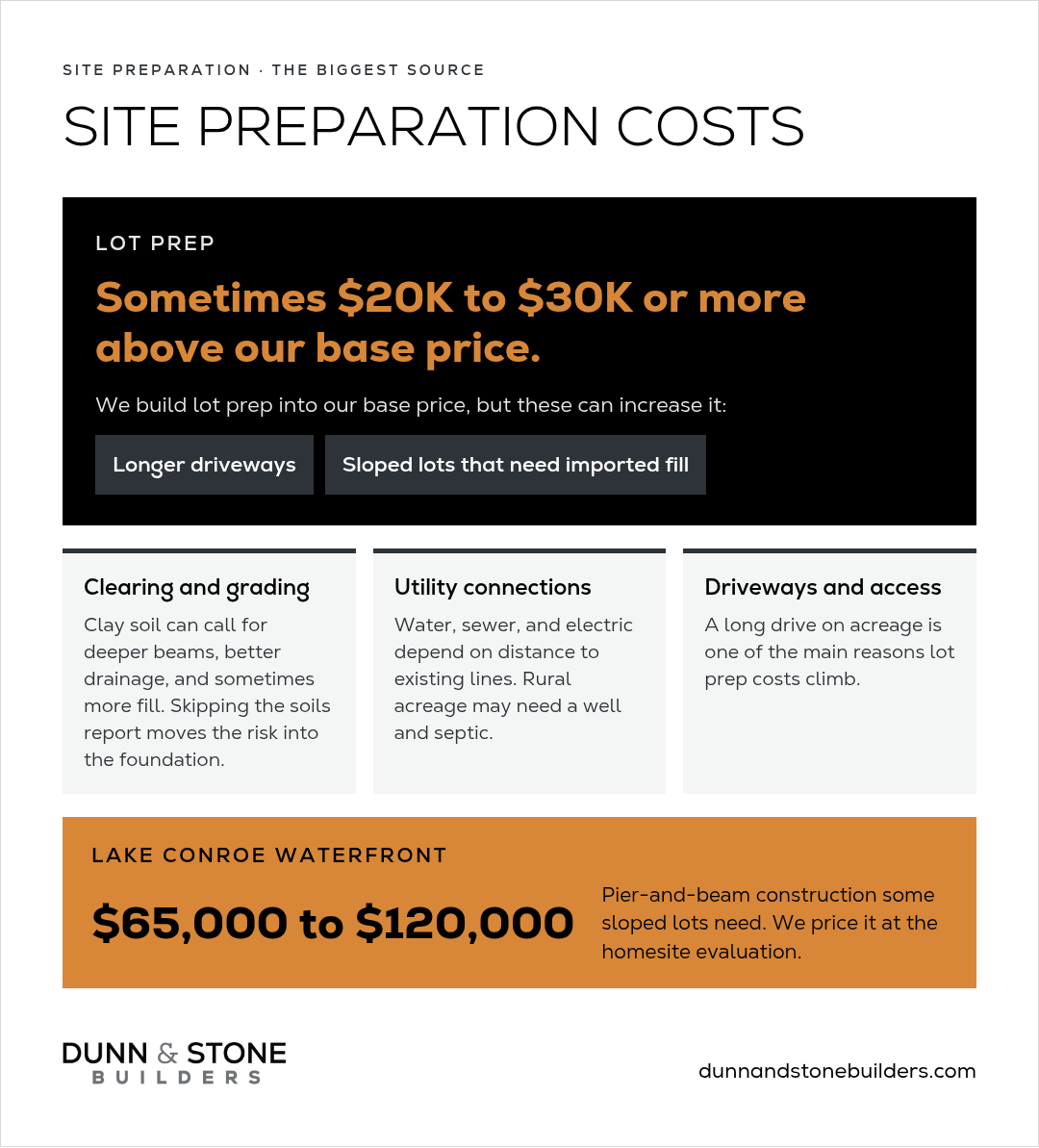
We walk every homesite before we write a contract. That evaluation surfaces the soil, drainage, tree cover, and elevation issues that turn into expensive surprises later.
Clay soil is the quiet driver in much of the Houston market. It expands when wet and shrinks when dry, and that movement can call for deeper beams, better drainage, and sometimes additional fill before the foundation is poured. Skipping the soils report to save money up front doesn't really save anything. It moves the risk into the foundation.
For a deeper look at soil, slope, flood elevation, and trees, see how homesite conditions affect custom home costs.
Water, sewer, and electric service depend on how far your lot sits from existing lines. Rural acreage may need a well and septic system, and a site evaluation of the soil decides what kind of septic system will work.
These costs move with distance and soil, which is why we price the utility scope during the homesite evaluation rather than after the contract is signed.
A short driveway on a suburban lot is modest. A long drive on acreage is one of the main reasons lot prep costs climb.
Lake Conroe waterfront lots bring their own variable. The slope down to the water can require pier-and-beam construction in some cases, which adds $65,000 to $120,000. We price that during the homesite evaluation, so it's part of the plan from day one.
These costs come early, because the permit has to be in hand before we break ground.
Where your lot sits decides a lot (pun intended). Inside a city such as Houston, Conroe, Huntsville, or Tomball, permitting typically runs $5,000 and up, and cities can require specific building practices that add another $3,000 to $6,000.
Most counties are easier and more affordable to work with, and they usually turn a permit around in two to three weeks.
Harris County has become stricter on flood-map rules that limit bringing in fill dirt to raise a home above Base Flood Elevation, and Montgomery County is moving in the same direction. Surveys, plan review, and drainage or engineering work can add to the paperwork side, depending on the lot. Architectural fees depend on the design path, since some homes need a full architect and stamped drawings while others work with an in-house design approach.
Our Harris County building permit guide walks through who issues your permit and how the fill rules work, and our page on permitting and preconstruction covers the local sequence.

Even the best plan can't remove every variable once crews are on the ground. The difference between a smooth build and budget stress usually comes down to how thoroughly the plan and site were settled before the contract was signed.
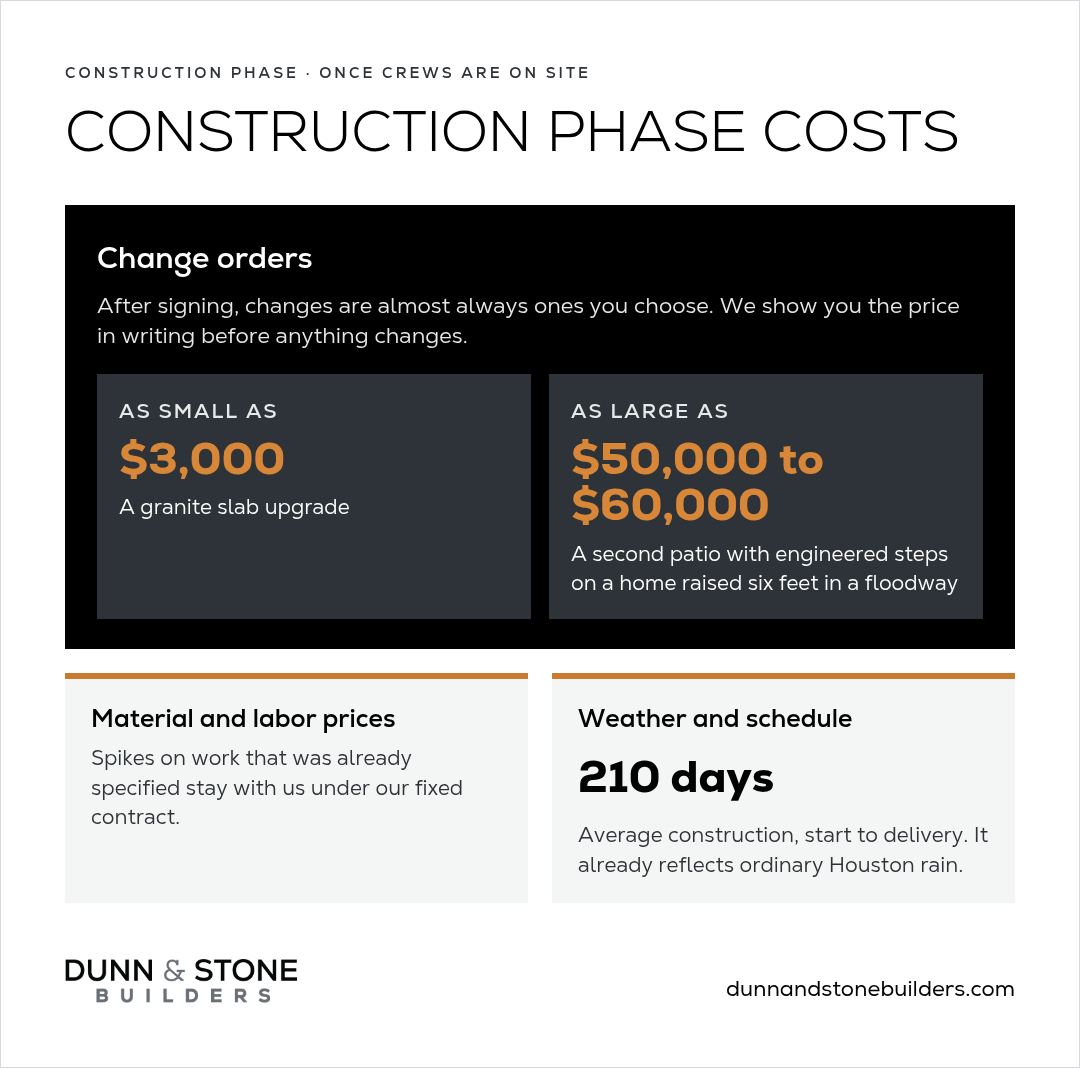
Under our fixed-price contract, the changes that come after signing are almost always ones you choose, like adding or upgrading something, so the decision stays yours. Falling in love with a different finish partway through is completely normal, and we'll show you the price in writing before anything changes.
A late change can be as small as a $3,000 granite slab upgrade or as large as $50,000 to $60,000 for a second patio with engineered steps on a home raised six feet in a floodway. For the full process, see how custom home change orders work after you sign.
Delivery fees and fuel surcharges can appear when lumber or trusses travel long distances. Market spikes in framing lumber or mechanical equipment can still lead to adjustments under some contracts, depending on how the allowance language is written.
Under our fixed contract, material or labor spikes on work that was already specified stay with us.
Houston weather can stretch a schedule by weeks, and extra time on a construction loan means more interest on the amount already drawn. Across recent Dunn & Stone projects, construction averages 210 days from start to delivery, and because that's an average of real builds, it already reflects ordinary Houston rain.
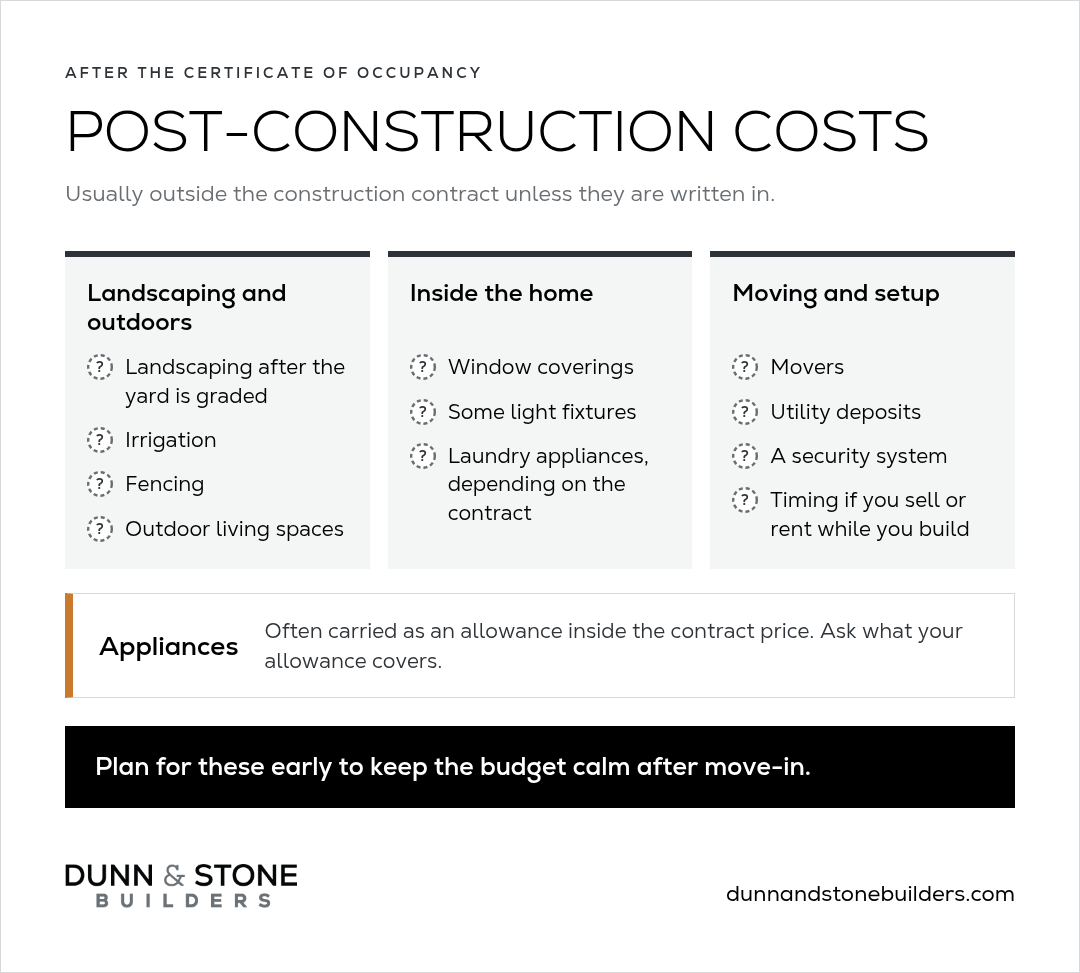
The Certificate of Occupancy is the start of life in the house, and a few costs still follow it.
Landscaping after the yard is graded, irrigation, and fencing usually sit outside the construction contract unless they're written in. Outdoor living spaces can be a later project, and planning for them early keeps the budget calm after move-in.
Window coverings are usually a separate purchase. Appliances are often carried as an allowance inside the contract price, so ask how your builder handles them and what the allowance covers. Depending on the contract, some light fixtures and laundry appliances may be separate purchases too.
Movers, utility deposits, and a security system all land in the weeks around closing. If you're selling a home or renting while you build, factor in the timing between the two.
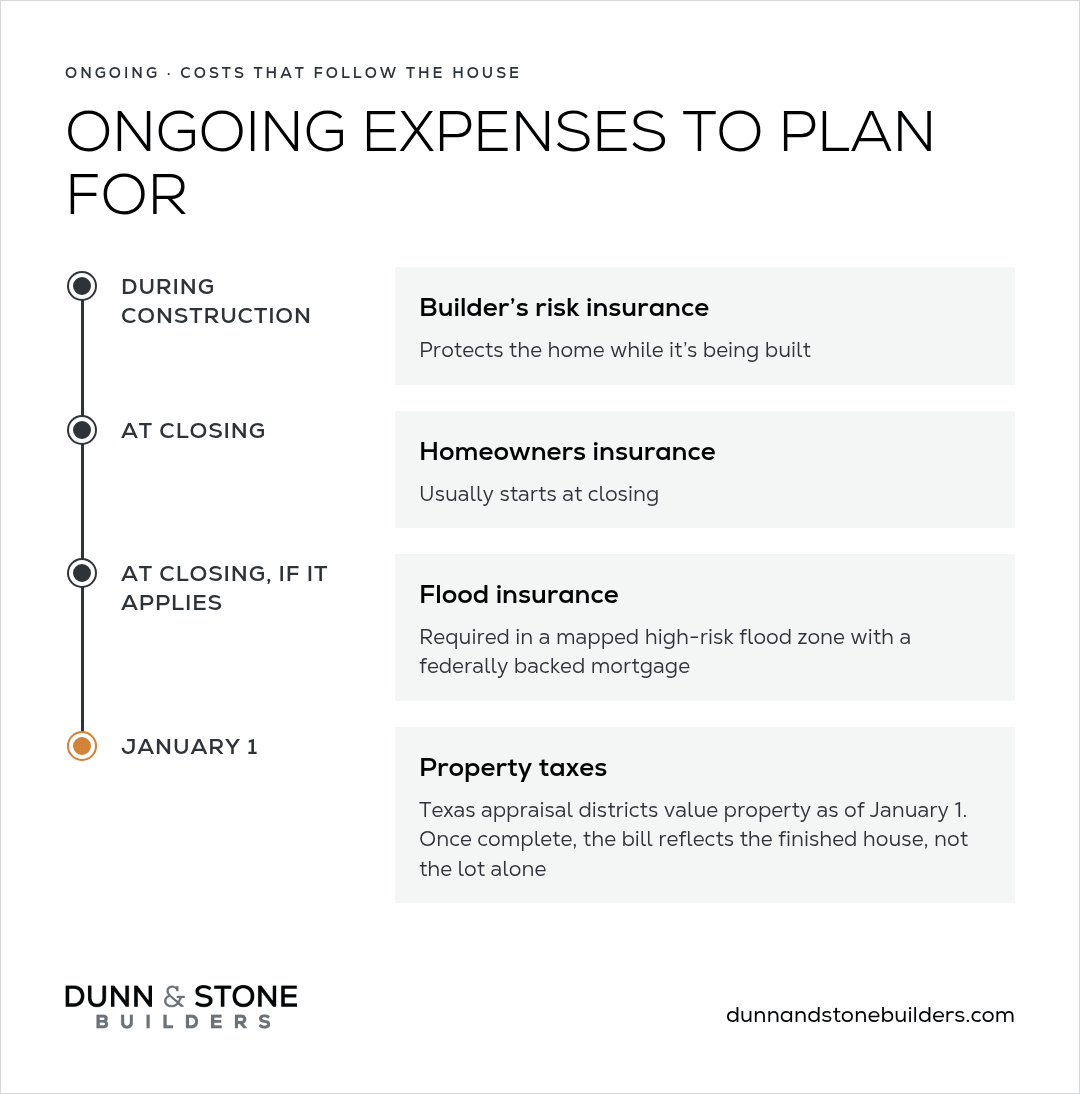
Property taxes follow the house. Texas appraisal districts value property as of January 1, so once the home is complete, the tax bill reflects the finished house rather than the lot alone. Homeowners insurance usually starts at closing. If the home sits in a mapped high-risk flood zone and the mortgage is federally backed, flood insurance is required.
During construction, builder's risk insurance protects the home while it's being built. See what builder's risk insurance covers.
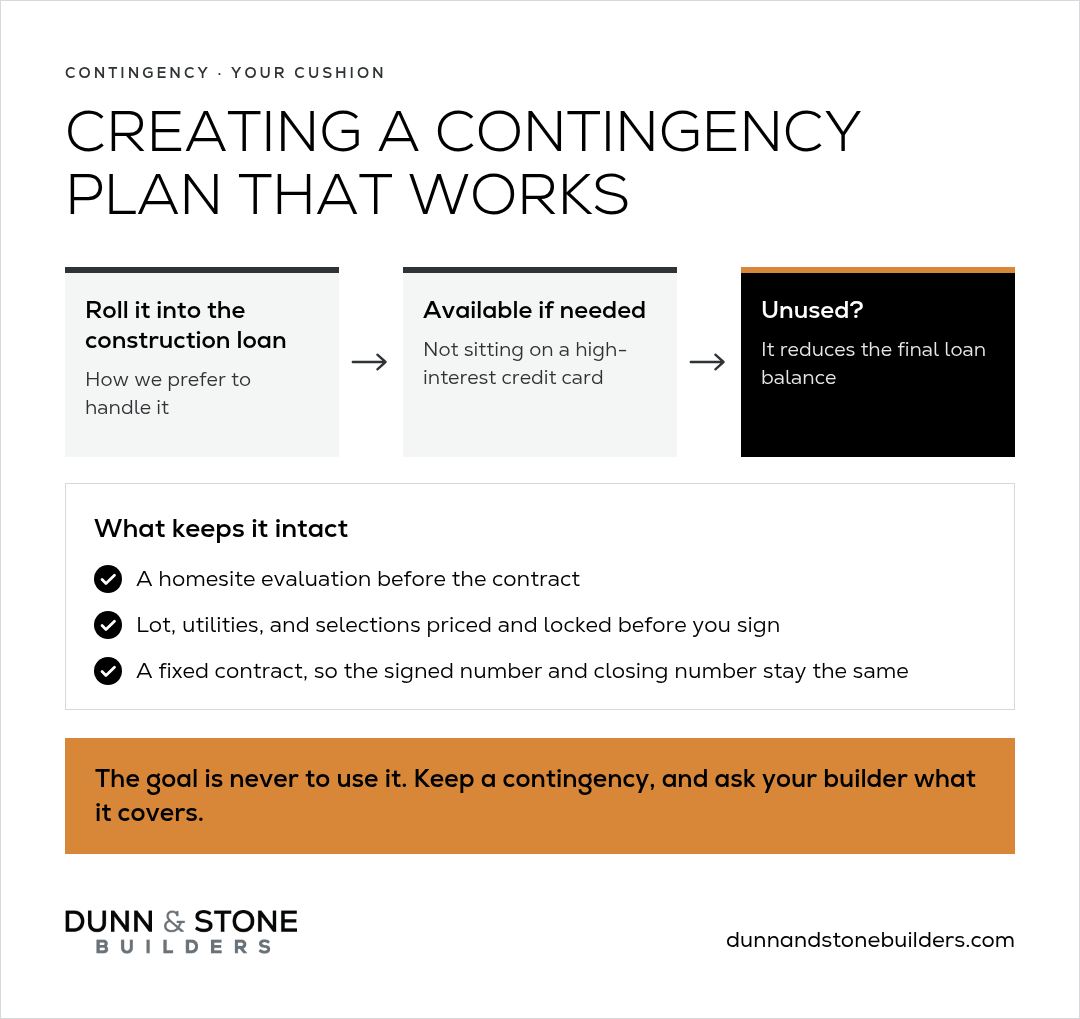
A contingency fund is your cushion against hidden costs. Keep a contingency, and ask your builder what it covers. The more of the lot, the utilities, and your selections that are priced and locked before you sign, the less that contingency has to carry.
At Dunn & Stone, we prefer to roll the contingency into the construction loan so it's available if needed and doesn't sit on a high-interest credit card. Unused contingency simply reduces the final loan balance.
The goal is never to use it. The homesite evaluation, locked selections, and fixed contract exist so the signed number and the closing number stay the same. When the soil report is clean, the utility runs are short, and the plan is locked early, the contingency stays intact and you close closer to your original number.
If you're preparing financing, our guides on how to get a loan to build a house and one-time close construction loans explain how contingency is typically handled.
A few questions up front cover most of the costs on this page:
For the full pricing picture, see our complete breakdown of home building costs and how we approach total cost transparency.

Some lot prep is built into our base price, but the final total depends on your lot, so the best first step is having it walked and priced before you sign. Beyond that, keep a contingency and ask your builder what it covers.

Site preparation, utility connections, and permit fees vary the most, because they depend on the specific land and municipality. Changes made after signing come next, and under a fixed price those are changes you choose.
Start with a realistic budget that already includes site work and soft costs. Complete soil tests and a homesite evaluation before the contract is signed. Finalize selections before framing. Use a fixed-price contract, so any change you make goes through a written change you approve.
We usually recommend it, because keeping the contingency inside the construction loan means the funds are available if needed without high-interest consumer debt. Unused contingency simply pays down the loan at closing.
The difference is control: an allowance upgrade is a choice you make, while a hidden cost is a variable nobody priced up front. Allowances are the builder's estimated cost for finishes you choose, such as flooring, lighting, and countertops. Upgrading those items is a conscious decision. Hidden costs are the land, utility, soil, permit, and schedule variables that were never fully priced in the original base number.
Appliances are often carried as an allowance inside the contract price, so the cost is included up to the allowance amount. If you choose appliances above it, the difference is added, so ask what your allowance covers before you sign.
It depends on your lot. Sometimes we see lot prep above our base price ranging $20K to $30K or more, mostly for longer driveways and sloped lots that need imported fill. We walk and price your lot before you sign. Sloped lake lots can need pier-and-beam construction, which adds $65,000 to $120,000.
The largest hidden costs of building a house come from site preparation, utility connections, permits, and the choices made after signing. Each one gets easier when it's priced before the contract.
We'd love to walk your lot with you, price the variables, and lock a fixed contract before any dirt is moved. Schedule a consultation with Dunn & Stone Builders, and bring your lot details and the plan you have in mind.

.webp)


