COMPANY
Home
Where We Build
About Us
Contact Us
Vendor Inquiry

Fred Loucks is CEO of Dunn & Stone Builders. He joined the company in July 2010 as purchasing manager and purchased the company in 2019. Since 2010 he has been the primary client contact for plan design and turning buyer goals into buildable plans. Dunn & Stone has built more than 1,000 homes across Greater Houston since 1999.
Most buyers focus on finishes and square footage when they budget a custom home. In the Houston area the land itself often moves the number more than the cabinets or the countertops.
A flat, already-cleared lot with utilities at the curb is the exception. Most of the parcels we see at Dunn & Stone Builders carry expansive clay, some degree of slope, tree cover, longer driveways, or elevation rules that add real dollars before the first wall is framed.
We price those variables during the homesite evaluation, before the construction contract is signed. That sequence keeps the final number from drifting. This guide walks through the conditions that create the largest cost deltas and how to surface them early.
In the Houston market a production-style subdivision lot is rare for custom work. Most of our projects at Dunn & Stone sit on acreage or larger suburban parcels that were never mass-graded.
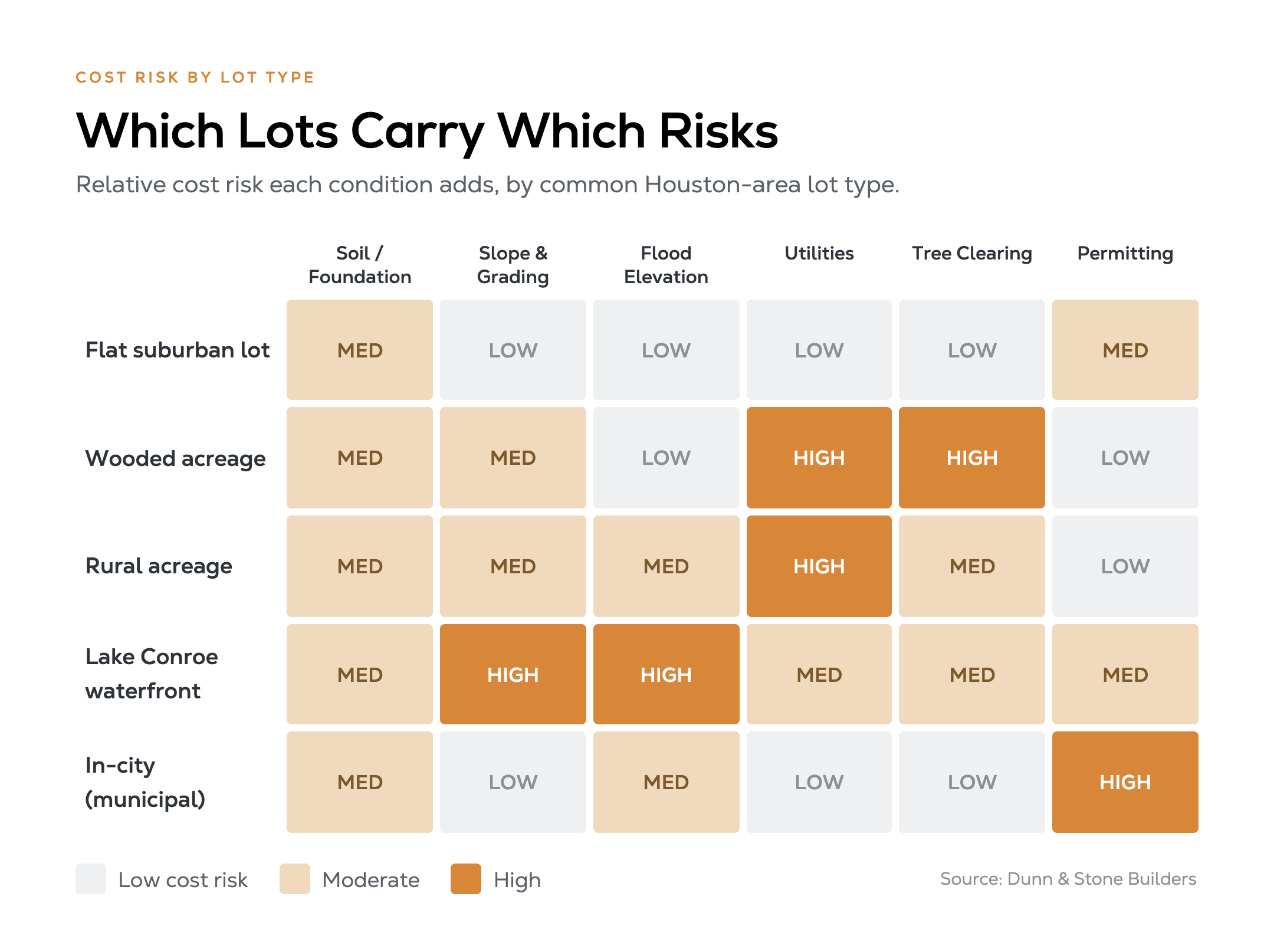
Those parcels bring clay soils that expand and shrink with moisture, drainage patterns that need engineering, mature trees that owners want to keep, and access roads that stretch farther than a standard driveway. Each of those factors shows up in the site-work line item.
We treat the homesite evaluation as the first real conversation. The goal is simple. Surface every variable while there is still time to price it honestly and lock it into a fixed contract. When that step is skipped, the same conditions reappear later as change orders and schedule delays.
The rest of this article breaks down the specific conditions we see most often and the ranges that have held across recent projects.
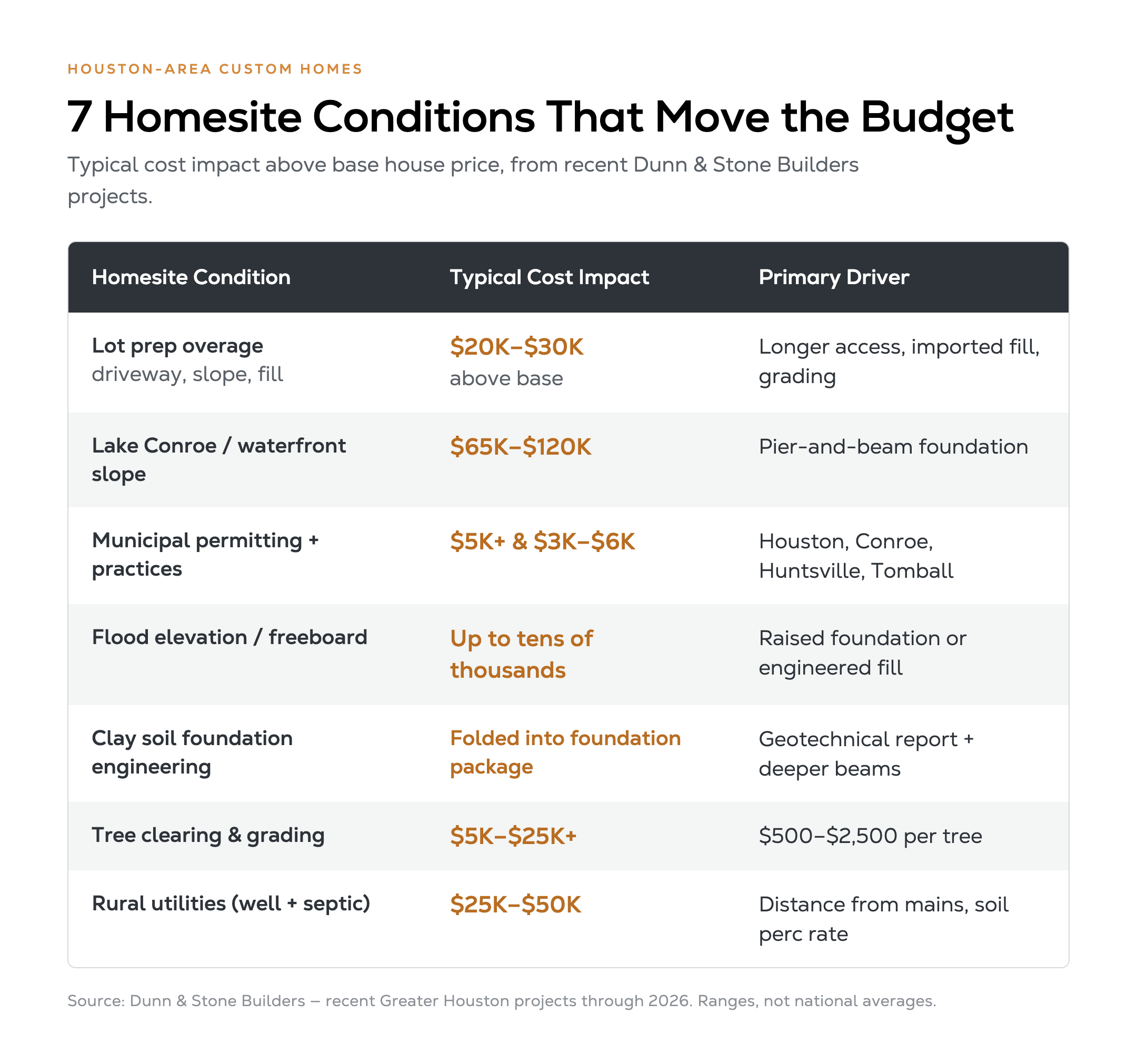
These ranges come from recent Dunn & Stone projects through 2026 and the Exploration Phase evaluations we run before contract. They are not national averages. They also sit inside the larger conversation about hidden costs of building a house that many first-time custom buyers underestimate.
Expansive clay soils are the quiet cost driver across much of Montgomery and Harris Counties. The soil expands when wet and shrinks when dry. That movement forces deeper beams, better drainage detailing, and sometimes additional engineered fill before the foundation can be poured.
A geotechnical report is required for permitting and for foundation design. Skipping it to save a few thousand dollars almost always costs more later when the engineer has to redesign or the slab moves.
On every homesite we walk at Dunn & Stone, the soil report is one of the first items we order or review. It tells us exactly what the foundation needs so the price we give you already accounts for it.
We order the soils report early and fold the recommendations straight into the foundation package. The cost of the report itself is modest. The cost of ignoring it is not. For the technical steps we follow on every site, see our notes on soil testing and foundation design.
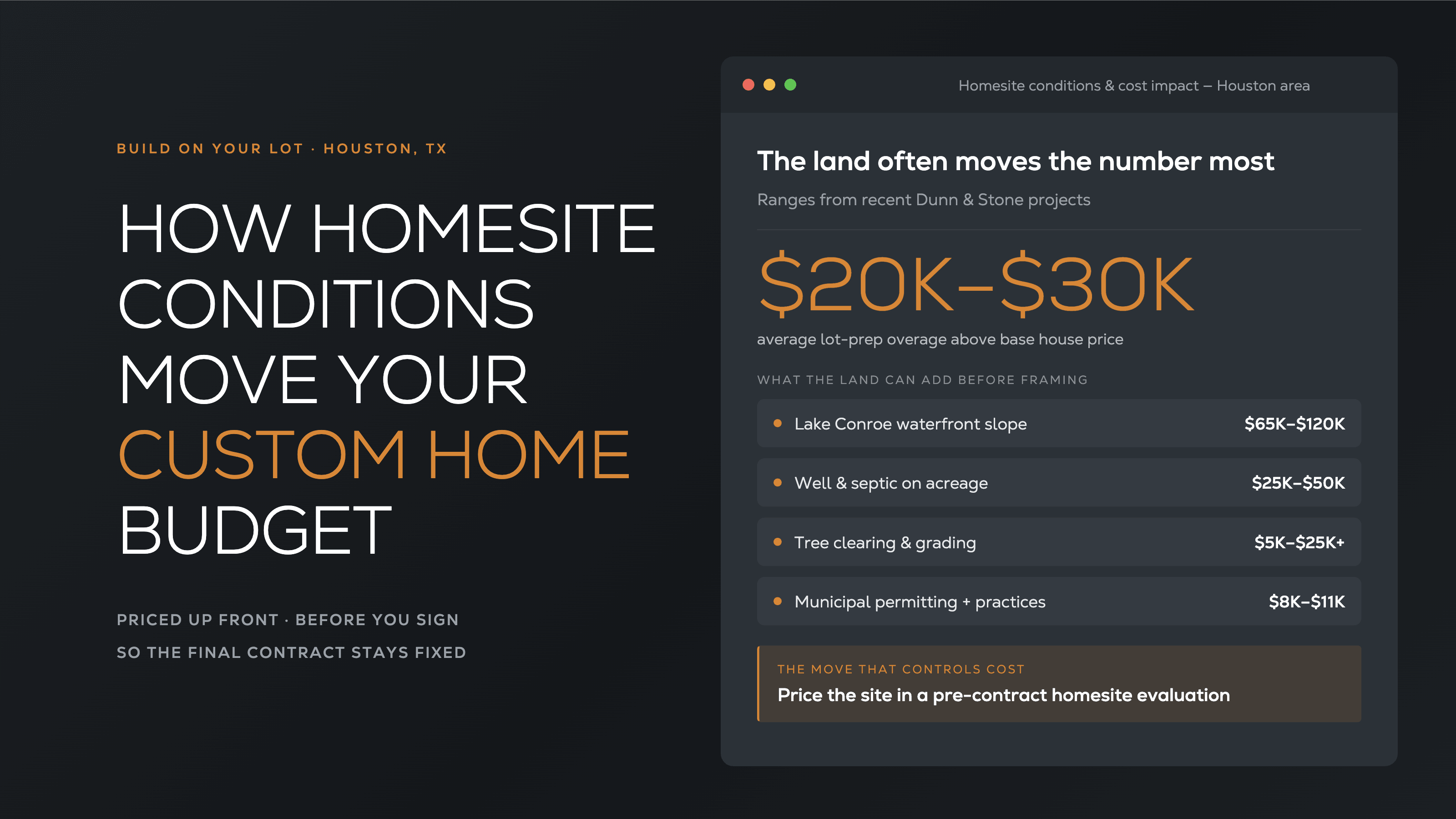
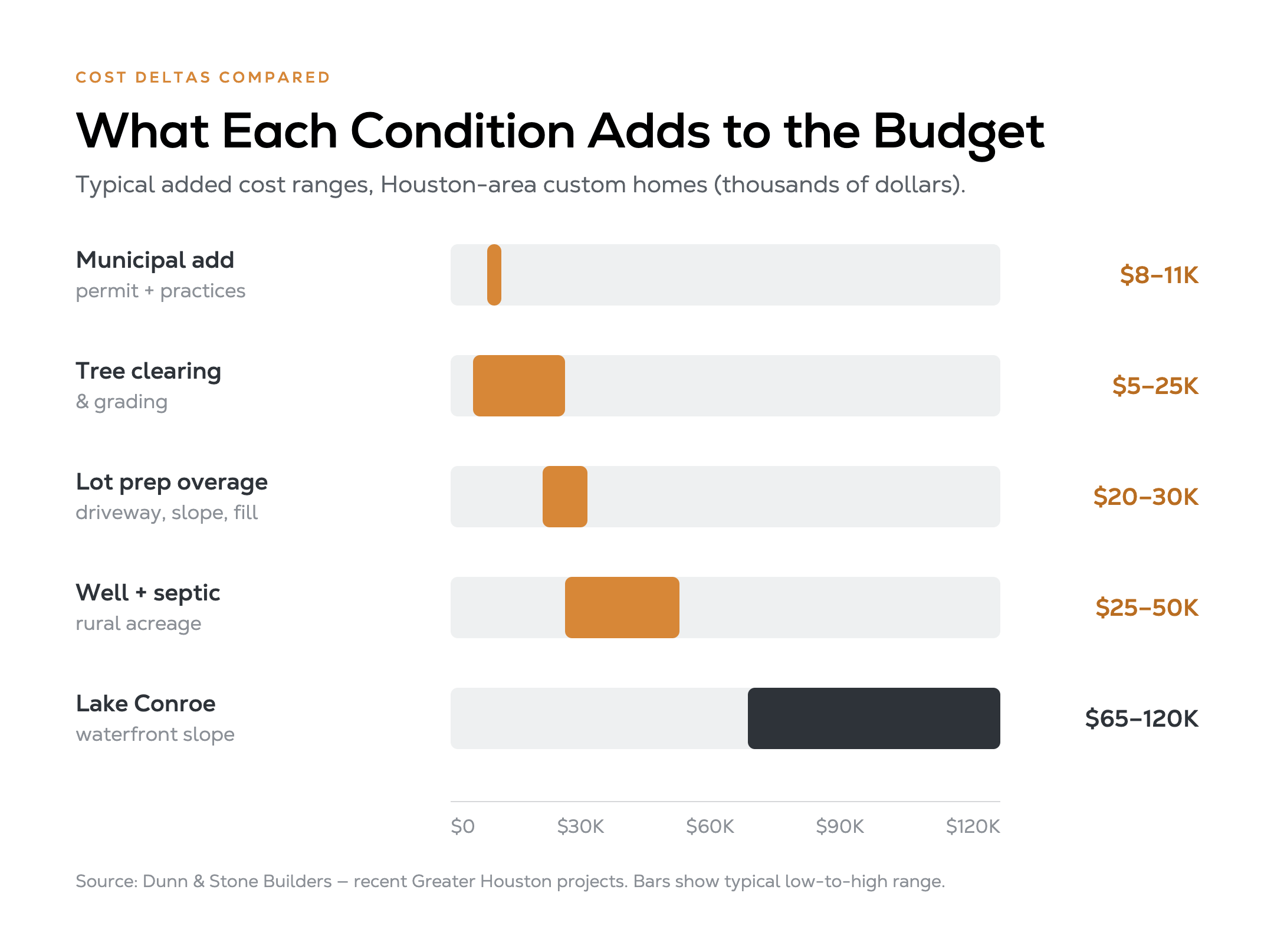
At Dunn & Stone Builders a gently sloping lot that needs only minor grading stays near the low end of the $20,000 to $30,000 overage range we see on recent projects. Steeper grades, longer driveways, or the need to import select fill push the number higher.
On Lake Conroe waterfront lots the slope down to the water is the single largest variable. In several recent projects that slope required pier-and-beam construction and added $65,000 to $120,000. That figure is not theoretical. It is the actual delta we have seen when the grade forces a change from slab-on-grade.
Drainage plans and detention requirements also live in this category. Harris County and Montgomery County both enforce positive drainage. On larger lots those requirements can include engineered swales or detention features that must be designed before the pad is cut. We price all of it during the homesite evaluation so it never appears as a surprise after framing starts.
Check every address on the FEMA Flood Map Service Center before you buy.
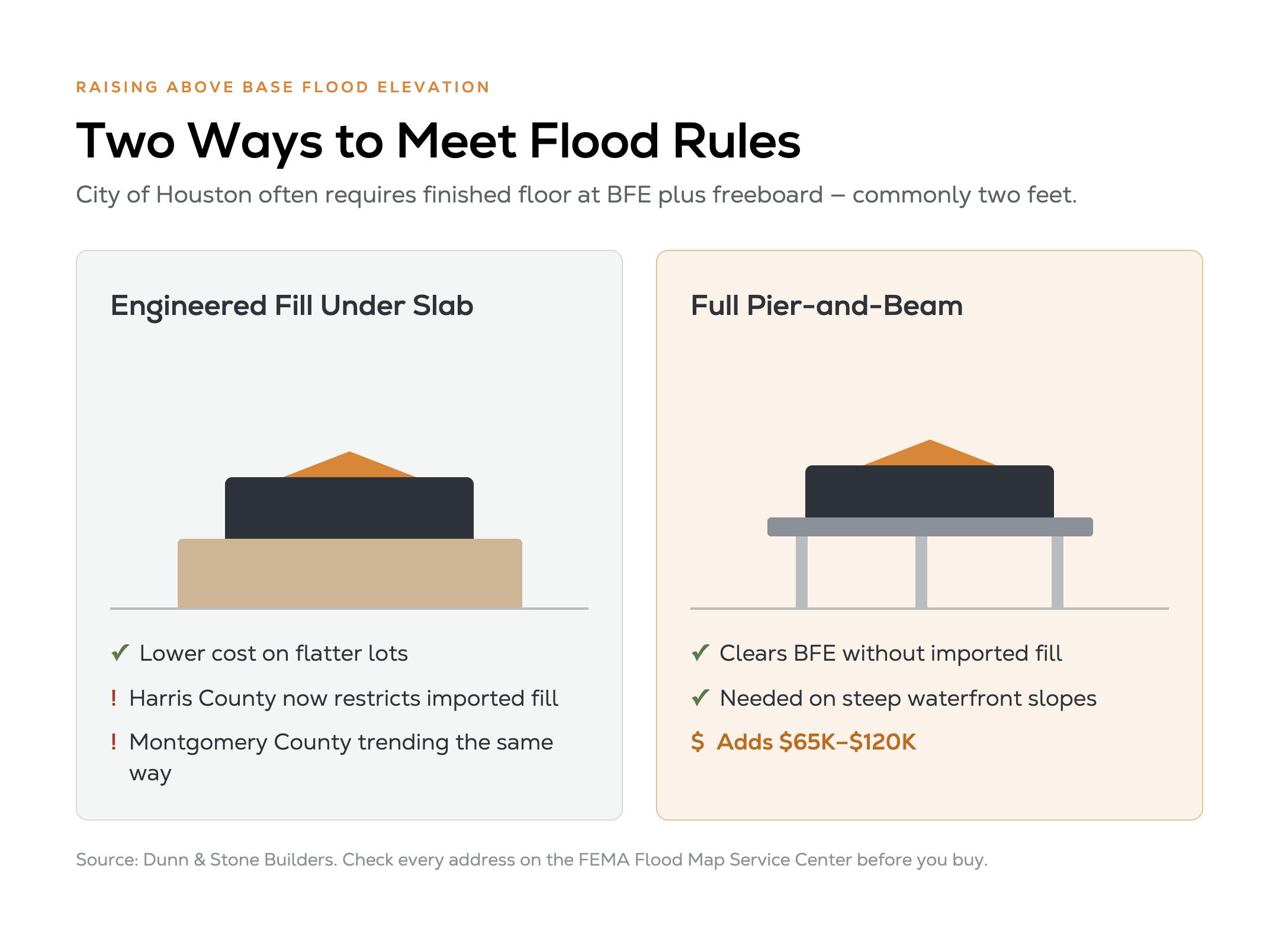
Harris County has become stricter about bringing in fill dirt to raise a home above Base Flood Elevation. Current requirements are outlined by Harris County Floodplain Management. Montgomery County is moving in the same direction; see the Montgomery County Floodplain Administration for current regulations. City of Houston rules often require finished floor at BFE plus freeboard, commonly two feet above the 500-year elevation in many areas.
Elevation strategies range from engineered fill under a slab to full pier-and-beam. The cost difference is material. At Dunn & Stone we price it during the homesite evaluation, not after the foundation drawings are already complete. For the full field process we use, see floodplain and drainage evaluation.
Flood rules are one of the clearest examples of why an early walk matters. A lot that looks perfect on a real-estate listing can carry elevation requirements that change both cost and design.
At Dunn & Stone Builders city water and sewer taps in the Houston area typically run $2,500 to $10,000. Rural lots that need a well and septic system push far higher. On acreage in northern Montgomery or Waller County the combined well-and-septic package regularly lands between $25,000 and $50,000. Engineered septic systems on poor-perc soil can exceed that range.
Tree removal is another visible line item. Large trees commonly cost $500 to $2,500 each to remove. A heavily wooded lot can run into the tens of thousands before grading even begins. Many owners want to keep mature oaks or pines for privacy and shade, which is understandable. The ones that must come down still have to be priced.
Longer driveways are common on acreage. A 200- to 300-foot drive can add $8,000 to $25,000 including culverts or retaining walls. Temporary access roads for construction equipment add another $2,000 to $8,000 if the permanent drive cannot support heavy trucks early in the job.
We scope and price all of these items in the Exploration Phase so they appear in the fixed-price contract rather than as change orders. The field steps we follow are detailed on our septic and utility planning page.
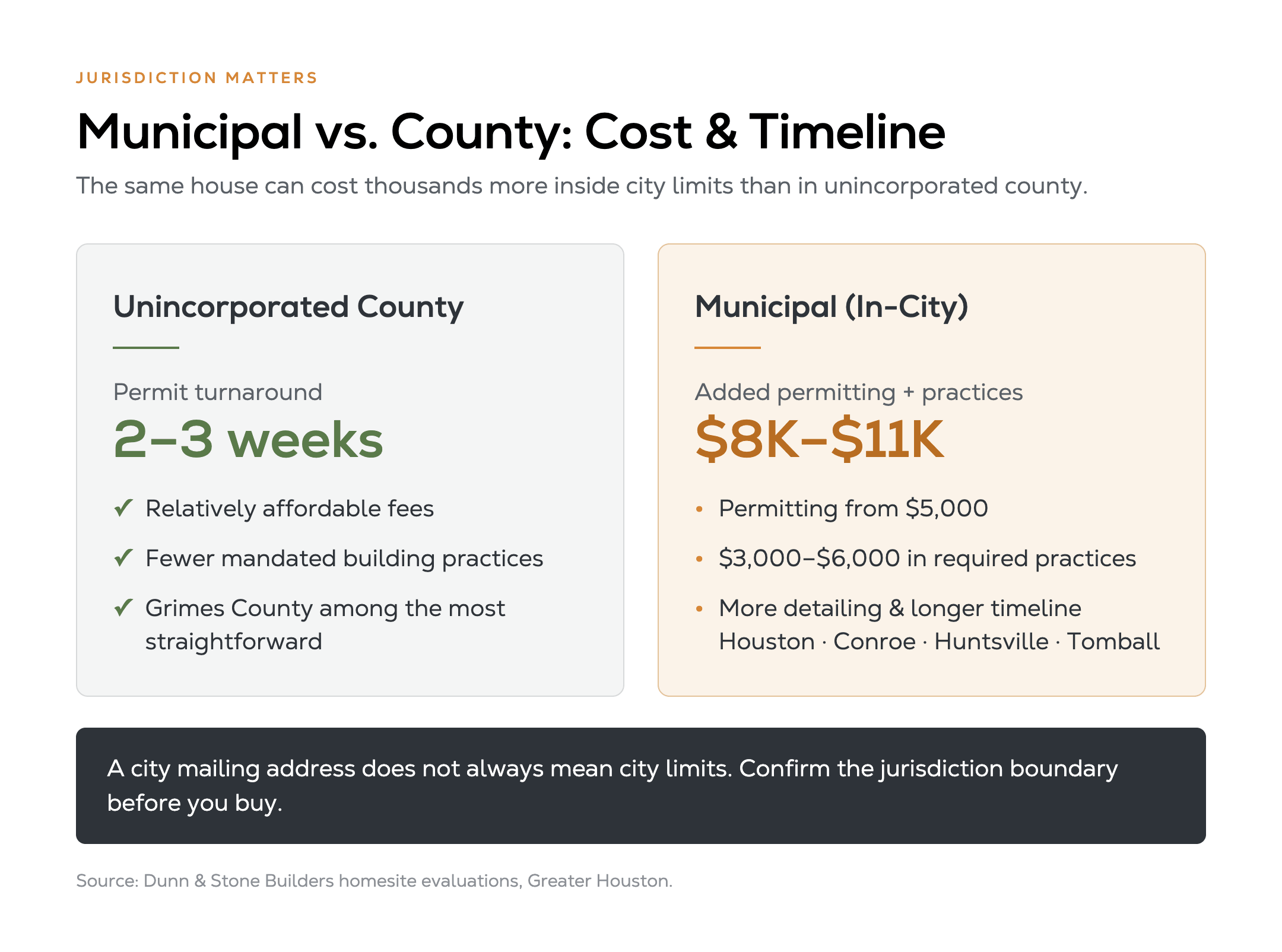
At Dunn & Stone Builders most counties turn a permit application around in two to three weeks and remain relatively affordable. Municipalities are more complex.
In the cities we occasionally work in (Houston, Conroe, Huntsville, Tomball) permitting typically starts at $5,000 and can stipulate building practices that add another $3,000 to $6,000. Grimes County, by contrast, has been straightforward and is a growing area for us. For current Montgomery County requirements see the Montgomery County permitting page.
The difference is not just the fee. It is the time and the extra detailing required. We flag jurisdiction during the initial homesite walk so the budget reflects the real path. A lot with a city mailing address can still sit in unincorporated county, and the reverse is also true. Confirming the boundary early prevents later surprises.
At Dunn & Stone the Exploration Phase (E0 to E4) happens before any construction contract is signed. We walk the lot, review soil, drainage, elevation, utilities, and access, and produce a clear cost picture.
Three points where owners most often get stuck later (and that the early evaluation prevents):
Because the site conditions are priced up front, our goal remains final contract equals final closing number. Change orders driven by unforeseen homesite conditions become rare.
When a client does make a late change, it is almost always a feature they decided they wanted after design was complete, not a surprise from the land. That is the difference the Exploration Phase creates.
This is the same process we use on every build on your lot project. You can start with a site evaluation or review the full service page for the sequence from exploration through construction. The early evaluation fits inside the larger steps to building a custom home.
The evaluation also protects the schedule. Construction itself averages about 210 days from start to delivery on recent projects. When site variables are left unresolved, that number stretches. Pricing them early keeps the calendar realistic. For the broader timeline picture see how long it takes to build a house.
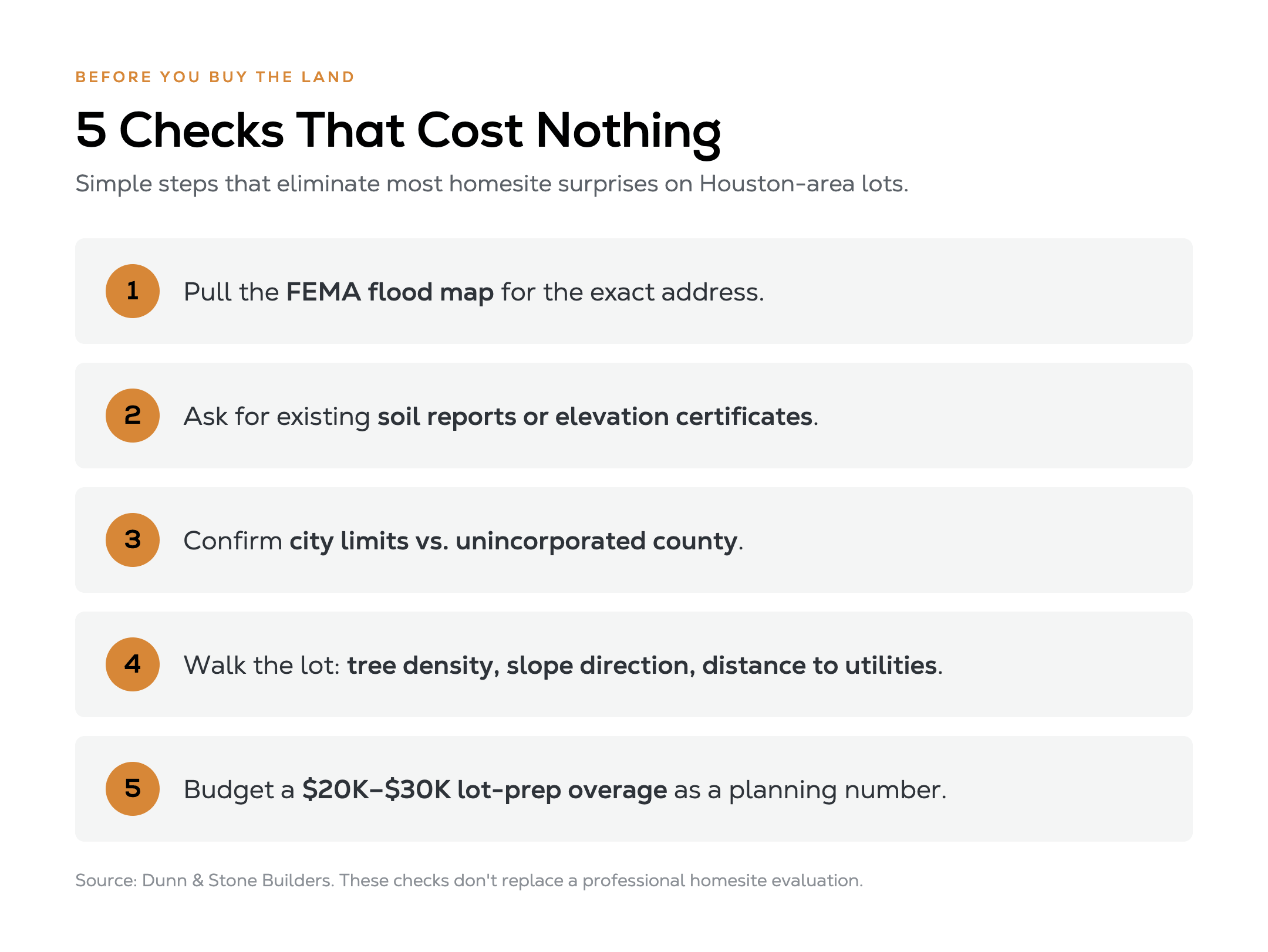
At Dunn & Stone Builders a few steps cost nothing and eliminate most of the surprises we see on Houston-area lots.
These checks do not replace a professional evaluation, but they keep you from falling in love with a parcel that carries expensive surprises. When you are ready for numbers specific to your land, run our cost to build a house calculator and then schedule a walk.
If you are still in the land-buying stage, our guide to buying land in Texas covers the larger process of evaluating tracts before you close.
On recent Dunn & Stone projects the average overage above the base house price is $20,000 to $30,000. Simple suburban lots stay near the low end. Acreage with trees, slope, or long utility runs can reach $25,000 to $75,000 before the foundation is poured.
Yes. Even moderate slopes require additional grading and fill. On recent Dunn & Stone builds, significant waterfront slopes on Lake Conroe have required pier-and-beam foundations that added $65,000 to $120,000.
Clay is the dominant soil across much of the Houston market. It drives the need for a geotechnical report and engineered foundation design. At Dunn & Stone the cost is captured inside the overall lot-prep and foundation package rather than as a separate line item in most contracts.
Municipal permitting typically starts at $5,000 and can add another $3,000 to $6,000 for required building practices. Most counties remain faster and more affordable. At Dunn & Stone the difference is flagged during the homesite evaluation so the budget reflects the real path.
Yes. A geotechnical report is required for permitting and foundation design in this market. We order it early (or confirm the seller already has one) to prevent redesign costs later.
Enter the exact address on the FEMA Flood Map Service Center. Harris County and Montgomery County rules on fill and freeboard have tightened. The map is the starting point, not the final word. We include floodplain review as part of every homesite evaluation.
Homesite conditions are the largest variable that sits outside the four walls of a custom home in the Houston area. At Dunn & Stone Builders we price those conditions during a pre-contract homesite evaluation so the final contract number stays fixed.
Use the cost to build a house calculator for a first planning number, then schedule a free consultation so we can walk your specific lot and give you exact figures before you commit.
Buyers comparing full custom work on complex sites with more controlled pricing often also review our semi-custom homes. If you want to compare the full cost picture, start with how much does it cost to build a house. If you already own the land, the same conversation starts with a focused site evaluation and moves straight into realistic numbers drawn from recent projects.

.webp)


