What's Included in a Fixed-Price Custom Home Contract

Table Of Contents
Share

By Fred Loucks, CEO, Dunn & Stone Builders

A fixed-price custom home contract is one construction number tied to a dated plan set and a written specification. That number holds for the work those pages name. It does not hold for work the drawings never showed, items listed as allowances, or changes you ask for after you sign.

The American Institute of Architects calls this a stipulated sum: you agree to complete the project for a specific amount. Read the attached plans, the finish schedule, and the exclusion list before you treat that amount as complete.

Key Takeaways

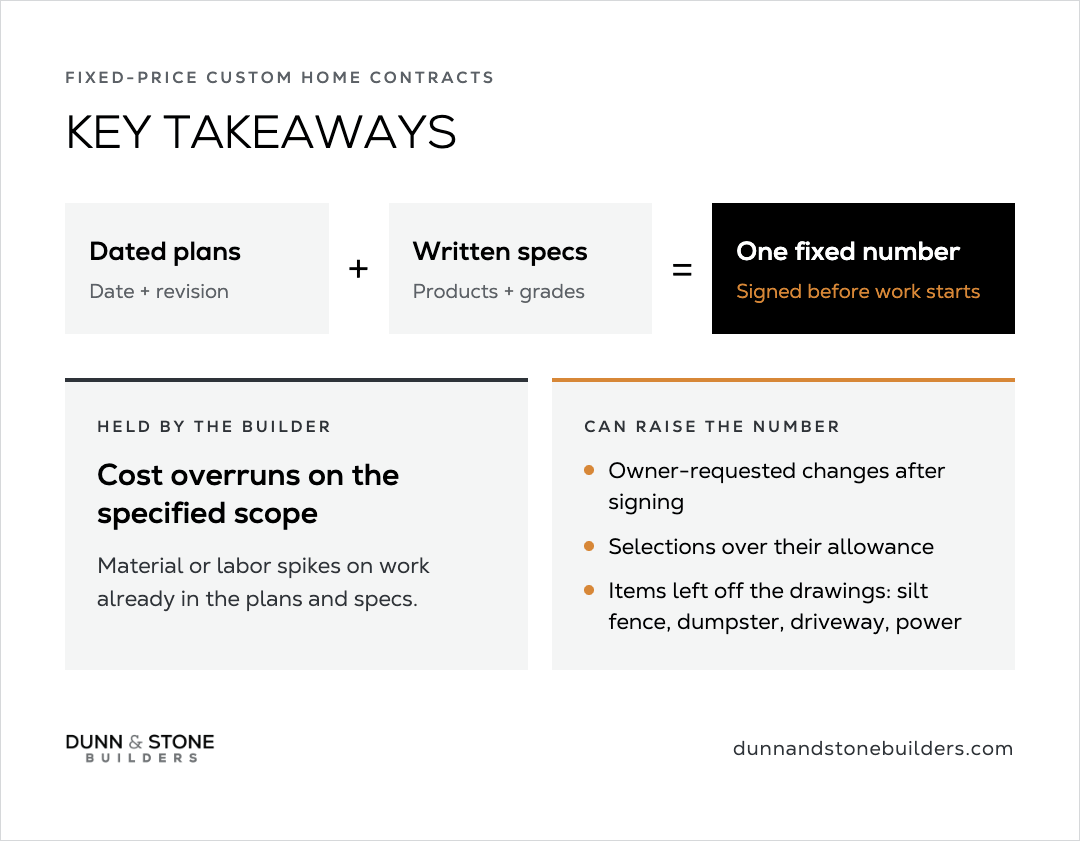
Infographic showing dated plans plus written specs equals one fixed number, with columns for cost overruns held by the builder versus owner changes, allowance overruns, and items left off drawings that can raise the price.
  • A fixed-price contract ties one number to dated plans and written specs.
  • Silt fence, a dumpster, the driveway, and power to the house are easy to assume and easy to leave off the drawings the number is tied to.
  • Allowances sit inside that number as placeholders. If the selection costs more, the difference is added.
  • After signing, the usual mover is an owner-requested change. Cost overruns on the specified scope stay with the builder.


What a Fixed-Price Custom Home Contract Actually Locks

A fixed-price custom home contract sets one construction total before work starts. The builder carries cost-overrun risk on the scope in the attached plans and specifications. You carry the cost of anything added, upgraded, or left outside that scope.

Fixed-priceCost-plus
How the price is setOne total, signed before construction, tied to dated plans and specsActual costs plus a builder fee, totaled as invoices arrive
Who carries overrun risk on the specified scopeThe builderThe owner
What moves the numberOwner-requested changes, allowance overruns, conditions the contract listed as unknownAnything that costs more than expected
What you are signingA scope and a numberA method for adding invoices


The table is only so you can tell which kind of contract you are holding. Under cost-plus, invoices are added as the work happens.

The number follows the finish level. Our contracts typically land near $180 a square foot on included features, about $213 as a portfolio average, and about $250 when the house is highly featured or the footprint is very small. Use those figures to sanity-check a quote. They do not replace the written specification.

The contract also names a $10,000 to $15,000 deposit.

Texas Property Code § 53.255 asks that a residential construction contract put four things in writing: a description of the work, the time, the cost or how the cost is set, and the method of payment. An oral promise that never makes it into the written contract may not be enforceable.

What the Contract Price Typically Includes

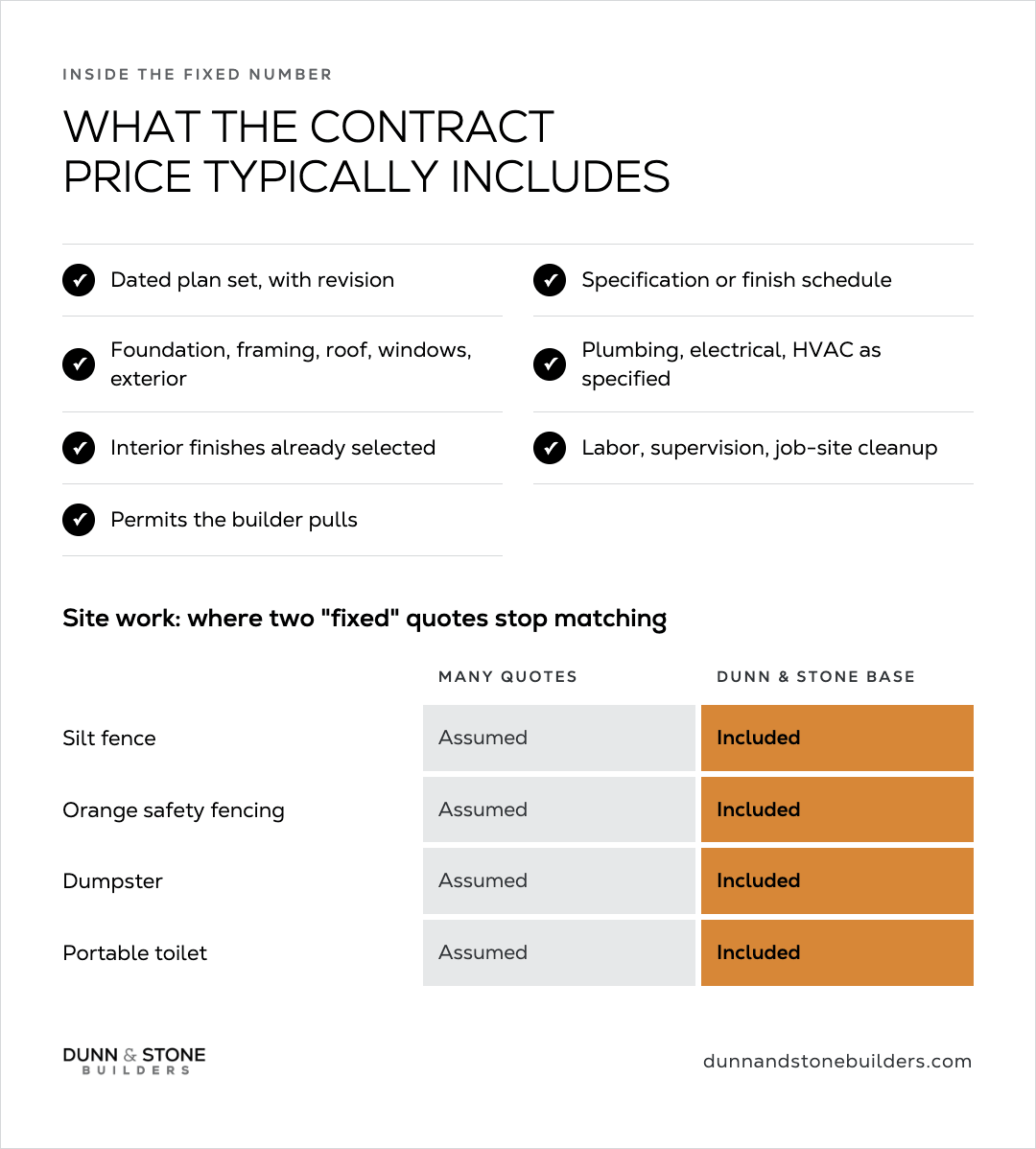
Checklist of items inside the fixed number—plans, specs, structure, MEP, finishes, labor, permits—plus a site-work table marking silt fence, orange fencing, dumpster, and portable toilet as Assumed on many quotes and Included in the Dunn & Stone base.

A fixed-price contract covers the work named in the dated drawings and the specification list. On a complete set of drawings and specs that usually means:

  • The approved plan set, identified by date and revision
  • The specification or finish schedule that names products and grades
  • Foundation, framing, roof, windows, and exterior finishes as drawn
  • Plumbing, electrical, and HVAC as specified
  • Interior finishes that have already been selected
  • Labor, supervision, and job-site cleanup
  • Permits the builder is responsible for pulling

Site work is where two quotes that both say "fixed" stop matching. Many quotes price the house and treat the lot as an assumption. On Dunn & Stone contracts the base already covers silt fence, orange safety fencing, a dumpster, and a portable toilet.

If you are comparing two fixed numbers, read the site-plan drawings first. A lower number often priced only the house.
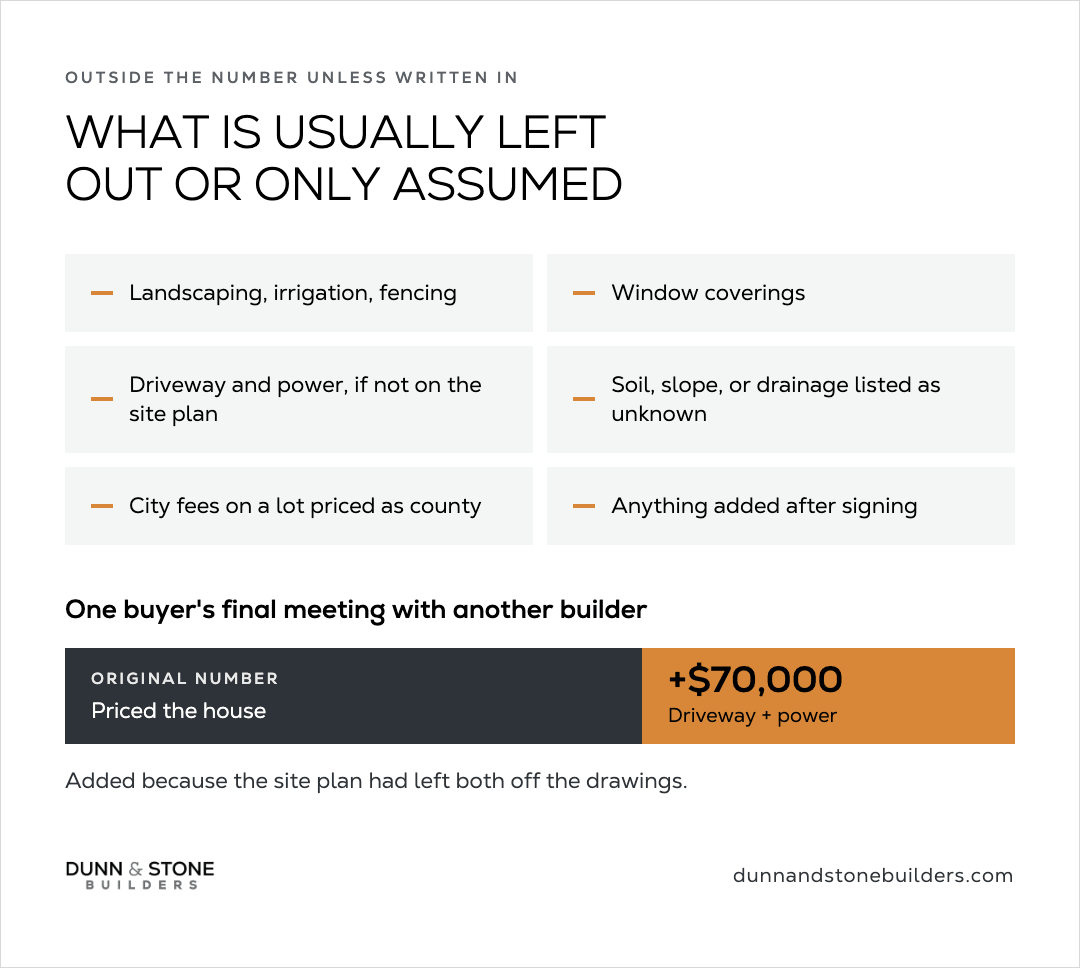

What Is Usually Left Out or Only Assumed

Two-column list of common exclusions (landscaping, window coverings, driveway and power if not on the site plan, unknowns, city fees, post-sign adds) with a bar graphic of an original house-only number plus $70,000 for driveway and power left off the drawings.

A fixed-price contract does not cover work the pages never named. Common items that sit outside the number unless they are written in:

  • Landscaping after the yard is graded, irrigation, and fencing
  • Window coverings
  • Driveway and electrical service if they are missing from the site plan
  • Soil, slope, or drainage work the contract listed as unknown
  • City permit fees and extra code requirements if the lot was priced as a county build
  • Anything you add after you sign

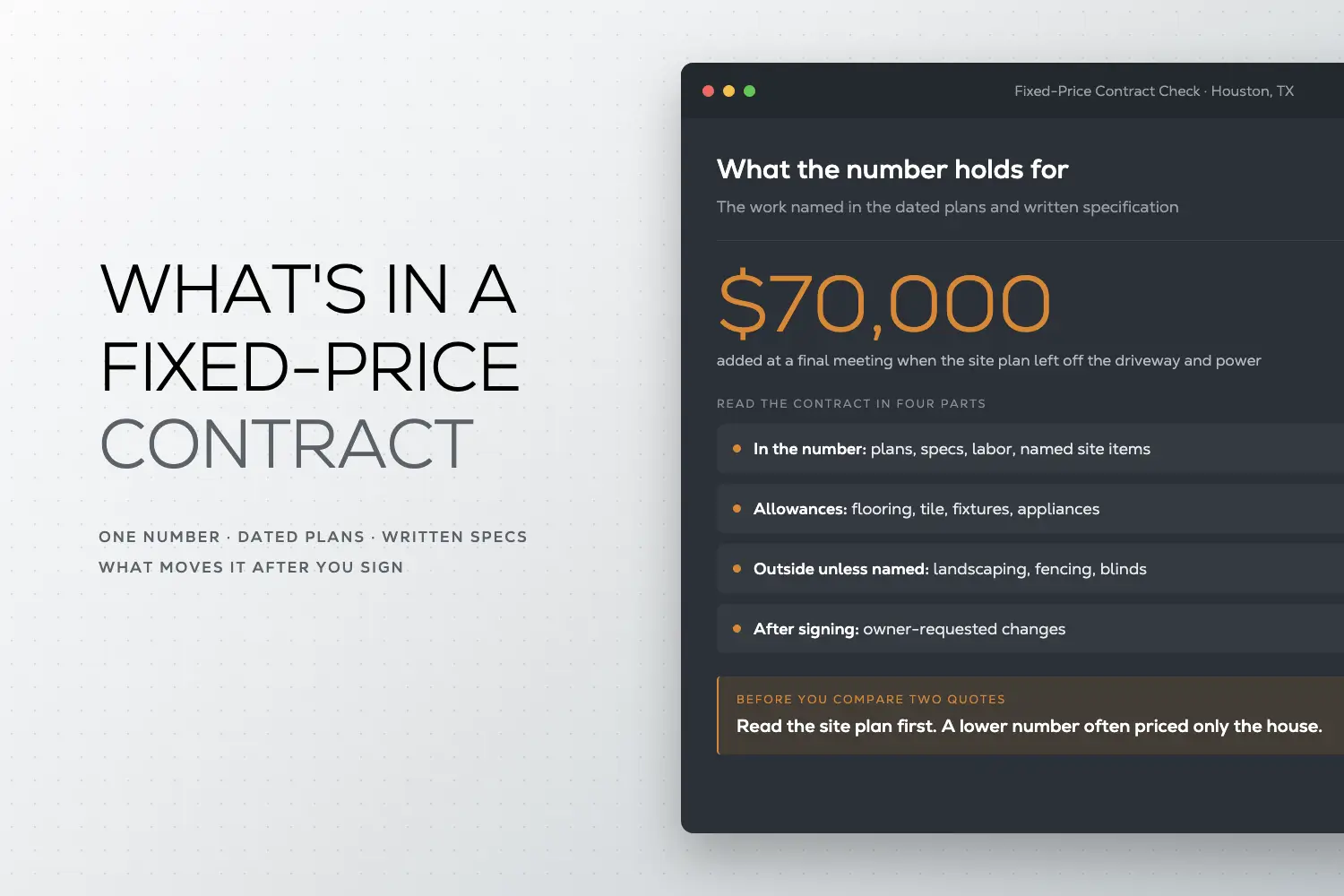
I have watched a buyer almost sign with another builder who added about $70,000 at the final meeting because the site plan had left off the driveway and the power to the house. The original number had priced the house and left those items off the drawings.

The surprise costs that hide in incomplete drawings are the same ones we cover in hidden costs of building a house.


How Allowances Sit Inside a Fixed-Price Contract

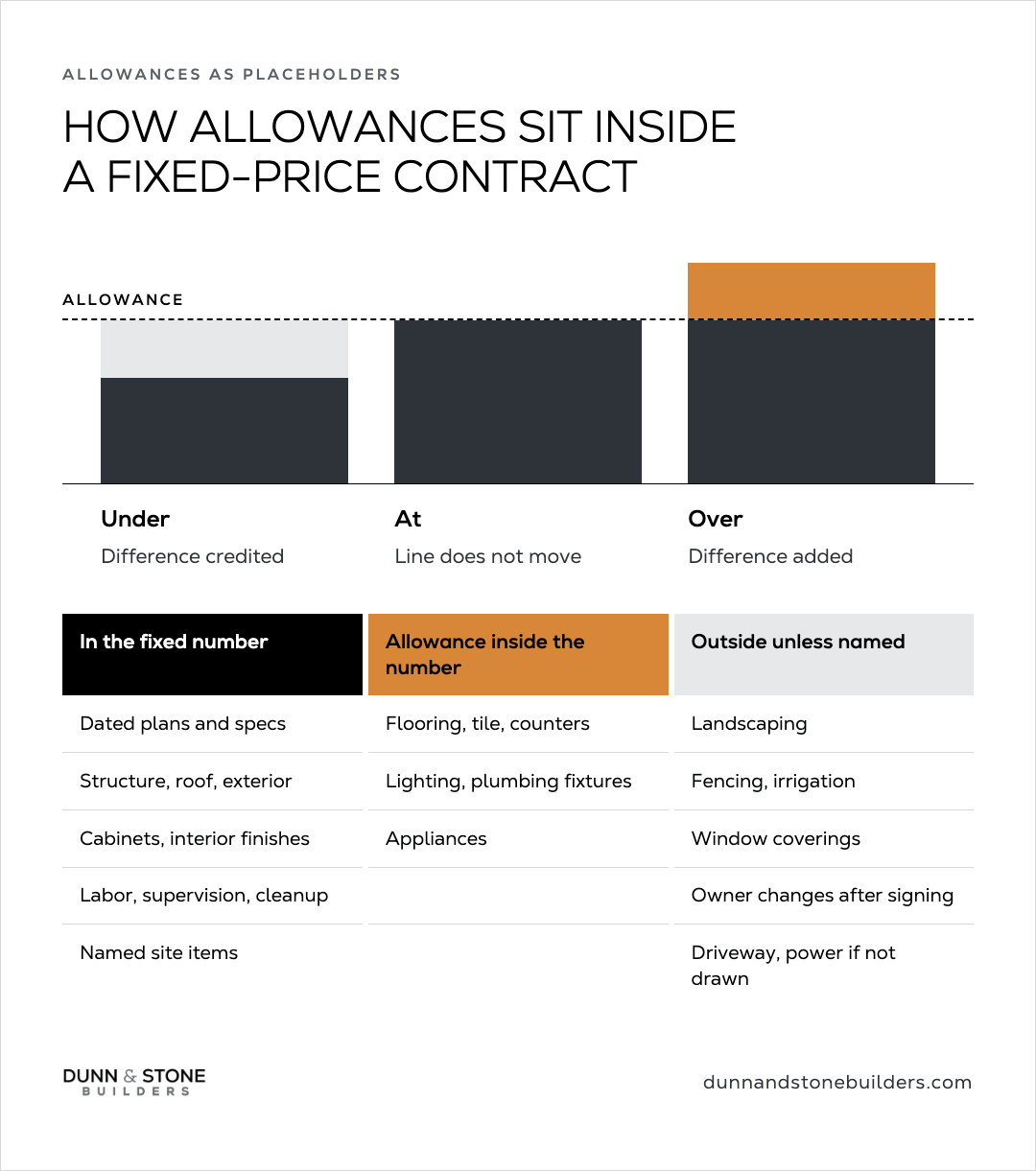
An allowance is a dollar placeholder inside the fixed total for a product you have not picked yet. Flooring, tile, countertops, lighting, plumbing fixtures, and appliances are the usual lines.

The contract number already includes that placeholder. Stay at or under it and the line does not move. Go over it and the difference is added. Come in under and the difference should be credited.

Ask what each allowance covers. Some contracts price material only. Others include tax, labor, and waste. A low allowance looks like a lower contract total until you pick the finish. The longer comparison of allowances against included features is a different article.
In the fixed numberAllowance inside the numberUsually outside unless named
Dated plans and the written specificationFlooring, tile, or counters still unselectedLandscaping after the yard is graded
Structure, roof, and specified exteriorLighting or plumbing fixtures still openFencing and irrigation
Specified cabinets and interior finishesAppliancesWindow coverings
Labor, supervision, cleanupOwner changes after signing
Named site items (silt fence, orange safety fencing, dumpster, portable toilet)Driveway and power if they are not on the drawings


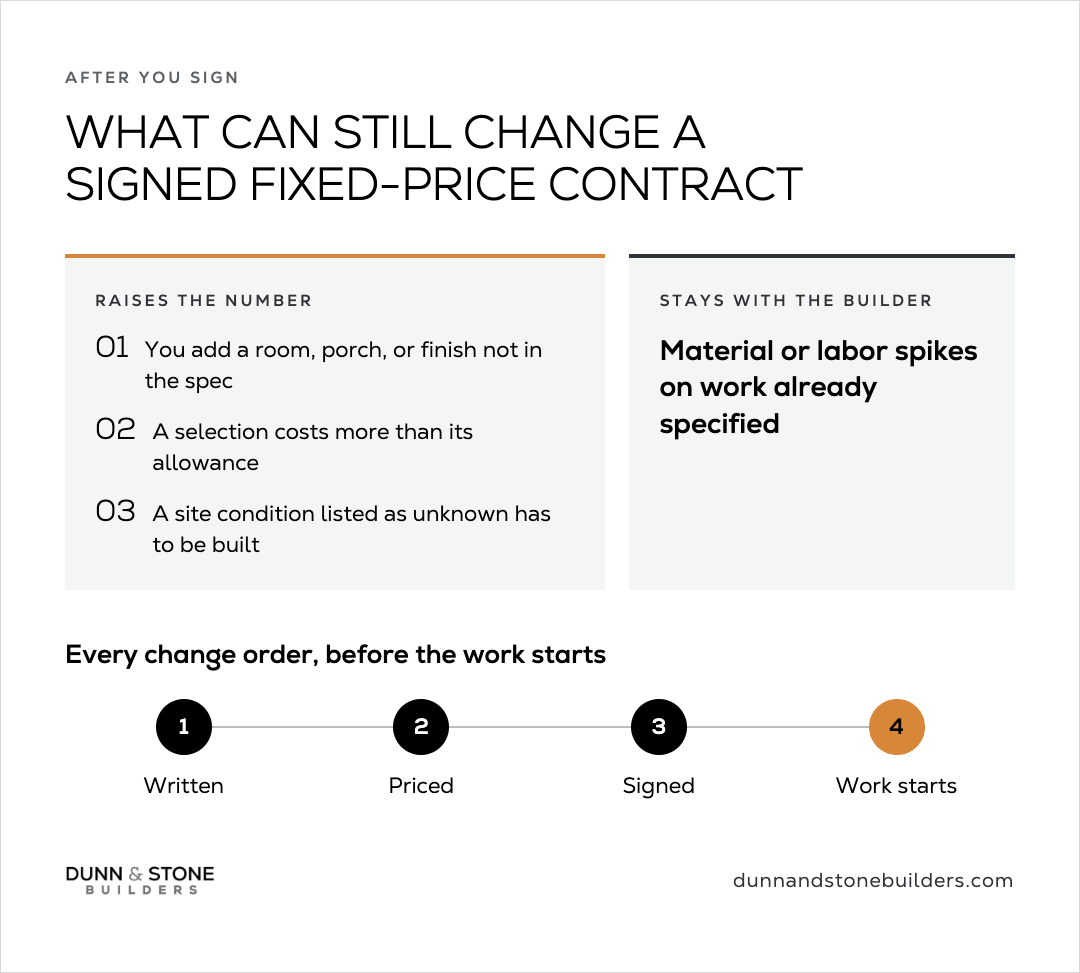
What Can Still Change a Signed Fixed-Price Contract

Infographic of three raisers (added scope, over-allowance selections, unknown site conditions), material/labor spikes staying with the builder, and a four-step change-order path: written, priced, signed, then work starts.

A signed fixed-price contract goes up when you add work, go over an allowance, or hit a site condition the contract listed as unknown.

  • You add a room, a porch, or a finish that was not in the spec
  • A selection costs more than its allowance
  • The contract listed a site condition as unknown and that work later has to be built

Material or labor spikes on work that was already specified stay with the builder.

A change after signing is a change order. It should be written, priced, and signed before the work starts. The full change-order process is a different article.


What to Verify Is Attached to the Fixed Price Before You Sign

Five-page checklist covering dated plans, named products or grades, allowance dollars and over/under rules, written exclusions, and site assumptions that match the lot, with a callout to ask which page is missing on a lower quote.

Before you sign a fixed-price contract, the documents should answer five things without a follow-up call:

  1. The plans are dated and marked with a revision, and the contract points to that set.
  2. The specification names products or grades, not "builder standard."
  3. Allowances are listed with dollar amounts and a rule for what happens when a selection comes in over or under.
  4. Exclusions are written. Driveway, power, landscaping, silt fence, and the dumpster are either in or out.
  5. Site assumptions match the actual lot, including city versus county permitting.

If a second builder's number is lower, ask which of those five pages is missing. Questions to ask a home builder covers the rest of the documents you should see before you sign.
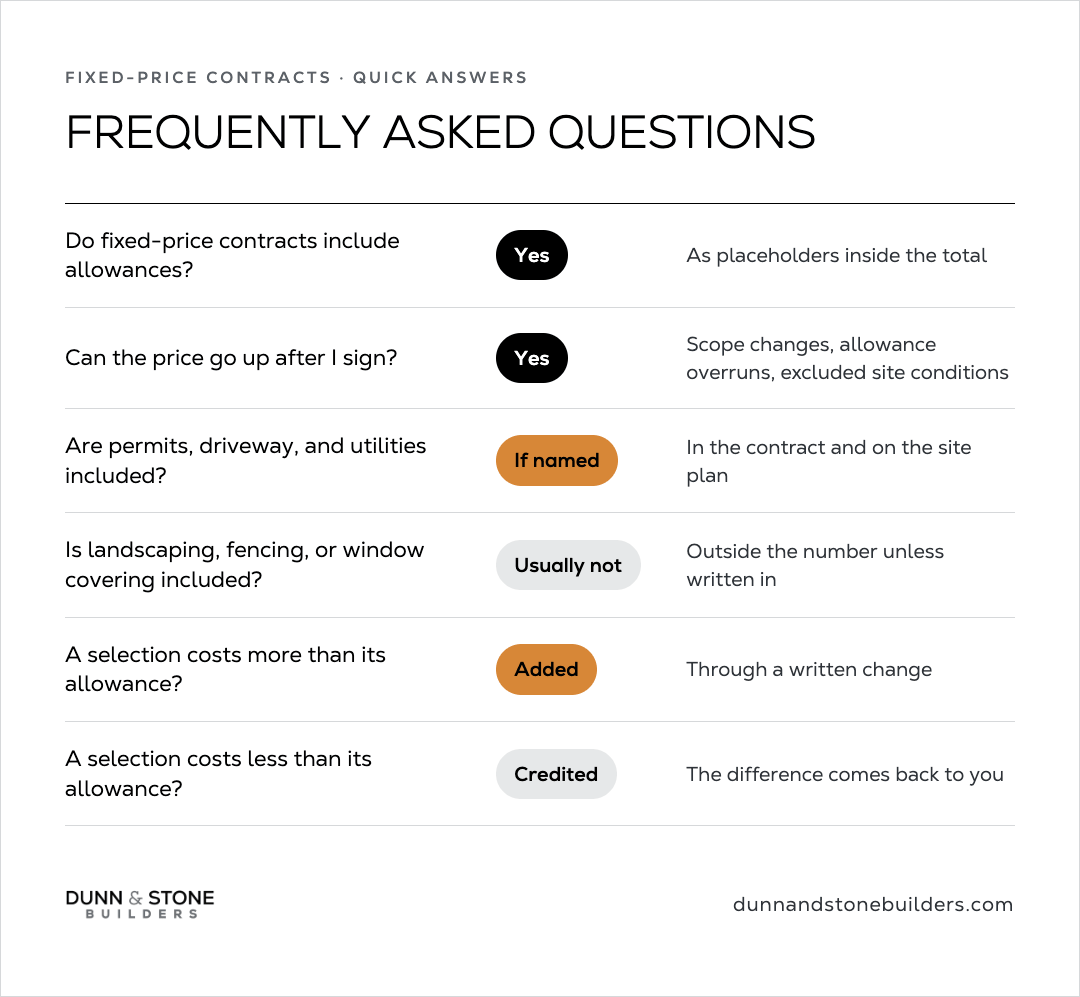

Frequently Asked Questions

FAQ table with badge answers—Yes, Yes, If named, Usually not, Added, Credited—for allowances, post-sign price increases, permits/driveway/utilities, landscaping/fencing/blinds, and over- or under-allowance selections.


What is included in a fixed-price custom home contract?

A fixed-price custom home contract includes the work named in the dated plans and the written specifications: structure, specified finishes, labor, and the site items listed as included. It does not include work left off the drawings, items carried as allowances above their placeholders, or changes requested after signing.


What is not included in a fixed-price building contract?

A fixed-price building contract usually excludes landscaping after the yard is graded, fencing, window coverings, and any driveway or utility work that is not on the site plan. Soil or slope work the contract listed as unknown, and city fees on a lot priced as county, sit outside the number too.


Do fixed-price contracts include allowances?

Yes. Many fixed-price custom home contracts include allowances for finishes that have not been selected yet, such as flooring, tile, fixtures, or appliances. The allowance is a placeholder inside the fixed total. Going over it adds cost. Coming in under should produce a credit.


Can the price still go up after I sign a fixed-price contract?

Yes. A signed fixed-price contract can still go up if you change the scope, go over an allowance, or hit a site condition the contract excluded. Overruns on the specified scope stay with the builder.


Are permits, driveway, and utilities included in the contract price?

Permits, driveway, and utilities are included only when the contract and the site plan name them. A quote that priced only the house can leave the driveway and power off the drawings and add them later.


What happens if my finish selections cost more than the allowance?

If a finish selection costs more than its allowance, the difference is added to the contract through a written change. If it costs less, the difference should be credited.

If you want a second set of eyes on a contract you already have, schedule a free consultation.
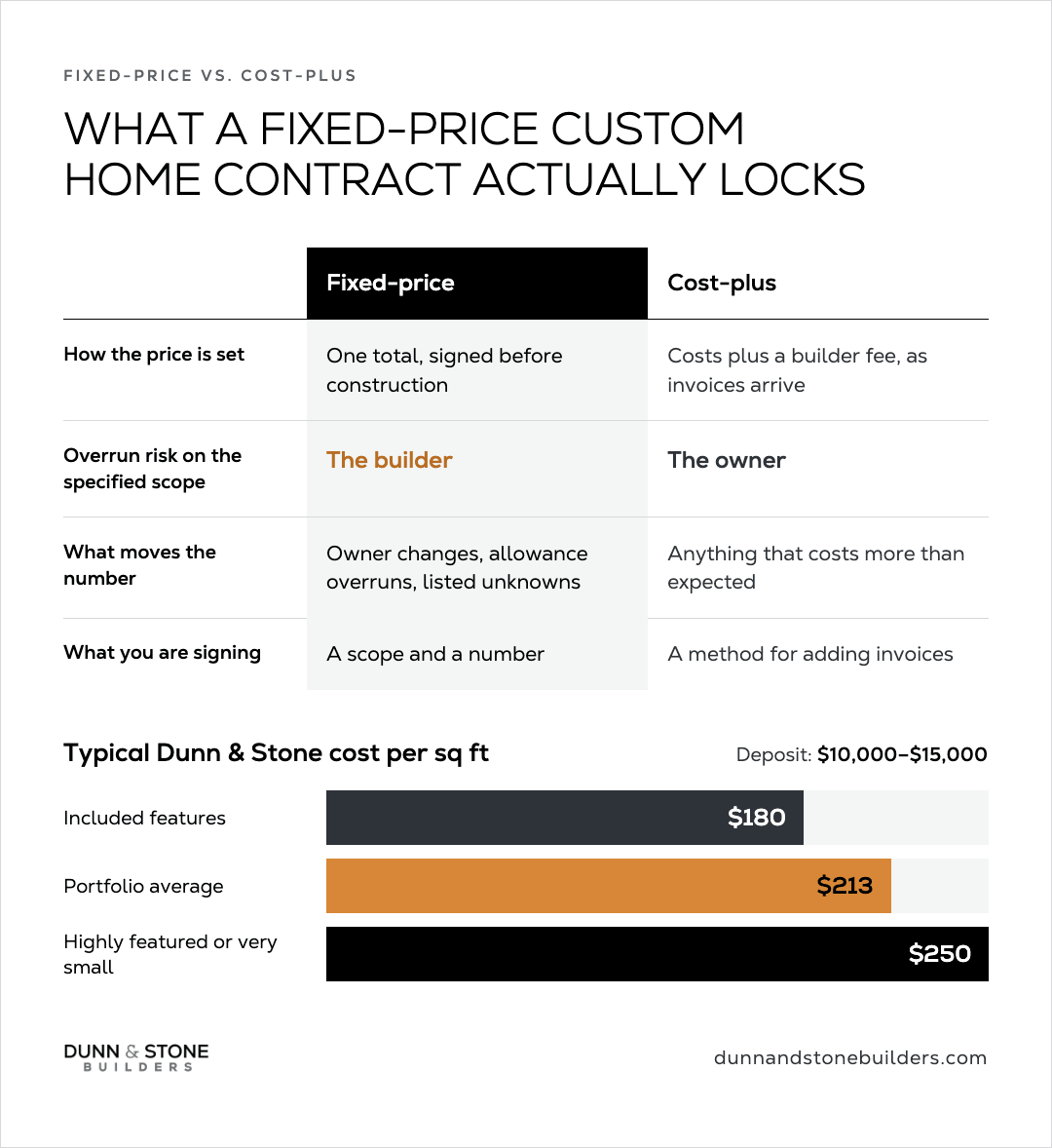

Table comparing fixed-price vs cost-plus on price setting, overrun risk, what moves the number, and what you sign, plus Dunn & Stone cost-per-sq-ft bars at $180, $213, and $250 with a $10,000–$15,000 deposit note.


Bar chart of under, at, and over an allowance line (credited, unchanged, or added) above three columns for what’s in the fixed number, allowance placeholders inside it, and items outside unless named.

Download The Blue Tape Walkthrough Checklist

Thank you! Your submission has been received!
Oops! Something went wrong while submitting the form.

Related Posts