COMPANY
Home
Where We Build
About Us
Contact Us
Vendor Inquiry

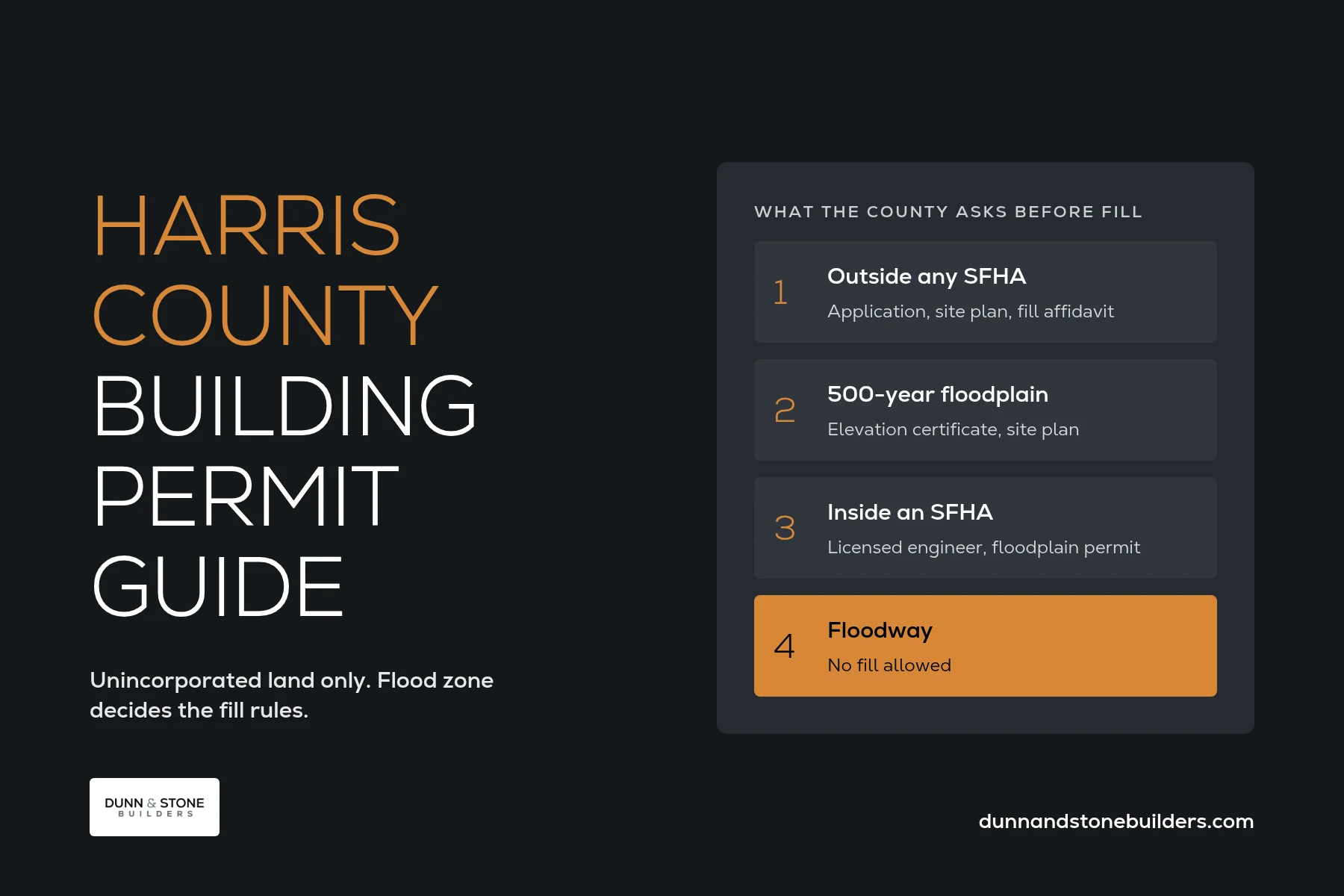
Harris County building permits cover only unincorporated land. If your lot sits inside the City of Houston or another city, that city issues your permit, not the county.
That one detail decides which office reviews your plans, which rules apply, how long you wait, and whether flood and fill rules shape your pad. It's worth checking before you buy the lot.
Outside city limits, the Harris County Office of the County Engineer (OCE) Permits Division handles residential permits, with applications taken through its ePermits portal. Section 4.01 of the county's floodplain regulations, quoted in its FAQ, is plain on the point: "All development within the unincorporated areas of Harris County without first securing a permit is prohibited." (OCE Permits FAQ)
We build across Harris County and the counties north of it.
Harris County issues building permits only for unincorporated areas, through the Office of the County Engineer and its ePermits portal. If your property is inside the City of Houston, Pasadena, Baytown, Tomball, or another city, that city's permitting office reviews and issues the permit.
| Unincorporated Harris County | Inside the City of Houston (or another city) | |
|---|---|---|
| Who issues the permit | Harris County OCE, Permits Division | The city's permitting office |
| Where to apply | ePermits portal | City portal (Houston Permitting Center for Houston) |
| Rules that apply | Harris County floodplain and permit regulations | City code and ordinances |
| What we see on cost | Fees set by the Harris County Permits Fee Schedule, plus floodplain requirements | Permitting typically adds $5,000 and up, and city building-practice requirements can add another $3,000 to $6,000 |

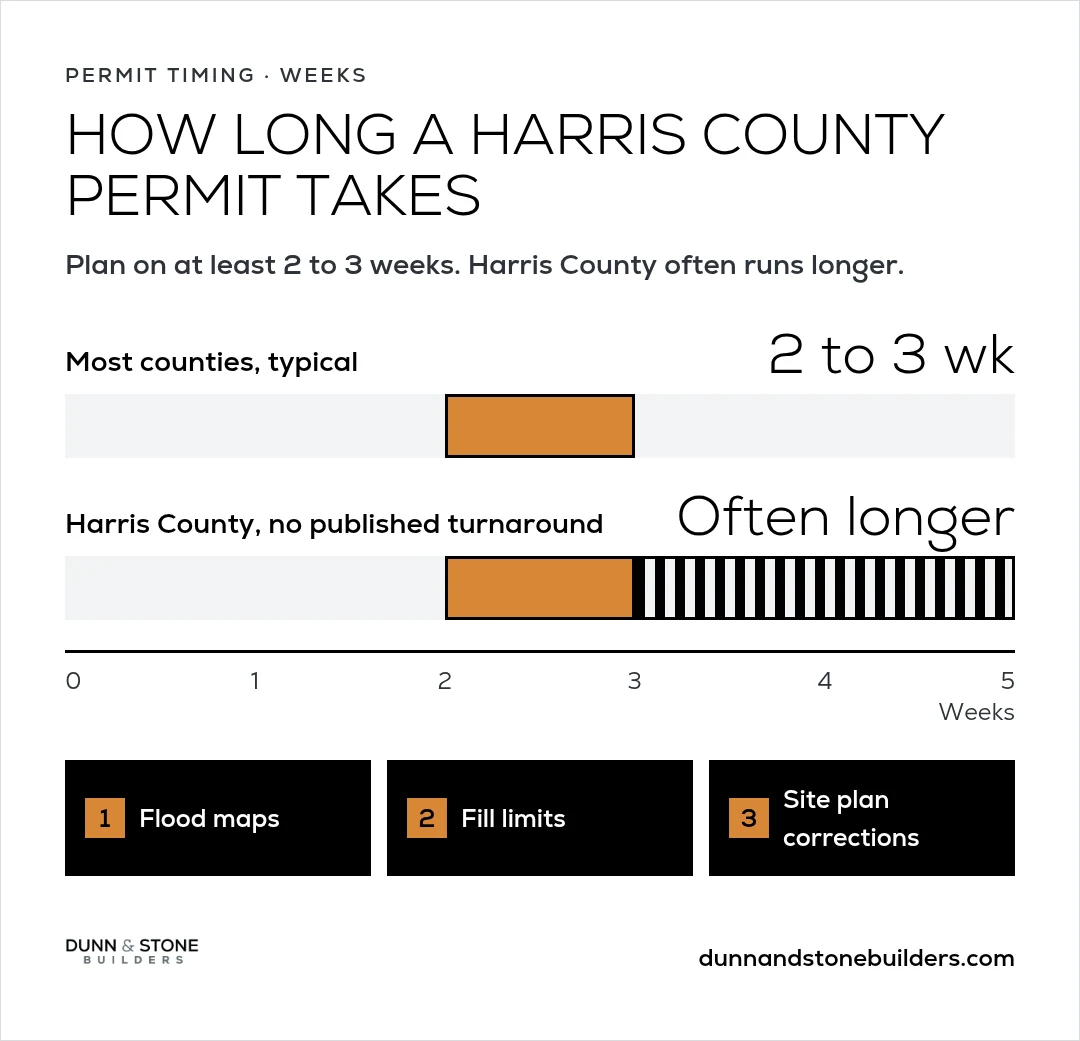
Harris County doesn't publish a standard turnaround for residential permits on its permits FAQ. In our experience, most counties turn a permit application around in 2 to 3 weeks. That's a typical range, so your wait can vary.
Harris County has become harder than most. The reason is its flood maps and its limits on bringing in dirt, which we cover below.
A complete application usually moves faster than one that comes back for corrections. Getting your site plan right the first time can save weeks.
Fill dirt is where many Harris County lots get complicated.
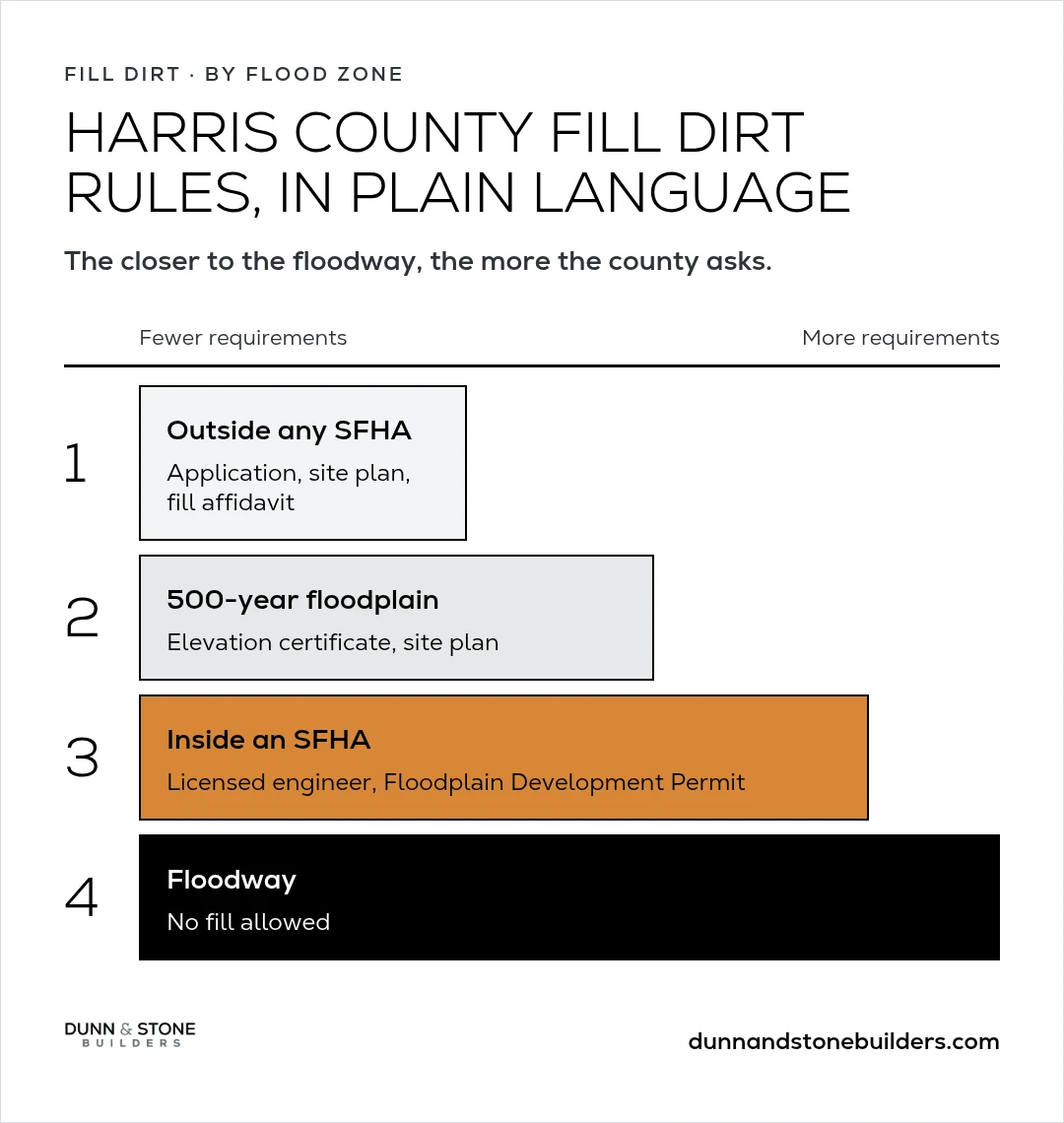
Many buyers assume they can truck in dirt and raise the pad above the flood line. In our experience, Harris County's flood-map rules now restrict bringing in fill to raise a home above Base Flood Elevation (BFE). That shapes the foundation, the site plan, and sometimes whether the lot works for the house you want.
The county counts fill as development. Its definition of development includes "filling, grading, paving, excavation or drilling operations." (OCE Permits FAQ)
The county will need 3 things, in its own words: "a completed residential application, and an accurate site plan and a fill affidavit." (OCE Permits FAQ)
The site plan has to show:
Harris County asks for an elevation certificate along with the development permit application and an accurate site plan. The county then compares the Base Flood Elevation to the lowest adjacent grade (LAG), the natural ground next to the home. If the LAG is at or above the BFE, the application is processed as if the home is outside the 100-year floodplain. If it's below, it's processed as if the home is inside it. (OCE Permits FAQ)
You'll need a Texas-licensed architect or engineer. Per OCE, they "will prepare mitigation, drainage and other documents required by the Harris County Floodplain Management Regulations." (OCE Permits FAQ)
On top of that, the county says "A Floodplain Development Permit is required for all work in the floodplain." (OCE Floodplain Management)
After construction, homes in a Special Flood Hazard Area need a Finished Floor Elevation Certificate certified by a Texas Registered Professional Surveyor, Engineer, or Architect. (OCE Floodplain Management)
The county's FAQ says it plainly: "No Fill is allowed in a Floodway." (OCE Permits FAQ)
| Where the lot sits | What Harris County asks for before fill |
|---|---|
| Outside any SFHA | Residential application, detailed site plan, fill affidavit |
| Inside an SFHA | Texas-licensed engineer or architect, mitigation and drainage documents, Floodplain Development Permit |
| Floodway | No fill allowed |
If you can answer these before closing, the permit stage is far less likely to surprise you.

Montgomery County starts with the same question: is the lot unincorporated or inside a city? We walk through that process in our Montgomery County permit guide.
We're seeing Montgomery County move closer to Harris County's stricter approach on flood and fill. If you're comparing lots across the county line, check the flood status on both.

The building permit lands in our Build Document Phase, alongside the survey, soils report, foundation plans, and the full set of construction drawings.
Want to see what your build might cost before the paperwork starts? Try our cost to build a house calculator.

Harris County doesn't issue building permits inside Houston, because the county permits only unincorporated areas. Inside Houston city limits, the City of Houston issues the building permit.
You apply through the Harris County OCE ePermits portal at epermits.harriscountytx.gov, or in person at the Harris County Permits Office, 1111 Fannin St., 1st Floor Lobby, Houston, TX 77002 (Monday to Friday, 7:30 a.m. to 4:30 p.m.). The Permits Division at 713-274-3900 can give an unofficial answer on whether a property is in a flood hazard area.
The county counts fill as development, so it needs a permit. Outside a flood hazard area, you file a residential application, site plan, and fill affidavit. Inside one, you need a licensed engineer or architect and a Floodplain Development Permit.
Harris County doesn't allow any fill in a floodway, so plan the home and pad around that part of the lot.
Harris County sets its permit fees in the Harris County Permits Fee Schedule on the OCE website, so the cost depends on your project. Check the current schedule before you budget, and add any floodplain engineering your lot needs.
Plan on at least 2 to 3 weeks, and treat that as a typical range that can vary. That's what we see in most counties, but Harris County has become harder because of flood maps and fill limits, and flood-zone lots and incomplete site plans tend to take longer.
You don't need a demolition work permit in unincorporated Harris County, according to OCE. You'll need a permit to build on the property once demolition is done.
Most lots in Harris County raise their own flood and fill questions. We're happy to look at yours with you. Schedule a free consultation with our team.

.webp)


