COMPANY
Home
Where We Build
About Us
Contact Us
Vendor Inquiry


Fred Loucks is CEO of Dunn & Stone Builders. He joined the company in July 2010 as purchasing manager, purchased the company in 2019, and has been the primary client contact for plan design and turning buyer goals into buildable plans since 2010.
Last updated July 2026.
When you’re ready to build your dream home, choosing the right builder is one of the biggest decisions you’ll make. The wrong choice shows up later as surprise costs, delayed move-in dates, or warranty headaches that drag on for months.
Houston’s market is different from most. There is no city-wide zoning. County permitting rules vary sharply. Clay soil and humidity create foundation and moisture challenges. The flood map system can dictate foundation design and fill restrictions. A builder who understands those realities will protect your budget. One who does not will discover them after you have already signed.
This guide walks through the exact evaluation process we use with every prospective client. It covers the types of builders you will meet, the red flags we see most often when buyers come to us after talking to others, the local knowledge that actually matters, the questions that separate transparent teams from the rest, and how to read a warranty that works after closing. We are members of the Greater Houston Builders Association (GHBA).
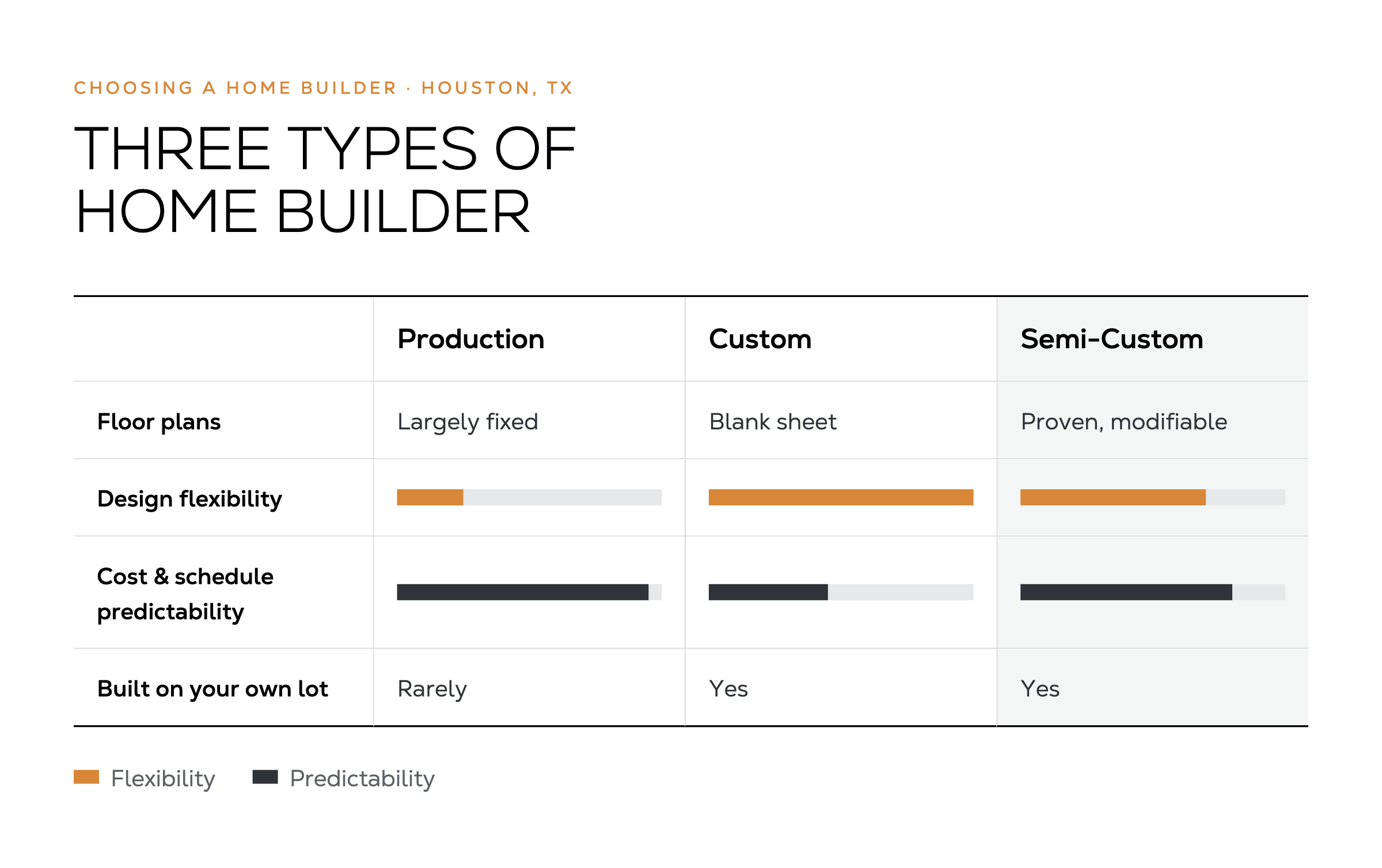
Most Houston buyers encounter three broad categories.
Production or “spec” builders construct homes on developed lots inside master-planned communities. Floor plans are largely fixed. Options exist, but major changes are limited. Speed and price predictability are the main advantages. The trade-off is less flexibility once construction starts.
Custom builders design and build a home unique to your lot and preferences. Some work from a library of proven plans that can be modified. Others start from a blank sheet. The range of customization is wide. So is the range of process discipline.
Semi-custom builders sit between the two. They offer a strong library of proven plans that can still be modified for site conditions, family needs, and finishes, while keeping the schedule and cost predictability closer to a production process. This is the model we use at Dunn & Stone.
Local knowledge is the real differentiator across all three. A national production builder may have scale. A local team that has already navigated Harris County flood-map rules, Montgomery County permitting trends, and the practical realities of clay soil and high humidity will usually deliver fewer surprises. We have completed hundreds of homes across Magnolia, Tomball, Montgomery County, and surrounding areas.
For a deeper look at how the choices differ in practice, see our comparison of custom vs production homes and our page on semi-custom homes. You can also review our guide to the top home builders in Houston.
We talk with buyers every week who have already interviewed other builders. Certain patterns appear repeatedly. The NAHB consumer resources on how to choose a home builder offer additional industry perspective on the same evaluation process.
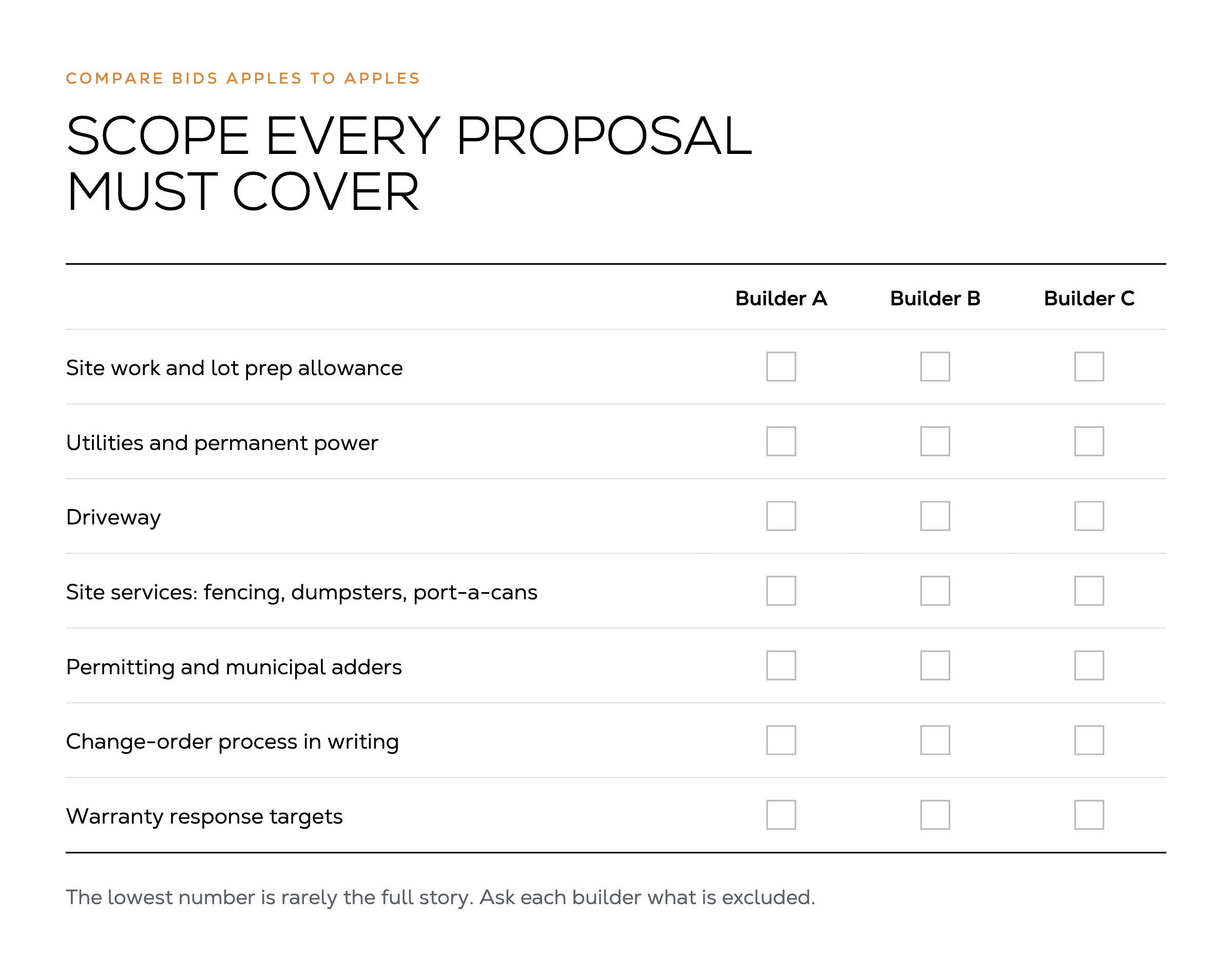
Missing line items that appear at the final contract meeting. We once spoke with a buyer who was days away from signing with a well-known builder. At the final meeting the price jumped roughly $70,000. The site plan had never included a driveway or permanent power to the house. Those items were simply added at the last minute. The buyer walked and came to us instead.
Quotes that stop at the Sheetrock walls. Some builders present a clean number that covers only the structure inside the walls. Gas to the dryer, electric to the dryer, silt fence, orange construction fence, dumpsters, and port-a-cans then become extras. Buyers often discover what's missing only when the loan is already maxed and the project is under way.
Vague or late cost transparency. If a builder cannot walk you through a clear cost breakdown before you sign—or if the answer is “we’ll figure that out later”—treat it as a warning. Our goal is that the final contract number equals the amount you pay at closing. We do this by being as clear as we can up-front. Changes that do occur are almost always driven by the client, not by items we held back.
Pressure to self-source materials or fixtures from big-box stores. We have seen the result when a client removed the flooring budget, bought product from a big-box retailer, and hired independent installers. The finished look was something we would not photograph. Quality, long-term availability for repairs, and recall tracking all suffer. We work with established partners such as Daltile so the products we install look amazing and remain supportable for years.
Unrealistic timeline promises. Weather, material lead times, and design changes all affect the calendar. A builder who guarantees an aggressive move-in date without discussing those variables is usually selling hope rather than a plan.
These patterns are not theoretical. They are the conversations that land on our desk when someone has already been burned.

Start with a focused search, then verify with more than marketing pages. Look for completed homes in the specific communities or counties you are considering. Review Google, Houzz, and BBB patterns rather than single reviews. Steady praise for communication and post-close service carries more weight than one glowing comment.
Ask for references from recent clients who built in similar conditions—acreage, flood-zone considerations, or municipal versus county permitting. Speak with them about change-order frequency and how warranty issues were handled.
Houston-area rules are not uniform. Most counties turn a permit application around in two to three weeks and remain relatively straightforward. Harris County has grown stricter on flood maps and now limits the ability to bring in fill dirt to raise a home above Base Flood Elevation. Montgomery County is moving in a similar direction. Grimes County remains easier to work with and is a growing area for us.
Municipalities (City of Houston, Conroe, Huntsville, Tomball) typically add $5,000 or more in permitting cost and can impose building-practice requirements that add another $3,000 to $6,000. A builder who already works inside those systems will price and schedule more accurately than one who discovers the rules mid-process.
If you already own land or are evaluating a lot, local knowledge of site conditions becomes even more critical. See our build on your lot process for how we handle that from the start.
Ask any short-list builder how they handle flood-zone lots, clay soil foundation design, and the difference between county and municipal timelines. Vague answers are a signal.
Bring a prepared list of questions (more on that below). Pay attention to how quickly and clearly they respond. Track whether they answer the question asked or pivot to marketing language. Request a walk-through of a recent completed home or an active job site when possible. Cleanliness, organization, and the quality of unfinished work reveal more than a model home.

Look for patterns across multiple sources. One angry review may be an outlier. Repeated complaints about missed deadlines, slow warranty response, or surprise costs are not. Contact two or three past clients who built within the last two years and ask specifically about communication during construction and after move-in.
Review recent projects, not just the best photos from five years ago. Confirm the builder has completed homes in the size range, style, and site conditions you need. On acreage lots we see living space over a garage far less often than on narrow urban lots. We avoid that “hot floor” configuration when possible because Houston humidity creates vapor-movement problems between unconditioned garage space and living space above it.
Response time to a simple information request is a useful early test. A team that takes a week to answer basic questions will usually take longer once the project is under way. During design, the clients who struggle most are those who keep circling back to decisions already settled or who bring products from outside the builder’s established suppliers. Those patterns create schedule risk.
Request a breakdown that includes site work, utilities, driveway, and the items some builders leave out. Ask what typical lot-prep overages look like above the base package. In our recent experience the average additional lot preparation sits in the $20,000–$30,000 range (down from historical $50,000–$60,000 because more is now included in base pricing). Understand how change orders are handled and whether the builder’s stated goal is zero surprises at closing.
Current portfolio ranges we see on signed contracts run roughly $173–$250 per square foot of living area, with an average near $213. Smaller homes and highly featured homes land toward the higher end of that band. Total contract prices on recent work have ranged from the high $500,000s into the low $1 millions, with an average sales price around $722,000. These numbers move with selections and site conditions. The useful signal is whether a builder can explain the drivers clearly.
For a fuller picture of cost drivers, use our cost to build a house calculator and review the related article on how much it costs to build a house.
Many of the questions that matter most are covered in detail in our separate checklist of 34 questions to ask a home builder. The Houston-specific ones we recommend adding include:
A builder who can answer these with concrete recent examples is usually more prepared than one who speaks only in generalities.
A strong warranty is more than a brochure claim. Ask how the process actually works once you have moved in.
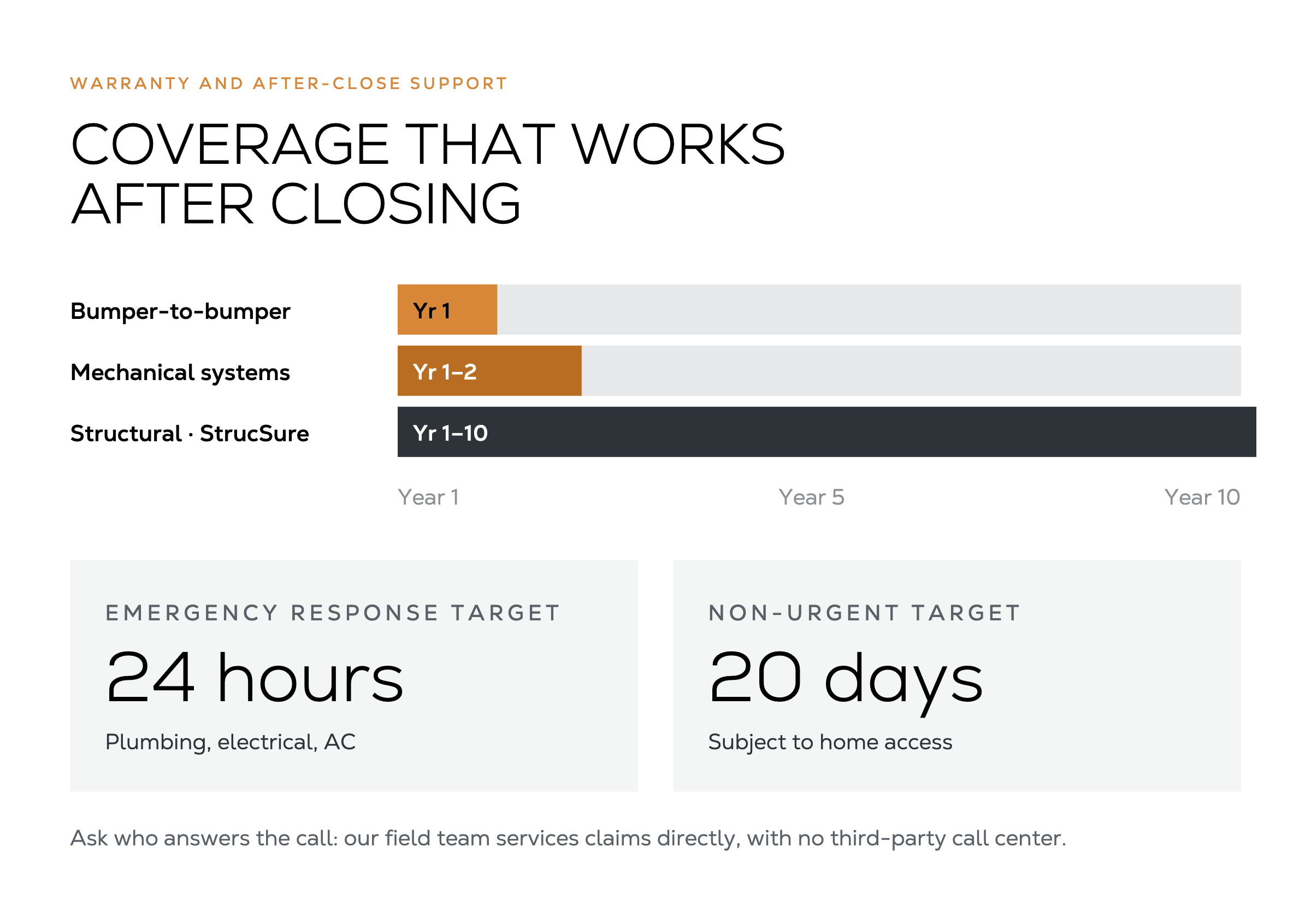
Our approach is straightforward. We service our own warranty claims directly. Clients call, email, or text the field team. There is no third-party call center between you and the people who built the house. Emergency items—plumbing, electrical, or AC—are targeted for resolution in 24 hours or less. Non-urgent items are targeted for 20 days or less, depending on access to the home.
Year-one claims are often cosmetic items that fall inside performance standards but that the client feels should look or function better. When the cost is reasonable we address them anyway. Referrals depend on how people feel after the keys are handed over.
We include StrucSure as a 10-year structural backstop. That coverage exists primarily as protection if something were to happen to the company itself. We still handle the day-to-day service. In our experience an additional third-party home warranty on top of the builder warranty and a solid homeowners policy rarely adds meaningful value in the first two years. A nearby lightning strike that damages systems, for example, is typically an insurance claim rather than a builder-warranty claim. For official details on the structural warranty provider, see StrucSure Home Warranty.
For more on how warranties actually perform in Texas, see our guide to the best home warranty companies in Texas.
Narrow the field to two or three builders. Request detailed written proposals that cover the same scope so you can compare apples to apples. Look at inclusions, material quality assumptions, timeline assumptions, and how each builder handles the items that often become late surprises.
Visit at least one completed home and, if possible, an active job site. Speak with recent clients about the full experience from design through the first year of ownership. For more on what happens after you sign, see our overview of the process of building a custom home.
The right builder will give you clear answers, realistic numbers, and a process you can follow. The wrong one will leave too many details for “later.”
If you are ready to talk through a specific lot or plan, schedule a free consultation. We can also walk you through current pricing ranges with the cost calculator and show how our semi-custom process works on the ground.
Start with local experience in the counties and communities you are considering, then verify transparent pricing, a clear warranty process, and references from recent clients. Ask specifically about flood-zone handling, lot-prep costs, and how change orders are managed. Tour completed work rather than relying only on model homes or marketing photos.
Watch for last-minute price jumps on items that should have been in the original scope (driveway, power, site work), quotes that stop at the walls, pressure to self-source materials that will affect warranty, and vague answers about county permitting or flood rules. Any of those patterns has cost buyers real money.
It matters more than most national marketing suggests. Harris County flood-map restrictions on fill dirt, Montgomery County permitting trends, municipal cost adders, clay soil foundation design, and Houston’s humidity all affect both cost and schedule. A team that has already navigated those conditions will price and plan more accurately.
Look for bumper-to-bumper coverage in year one, mechanical systems in year two, and structural coverage through year ten. Ask for the builder’s actual response targets for emergencies versus non-urgent items. Our targets are 24 hours or less for plumbing, electrical, or AC emergencies and 20 days or less for non-urgent work, subject to home access.
Production offers speed and price predictability with limited flexibility. Full custom offers maximum design freedom with more process variables. Semi-custom keeps proven plans and a disciplined process while still allowing meaningful changes for site and lifestyle. Match the model to how much design flexibility you actually need and how much process risk you are willing to carry.
Require written proposals that cover the same scope, including site work, utilities, driveway, and standard finishes. Ask each builder to explain what is excluded. Then evaluate the quality assumptions behind the numbers, the clarity of the timeline, and how change orders will be handled. The lowest number is rarely the full story.

.webp)


