COMPANY
Home
Where We Build
About Us
Contact Us
Vendor Inquiry

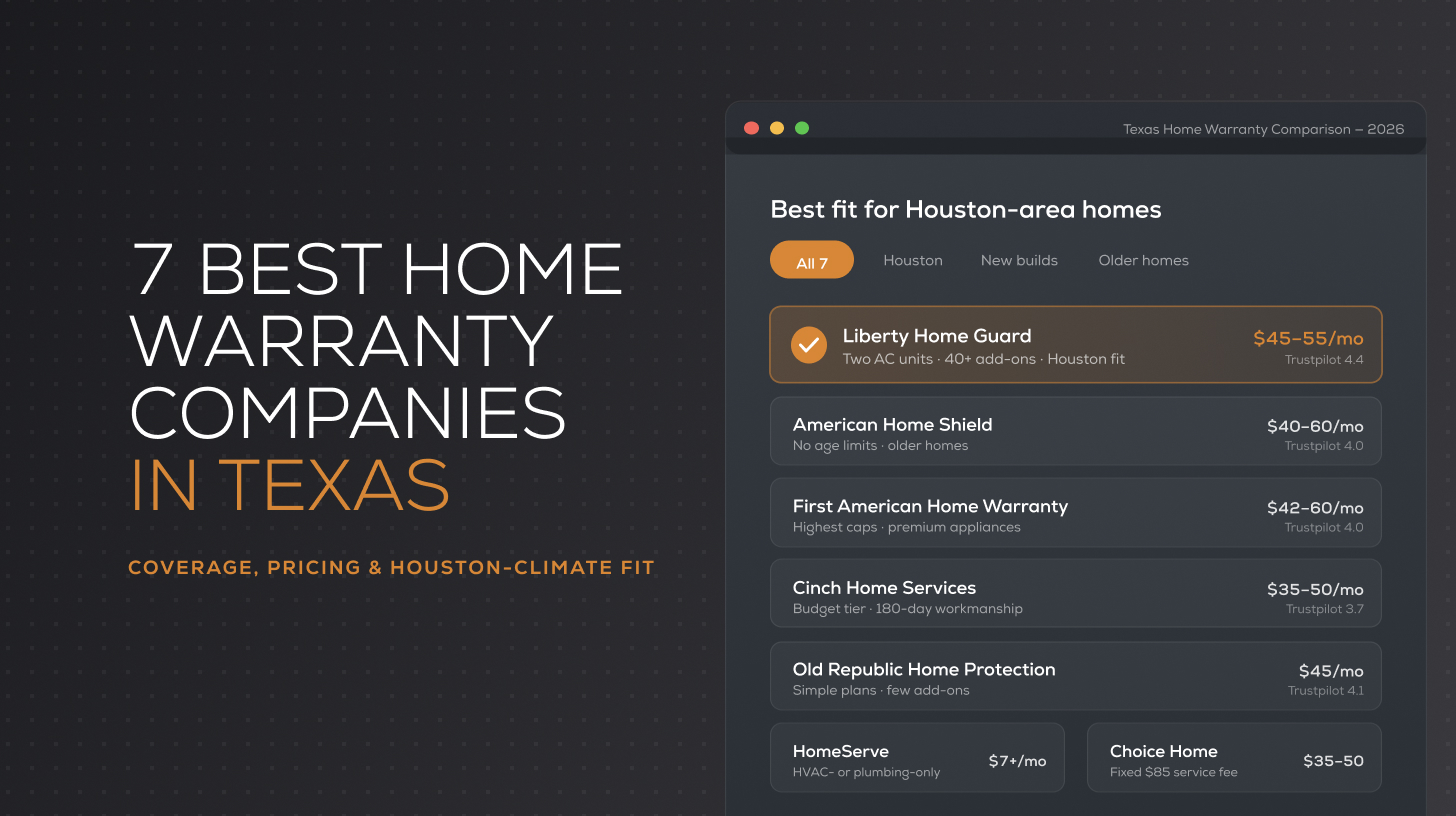
For a Texas homeowner in 2026, seven home warranty companies are most worth comparing. The list: Liberty Home Guard, American Home Shield, First American Home Warranty, Cinch Home Services, Old Republic Home Protection, HomeServe, and Choice Home Warranty.
Liberty Home Guard fits most Houston-area homes well. Its standard plan covers two AC units, and most homes here have two.
American Home Shield works well for homes older than 15 years. It covers systems and appliances of any age, and it doesn't require maintenance records.
Just closed on a newly built home in the Greater Houston area? You may not need a third-party warranty at all in years one or two. Your builder's warranty already covers most of what these companies sell.
We're a Texas custom home builder, and we put this guide together for the families we close with. The companies below are the ones our homeowners ask us about most often after move-in. We earn nothing if you sign with any of them.
Pricing is the starting tier across published sources as of May 2026. Quotes for a specific Texas address typically vary 10 to 25% from these ranges.
Customer-reputation summaries draw from Trustpilot, the Better Business Bureau, and Consumer Affairs. Trustpilot scores in particular shift week to week, and they can differ substantially from BBB or Consumer Affairs numbers for the same company.
One note on Liberty Home Guard specifically: NerdWallet's 2026 review found that some of Liberty's 5-star Trustpilot reviews come from contracted technicians, not homeowners. The aggregate is real, but read homeowner reviews directly before signing.
Four things had to be true for a company to make this list.
They're licensed in Texas. Home warranty companies in Texas are regulated by the Texas Department of Licensing and Regulation as Residential Service Companies. Every company below is registered and currently active. If you're considering a company that isn't on this list, you can verify its TDLR registration before signing.
They cover what fails in Houston-area homes. Houston heat runs AC systems near-continuously from May through October, which accelerates wear. Clay soils stress slab plumbing.
Summer humidity rusts coils and water heater anodes. Every plan below covers HVAC and plumbing as core protection, not as add-ons.
They publish pricing and service fees. Some warranty companies hide pricing behind a quote form. The seven below publish at least a starting price, a service-fee range, and the contract terms before they ask for your address.
They have a meaningful track record of public reviews. Each company below has at least 1,000 Trustpilot reviews. Companies with smaller review bases are harder to evaluate honestly, regardless of their average score.

Liberty Home Guard's standard plan covers two AC units. That matters in Houston, where most of the homes we build run 2,500 to 4,500 square feet. Homes that size almost always have dual HVAC systems.
A single unit can't keep up with that much square footage in a Texas summer, so most floor plans split the load across two. A plan that covers only one AC will leave half the house uncovered on the August day the second unit fails.
Liberty's add-on catalog is the largest in the industry. There are 40-plus options including septic, well pumps, pool equipment, second refrigerators, and stand-alone freezers. Custom homes often have non-standard equipment that most plans simply don't include.
A few honest caveats:
Starts at: ~$45–$55/month | Service fee: $75–$125 | Workmanship guarantee: 60 days
Good fit for: Texas homeowners with two AC units, a pool, or custom equipment that needs specific coverage.
American Home Shield has been writing home warranties since 1971. Its main differentiator is age tolerance: AHS covers systems and appliances regardless of age and doesn't require maintenance records.
Most competitors have age caps. AHS will write a contract on a 25-year-old water heater the same as on a one-year-old one.
For a new build, this matters less. For a buyer moving into a 1980s home in Spring or a 1990s home in The Woodlands, it matters a lot. AHS also covers unknown pre-existing conditions on its higher-tier plans, which is rare.
The HVAC coverage cap on the standard plan runs around $5,000 per system. That's reasonable for replacement of mid-range Texas-sized units.
The honest tradeoff: AHS has high complaint volume. BBB's public profile shows more than 15,000 complaints over the past three years. Homeowners report wait times ranging from same-day to several weeks, depending on region and season.
Starts at: ~$40–$60/month | Service fee: $100–$125 | Coverage caps: Up to $4,000 per appliance, $5,000 per HVAC system on ShieldPlatinum
Good fit for: Older homes where appliance age would disqualify you from cheaper plans, or homes with unknown maintenance history.
First American has the highest coverage caps of the seven companies here. Its Premium plan pays up to $7,000 per appliance with no cap on most systems including HVAC.
For owners of larger custom homes with high-end appliance packages (Sub-Zero refrigerators, Wolf ranges, Viking ovens), that ceiling matters. A single appliance replacement can blow past a $3,000 cap from a competitor.
One feature to know about is the First American Advantage coverage. It's included with the Essential and Premium plans and available as a paid add-on on the Starter plan.
It covers items most warranties exclude: crane fees for rooftop HVAC, code-violation corrections, building permits, refrigerant disposal, and issues caused by improper installation. The per-claim caps are typically $500 on Essential and $1,500 on Premium.
If you're buying a home where the original install quality is unknown, that coverage is rare in the industry. Confirm the current cap and exclusions in your contract before relying on it. The tradeoff: First American doesn't cover pre-existing conditions, which limits its value for older homes.
Starts at: ~$42–$60/month | Service fee options: $75, $100, or $125 (your choice; lower fees mean higher premiums) | Coverage caps: Up to $7,000 per appliance on Premium; unlimited on most covered systems
Good fit for: Higher-end Texas homes with custom appliances, or buyers worried about installation quality on a resale.
Cinch starts at $35 per month and covers things competitors exclude. Two examples relevant to Texas: rust and corrosion damage (Houston humidity) and unknown pre-existing conditions on the Complete Home Plan.
Cinch's 180-day workmanship guarantee runs about six times longer than the industry norm. Most competitors offer 30 to 60 days.
If a Cinch-dispatched technician fixes your AC in June and the same problem returns in October, the repeat call is covered. That's useful in Texas, where partial HVAC fixes often come back within months.
The tradeoffs are real. Cinch's customer reputation is polarized: solid scores on Consumer Affairs, lower scores on Trustpilot, and recurring complaints about claim-approval delays.
The base "Repair Only" plan excludes HVAC entirely, which removes most of the value for a Houston homeowner. You'll need the Complete Home Plan or Built-in Systems plan to get coverage that fits the climate.
Starts at: ~$35–$50/month | Service fee: $100–$150 | Workmanship guarantee: 180 days
Good fit for: Budget-conscious Texas buyers willing to read the plan details closely.
Old Republic doesn't try to be everything. Its plans cover what reliably breaks: HVAC, plumbing, electrical, and major appliances.
Add-on options are limited. Customization is limited. Service fees sit around $100. If you want a warranty you can sign up for without decoding a 14-page menu of optional coverage, Old Republic keeps things straightforward.
Starts at: ~$45/month | Service fee: ~$100
Good fit for: Texas buyers who want a no-fuss plan and don't need unusual add-ons.
HomeServe works differently from the others. Instead of bundling everything into one plan, you buy individual system protection.
A plumbing plan. An HVAC plan. An electrical plan. Several of HomeServe's plans have no service fee at all.
This works well if you only want one or two systems covered. If you want whole-home protection, the cost of stacking four single-system plans usually exceeds a Liberty or AHS bundled contract.
For a new-construction buyer, your builder warranty already covers HVAC, plumbing, and electrical. HomeServe is a clean way to add appliance-only protection on top of that, without paying for coverage you already have.
Starts at: $7+/month per system | Service fee: $0–$100 depending on plan
Good fit for: Homeowners who want one or two specific systems covered, not the whole house.
Choice's pricing is the most predictable on this list: $35 starting premium, $85 fixed service fee on every claim. If you want to know exactly what each claim will cost before you file it, that consistency has value.
The honest caveat: Choice has more Trustpilot reviews than any other company on this list, close to 60,000. It also draws a higher proportion of denial complaints than its peers, based on recent Consumer Affairs and BBB feedback. If you choose Choice, document everything, push back on denials in writing, and know that escalation may take you to the TDLR Ombudsman.
Starts at: ~$35–$50/month | Service fee: $85 fixed
Good fit for: Buyers who prioritize predictable, fixed pricing and are willing to advocate for themselves on claims.
Just closed on a newly built home in Texas? Much of what a third-party home warranty would sell you is coverage you already have.
A typical Texas builder warranty covers three timeframes, often called a 1-2-10 warranty:
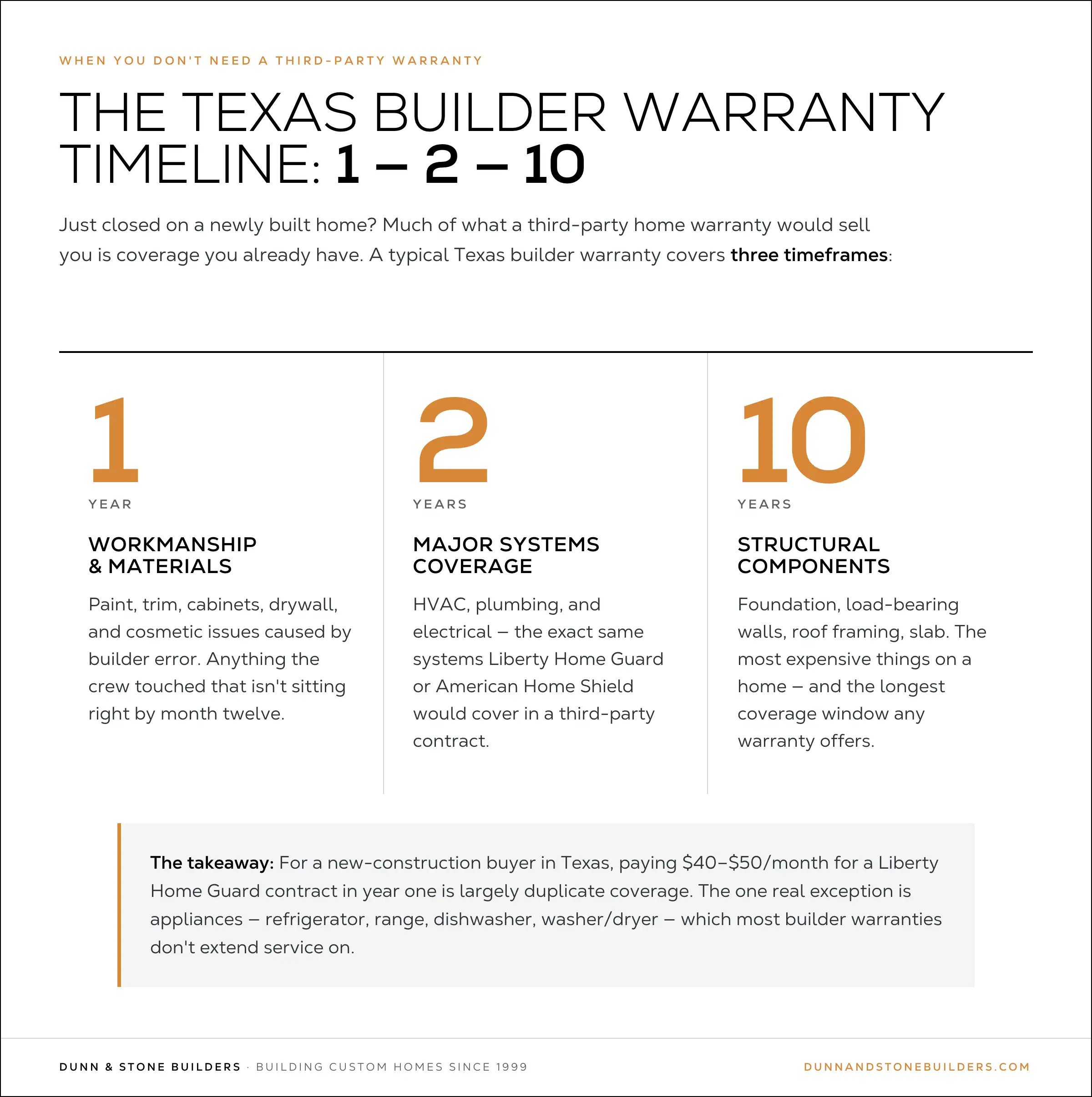
A Liberty or AHS contract is selling you protection on HVAC, plumbing, and electrical. Your builder's warranty already covers those for the first two years. We cover what's in a typical new construction home warranty in detail.
For a new-construction buyer in Texas, paying $40 to $50 a month for a Liberty Home Guard contract in year one is largely duplicate coverage. Years one and two pay for protection you already have.
One real exception: appliances. Most builders don't extend warranty service on the refrigerator, range, dishwasher, or washer/dryer.
Those go through the manufacturer's warranty, which typically runs 12 months and covers parts but not labor. If you want appliance-only protection on a new home, HomeServe's à la carte structure or Cinch's appliance plan are reasonable choices. For a resale home — especially anything older than 15 years — the case for a third-party warranty is much stronger.
Three factors matter more than monthly premium, and buyers skip them because they're not in the marketing copy.
A plan that covers HVAC "up to $1,500" is close to useless in Houston. A full system replacement here runs $8,000 to $15,000.
The cap matters more than the monthly premium. Aim for at least $3,000 per appliance and $5,000 per system. Higher is better.
Almost every warranty excludes pre-existing conditions. The definition is where companies separate.
Some require maintenance records. Some require a recent inspection.
Some define "pre-existing" as anything detectable at the time the contract started, which is broad enough that the company can deny most claims. Read the exclusion section before you sign.
A warranty is only as useful as the technician they send out. Before signing, ask each company how many in-network contractors operate within 25 miles of your address.
In rural Montgomery County, Liberty County, and the outer ring of the Greater Houston metro, network density drops fast. You may wait a full week for service in the middle of a Houston summer. For more on what these contracts cover and don't, see our guides on home warranty coverage for windows and HVAC repairs.

Home warranty companies in Texas are regulated by the Texas Department of Licensing and Regulation (TDLR) as Residential Service Companies. Two practical things follow from this.
First, the company you sign with must be licensed in Texas. You can verify any company on the TDLR's Service Contract Providers page. If a company isn't registered with TDLR, you can walk away.
Second, TDLR runs an RSC Ombudsman at 512-936-3049 who acts as an intermediary between homeowners and warranty companies on claim delays and denials. Most buyers never learn this office exists. If you've filed a legitimate claim and the company is stonewalling you, the Ombudsman is your escalation path before small claims court.
Building a new home with a reputable Texas builder. You can probably skip the third-party warranty in years one and two. Consider appliance-only coverage through HomeServe or Cinch, and revisit at year three.
Buying a resale home 0–15 years old in the Houston area. Liberty Home Guard if you have two AC units, First American if the appliances are high-end, Cinch if you're budget-constrained.
Buying a resale home older than 15 years. American Home Shield. The age-cap absence is what makes the difference here.
Tight monthly budget. Cinch Complete Home Plan, or Choice Home Warranty if predictable service fees matter more than denial risk.
Only one system to protect. HomeServe.
For most Texas homeowners with a typical Houston-area home, Liberty Home Guard works well. Its standard plan covers two AC units, and its 40+ add-on options let you tailor a plan to custom equipment.
For homes older than 15 years or with unknown maintenance history, American Home Shield is a better fit. It covers systems and appliances of any age.
Probably not in years one and two. A new construction builder warranty typically covers workmanship for one year and major systems — HVAC, plumbing, electrical — for two years. A third-party home warranty mostly duplicates that coverage.
The earlier case for buying is appliance protection, since most builder warranties exclude refrigerators, ranges, and washer/dryers once the manufacturer's 12-month warranty expires.
Comprehensive home warranty plans in Texas typically run $35 to $80 per month. On top of that, you'll pay a service fee of $75 to $150 each time a technician comes out.
Single-system plans from providers like HomeServe start at $7 per month. Quotes for a specific Texas address often differ from advertised starting prices by 10 to 25%.
Three companies stand out for Houston conditions. Liberty Home Guard covers two AC units in its base plan.
First American has the highest coverage caps overall, with no cap on most systems. American Home Shield has no age limits on appliances or systems.
The shared theme is HVAC. Houston summers force AC systems to run almost continuously from May through October.
A strong HVAC coverage limit matters. So does a workmanship guarantee long enough to cover repeat failures within the same season.
Yes, more often than the industry advertises. Common denial reasons are pre-existing conditions, missing maintenance records, and damage classified as improper use.
To reduce denial risk: file claims promptly, keep maintenance records, photograph damage before and after, and read the contract's exclusion list before signing. If a denial seems improper, you can escalate to the TDLR RSC Ombudsman at 512-936-3049.
Most home warranty contracts transfer to a new owner within a set window after closing. Liberty Home Guard, American Home Shield, and First American all permit transfers, though the process differs at each. You'll usually need to notify the company in writing within 30 to 60 days of closing.
Homeowners insurance covers sudden, accidental damage from external events: storms, fires, theft, falling trees. A home warranty (a residential service contract in Texas) covers mechanical failure of systems and appliances from normal wear. You typically need both.
On a new home, neither is a substitute for your builder's structural warranty, which covers foundation, framing, and load-bearing components for up to 10 years.
Check the company's registration on the TDLR Service Contract Providers page. All home warranty companies operating in Texas must be licensed through the TDLR's Residential Service Companies program.
If a company isn't listed, you can walk away. For unresolved complaints with a licensed company, the TDLR RSC Ombudsman at 512-936-3049 can step in.
Whatever you decide about a third-party home warranty, the strongest coverage on a new home is the builder's warranty itself. Every home we build at Dunn & Stone comes with a 1-year workmanship warranty, a 2-year systems warranty, and a 10-year structural warranty.
We build in Pinehurst, Magnolia, The Woodlands, Montgomery, and on lots in and around Conroe. We've been building in Texas since 1999, and we handle warranty service ourselves rather than handing it off.
If you're weighing builders, the questions worth asking a home builder include several on warranty service specifically.
What's covered. What isn't. How the builder responds to repair requests after closing.
If you'd like to talk through a custom build, get in touch with our team. We'll walk you through our process, our warranty, and the homes we've built near you.

.webp)


