COMPANY
Home
Where We Build
About Us
Contact Us
Vendor Inquiry

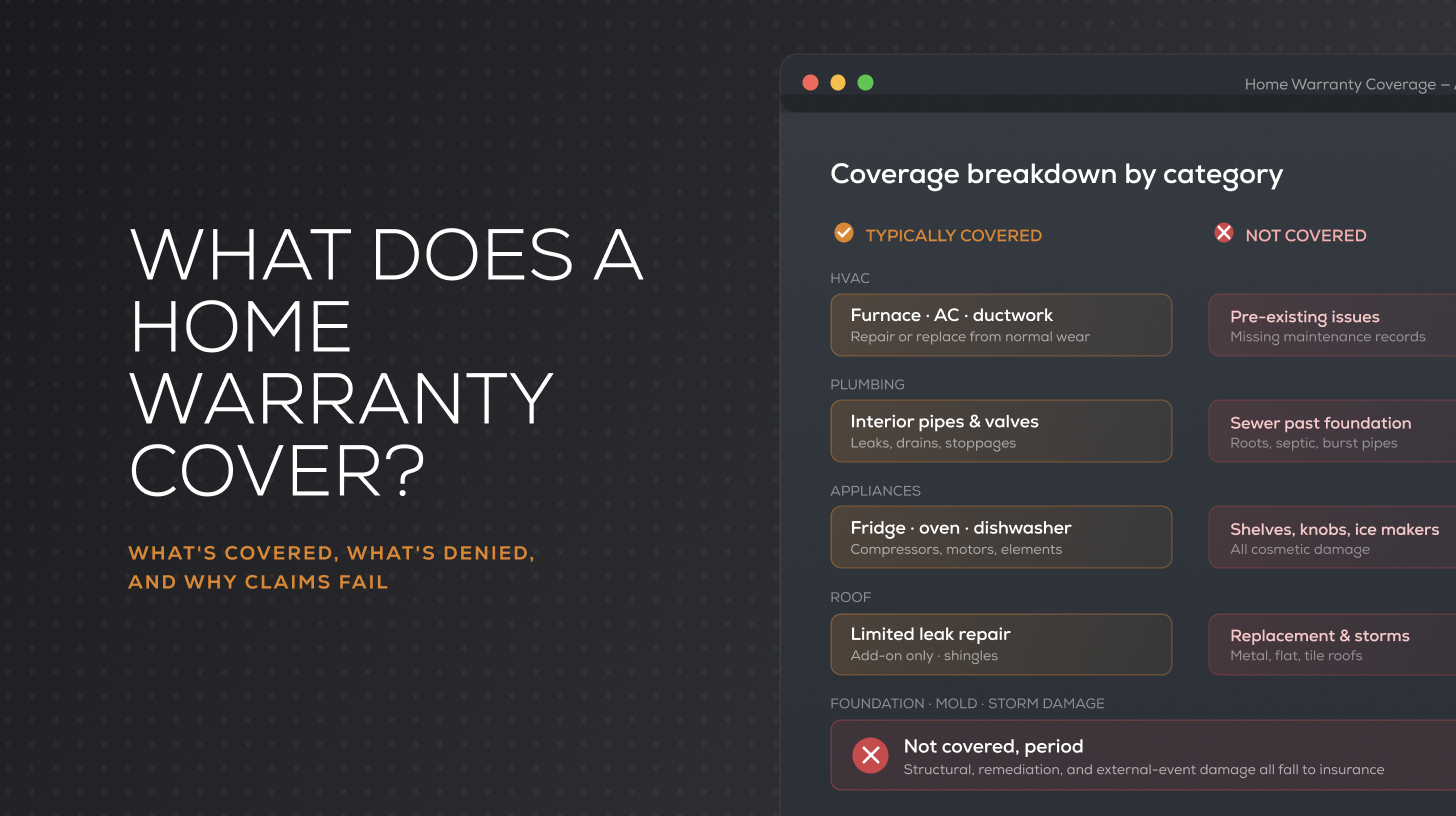
A home warranty is a service contract that pays to repair or replace major home systems and appliances when they fail from normal use. Most plans cover HVAC, interior plumbing, electrical, water heaters, and kitchen and laundry appliances.
Coverage typically excludes pre-existing conditions, cosmetic damage, and structural elements like roofs and foundations. It also excludes anything tied to poor maintenance, improper installation, or external events like storms, flooding, or fire.
Dunn & Stone Builders has built custom homes in the Greater Houston area since 1999. Our warranty specialist, Mitch Howard, has worked in residential construction since 1984. Between Mitch and our project management team, we've helped homeowners file warranty claims for years.
Two things to know before you keep reading. We're a custom home builder, not a warranty company.
The patterns below come from coordinating real claims for our homeowners. You're getting a builder's view of how these contracts behave, not a sales pitch.
The longer version, with the rules behind each row, is below.
Most home warranty plans split into two buckets: systems and appliances. Some providers sell them separately, some bundle them into a comprehensive plan. The comprehensive plan is usually the better value if you want coverage across both categories.
Major systems generally include:
Major appliances generally include:
What "covered" means in practice: the warranty company sends a contractor to diagnose the problem. You pay a service fee, usually $75 to $150 per visit.
If the failure qualifies, the company pays to repair or replace the item. Coverage stops at whatever cap your plan sets per item and per year.
If the failure doesn't qualify, you keep the service fee invoice and the item stays broken. Most homeowner frustration with home warranties starts there. The contract often covers less than the marketing pages suggest.
Every contract spells out coverage limits and exclusions, and the language gets dense. The categories below show up in almost every denied claim we've coordinated.
Pre-existing conditions. If the technician decides the failure was developing before coverage started, the claim gets denied. This ranks as one of the most common denial reasons across the industry. Homeowners struggle to dispute it because they can't prove a part wasn't already worn.
Poor maintenance. Warranties cover normal wear and tear, not neglect. Skipped HVAC tune-ups, dirty filters, ignored water heater flushes, and untreated leaks give the company grounds to deny.
Cosmetic damage. Scratches, dents, dings, peeling paint, chipped tile, stained countertops. If the item still functions, it isn't covered.
Code violations and improper installation. If a previous installer didn't meet code, the warranty company can refuse to repair the item. You'll need to bring it up to code at your own expense first.
Structural elements. Roofs, foundations, walls, framing, exterior doors, and windows are construction, not appliances. A few plans offer limited roof leak add-ons, but coverage for replacement is rare. We break down the window-specific picture in our windows warranty coverage guide.
Outdoor and detached items. Sewer lines outside the foundation, outbuildings, sprinkler systems, pools, and spas usually require add-on coverage.
Damage from external events. Storms, hail, lightning, flooding, fallen trees, fire, theft, and vandalism. Homeowners insurance handles all of these.
Specific parts of a covered item. A plan might list refrigerator as covered, then exclude shelves, drawers, ice makers, water dispensers, and interior lights. The compressor fails and you're covered, but a cracked shelf is on you. Garage doors follow the same rule, with the opener motor covered but the door panels left out.

The "does home warranty cover ___" question gets asked thousands of times a month across HVAC, plumbing, roofs, and mold. Here's how each category plays out.
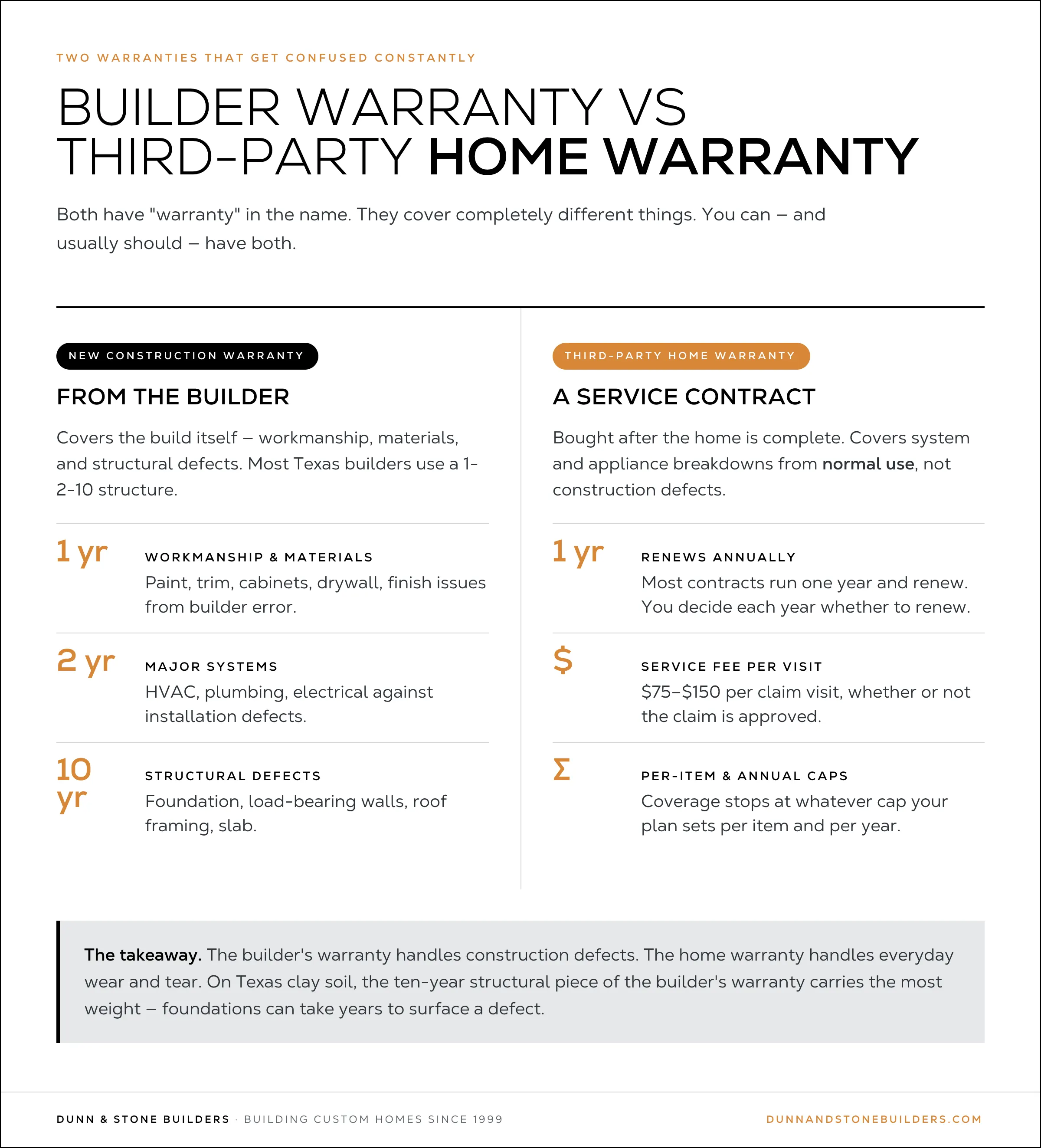
Yes, most home warranty plans cover interior plumbing failures from normal wear, including pipes, drains, valves, and stoppages within the home's main foundation. Coverage usually stops at the foundation line.
Standard plumbing coverage handles leaks in interior copper or PEX lines, broken shut-off valves, water hammer, and accessible stoppages. Common exclusions are sewer lines outside the foundation, septic systems without an add-on, frozen or burst pipes, and stoppages caused by tree roots.
For Greater Houston homes, two patterns trip up plumbing claims.
The first is clay soil movement causing slab-line shifts, which the warranty company classifies as foundation-related rather than plumbing. The second is root intrusion in sewer lines from older trees on rural lots in Conroe, Magnolia, and Montgomery County. Both surprise homeowners who assumed plumbing was plumbing.
Most standard home warranties do not cover the roof. A few providers offer limited roof leak coverage as an add-on, which pays to patch active leaks over occupied living areas. The add-on does not pay for roof replacement.
Even with the add-on, the exclusions stack up.
Metal roofs, flat roofs, built-up roofs, and tile roofs are commonly excluded. Roofs over patios, porches, garages, decks, and skylights are excluded too. Damage from storms, hail, or wind belongs to homeowners insurance.
For a new build, your roof falls under the builder's warranty for a defined window, usually one year for workmanship and longer for structural defects. After that window closes, the roof becomes a homeowners insurance question for damage and an out-of-pocket question for age-related wear. We explain the builder side of this in our new construction home warranty guide.
Yes, standard home warranties cover HVAC systems failing from normal use, including the furnace, central air, ductwork, thermostats, and electrical components. Coverage caps and exclusions are where most HVAC claims get complicated.
Houston puts more stress on HVAC than most parts of the country. Many of our builds run two AC units because a single system can't keep up with summer load on a home over 3,000 square feet.
Some warranty plans only cover one unit per home unless you upgrade to a multi-unit add-on. That clause matters in Houston, and it's worth checking before you sign.
The most common HVAC denial reason has nothing to do with the failure itself. It's missing maintenance records. If a homeowner can't produce annual service tickets, the company can argue the breakdown came from neglect.
Keep every HVAC invoice in a folder, physical or digital. Our home warranty HVAC coverage breakdown walks through what to document.
Standard home warranties do not cover mold. Mold remediation sits outside almost every consumer warranty plan, even when the underlying cause is a covered failure.
If a pipe leaks for three weeks before you notice, the warranty might pay to repair the pipe. It will not pay to remediate the mold that grew while the leak was undetected. Homeowners insurance sometimes steps in, depending on the policy language and whether the water source was sudden and accidental rather than gradual.
Mold matters more in humid climates. Greater Houston averages around 75% relative humidity year-round, which is enough to grow mold quickly behind walls, under sinks, and in attics with poor ventilation. A serious remediation can run five figures.
The cheapest insurance is the same advice your inspector gives. Address water issues fast. Ventilate bathrooms and laundry rooms, and run dehumidifiers in spaces with poor airflow.
Foundation drainage matters too. We engineer drainage into every Houston-area build sitting on clay soil for that reason.
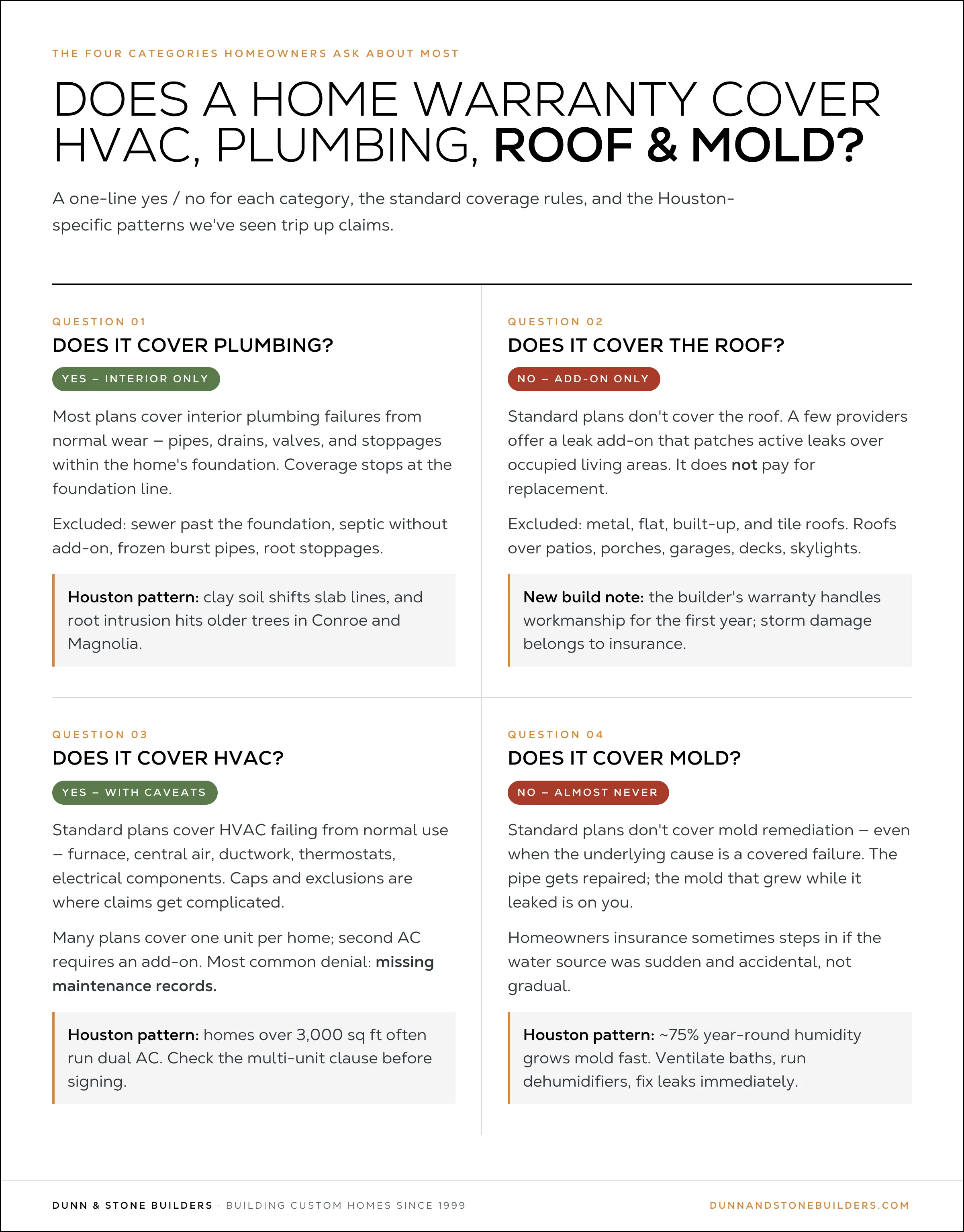
These two warranties get confused often because both have "warranty" in the name. They cover different failures.
A new construction warranty comes from the builder. It covers the build itself: workmanship, materials, and structural defects.
Most builders use a 1-2-10 structure.
Year one covers workmanship and finish issues. Years one and two cover major systems like HVAC, plumbing, and electrical against installation defects. Years one through ten cover structural defects in load-bearing components like the foundation and roof framing.
A third-party home warranty is a service contract you buy after the build is complete. It covers system and appliance breakdowns from normal use.
You can have both. The builder's warranty handles construction defects. The home warranty handles everyday wear and tear on systems and appliances.
For a custom home built on Texas clay soil, the structural piece of the builder's warranty carries the most weight. Foundations move on clay, and the ten-year structural window gives you a path to address defects that take years to surface. We cover what a strong builder's warranty looks like, and what to ask before signing, in our questions to ask a home builder guide.
The denial reasons we see most often, in rough order of frequency:
A few habits prevent most denials.
Keep every service invoice. File claims fast, the day you notice the problem if possible. Get a home inspection at the start of coverage so pre-existing conditions are documented in writing.
The math is different for a newly built home than for a resale. Major systems are new.
Manufacturer warranties on the HVAC unit, water heater, and most appliances cover the first one to ten years depending on the component. The builder's warranty covers installation defects in those same systems during the first one to two years.
For a new construction buyer, an additional home warranty adds two things. First, coverage for failures the manufacturer or builder warranty doesn't cover. Second, the convenience of a single phone number when something breaks.
Some buyers value that convenience and pay the premium. Others find the early-life risk is already handled and put the home warranty money into a maintenance fund instead.
For a resale home with aging systems, the math usually tilts toward buying the warranty. A 12-year-old AC system in a Texas climate is one breakdown away from a $5,000 repair bill, and a warranty can soften that hit.
We don't sell warranties. When homeowners ask for a recommendation, we point them to providers we've worked with for years. Our Texas home warranty company comparison breaks down pricing, coverage caps, and the add-ons that matter for Houston conditions.
A home warranty covers system and appliance breakdowns from normal use. Homeowners insurance covers damage from external events like fires, storms, theft, and certain water losses. They don't overlap.
A dishwasher that dies of old age goes to the warranty. A dishwasher destroyed by a kitchen fire goes to insurance. Most homeowners need both, and lenders require insurance regardless of whether you buy a warranty.
Most basic home warranty plans in Texas cost $400 to $700 per year. Comprehensive plans that bundle systems and appliances typically run $700 to $1,100 per year. Texas averages sit around $610 to $944 annually depending on coverage level, and service fees add $75 to $150 per claim visit.
Add-ons cost extra. Pools, septic systems, second AC units, and roof leaks each add $50 to $200 per year. Premiums in Houston tend toward the higher end because dual-AC homes and HVAC service calls drive up expected payouts.
Home warranties do not cover pre-existing conditions, cosmetic damage, structural elements, mold, or damage from outside events. They also exclude specific parts of otherwise-covered items, like refrigerator shelves or garage door panels. Anything outside the home's main foundation, including sewer lines and detached structures, typically requires an add-on.
Most home warranty plans cover the refrigerator if it's included in the appliance section. Coverage handles compressor failure, sealed system issues, thermostats, and door switches from normal wear.
Most plans exclude shelves, drawers, ice maker components, water dispensers, interior lights, and any cosmetic damage. Built-in models and second refrigerators in garages or outdoor kitchens usually require an add-on.
Most home warranty contracts run one year and renew annually. A warranty included with a home purchase often covers the first year of ownership only. After that, the homeowner decides whether to renew.
Builder warranties last longer. They typically run one year for workmanship, two years for systems, and up to ten years for structural coverage.
A few providers, like American Home Shield, offer plans that include some coverage for pre-existing conditions. Most plans exclude them.
The safer path is to get a home inspection right before buying coverage so anything pre-existing is documented in writing. That documentation gives you something to point to if the warranty company denies a later claim.
Lying on the application, failing to pay premiums, and certain kinds of damage caused by the homeowner can void coverage entirely. More often, the issue is a single denied claim rather than a voided policy. A voided policy is the worst-case outcome and is rare in practice.
A solid warranty conversation starts before the home is built. The builder's warranty backs the construction itself. The third-party home warranty fills in the gaps for system and appliance breakdowns from daily use.
Manufacturer warranties handle the components inside those systems, and homeowners insurance covers damage from outside events. The four together make the financial picture more predictable.
Dunn & Stone Builders has built custom homes in the Greater Houston area for over 25 years. Our service area includes Pinehurst, Conroe, Magnolia, Montgomery, The Woodlands, and surrounding communities.
We're a member of the Greater Houston Builders Association and the National Association of Home Builders, and we're BBB accredited. Our team carries over 100 years of combined construction experience, and our warranty specialist has worked in the industry since 1984.
Want to talk through what your custom build would look like? That includes the builder's warranty coverage we provide on every home. Schedule a free consultation with our team and we'll walk you through it.
Still working out the budget? Our cost to build a house calculator gives a starting estimate based on your lot, square footage, and finishes.

.webp)


