COMPANY
Home
Where We Build
About Us
Contact Us
Vendor Inquiry


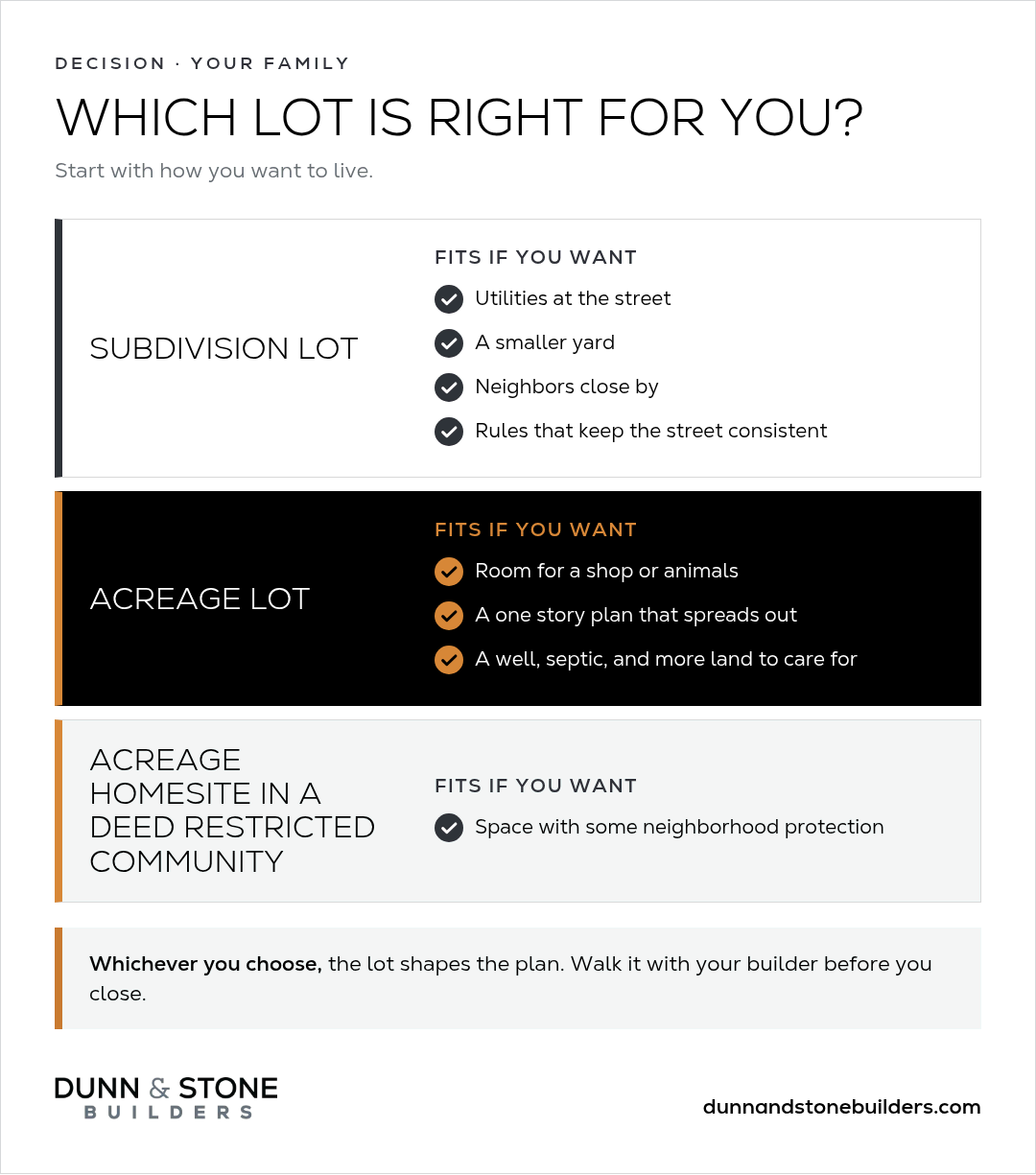
A subdivision lot gives you water and sewer at the street, paved access, and HOA rules that shape what you build. An acreage lot gives you room and fewer rules, but you take on a well and septic system, a longer driveway and power run, and more site work. The right one depends on how you want to live.
It's a good question to settle before you pick a builder, because the land you choose shapes the plan, the permits, and the price.
Dunn & Stone has built in Montgomery County since 1999, on acreage and inside neighborhoods across Magnolia, Tomball, Montgomery, Conroe, and Spring. Once a house goes on the lot, these are the differences we see.
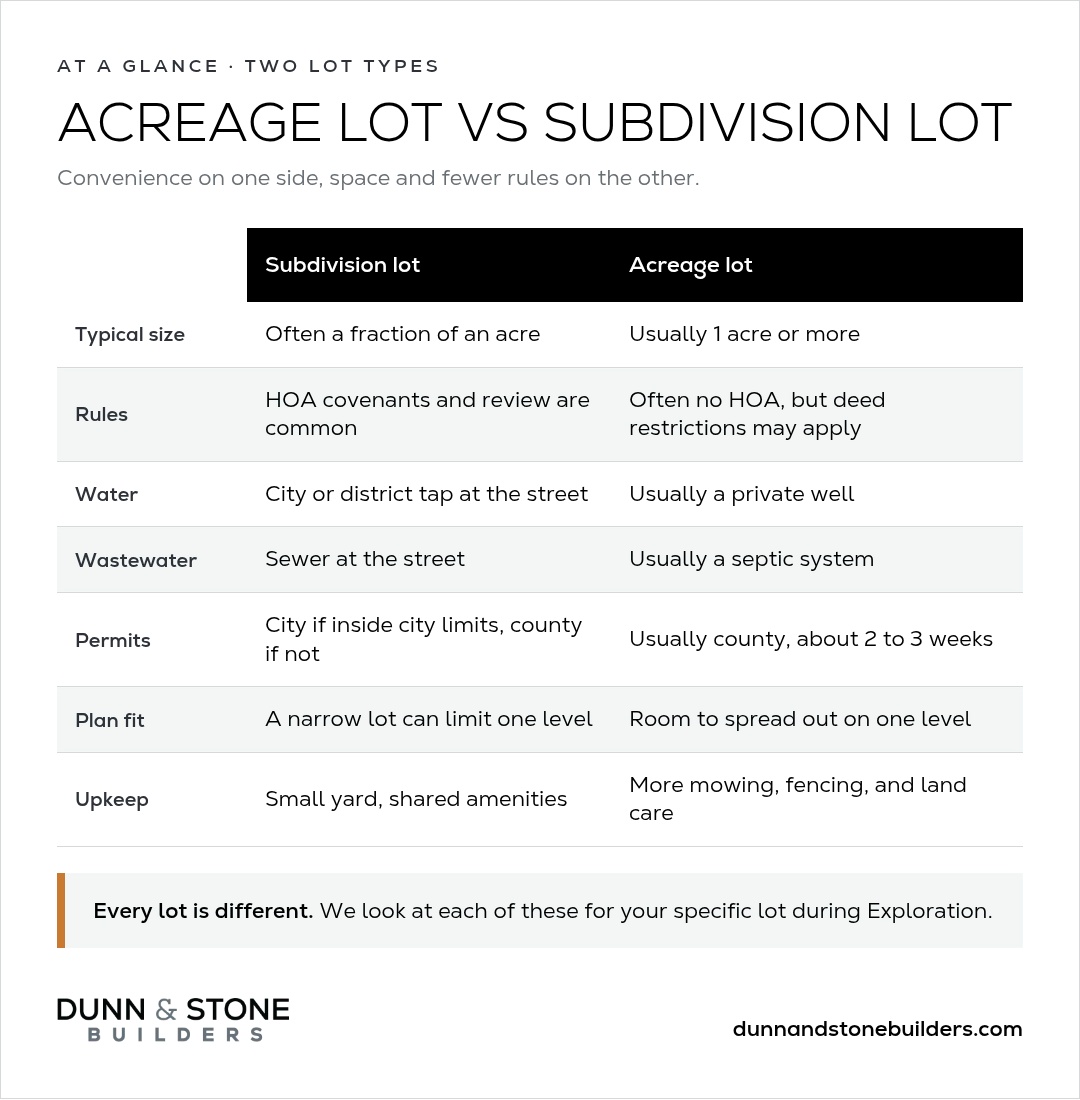
The two lot types usually compare like this.
We look at each of these for your specific lot during our Exploration phase.
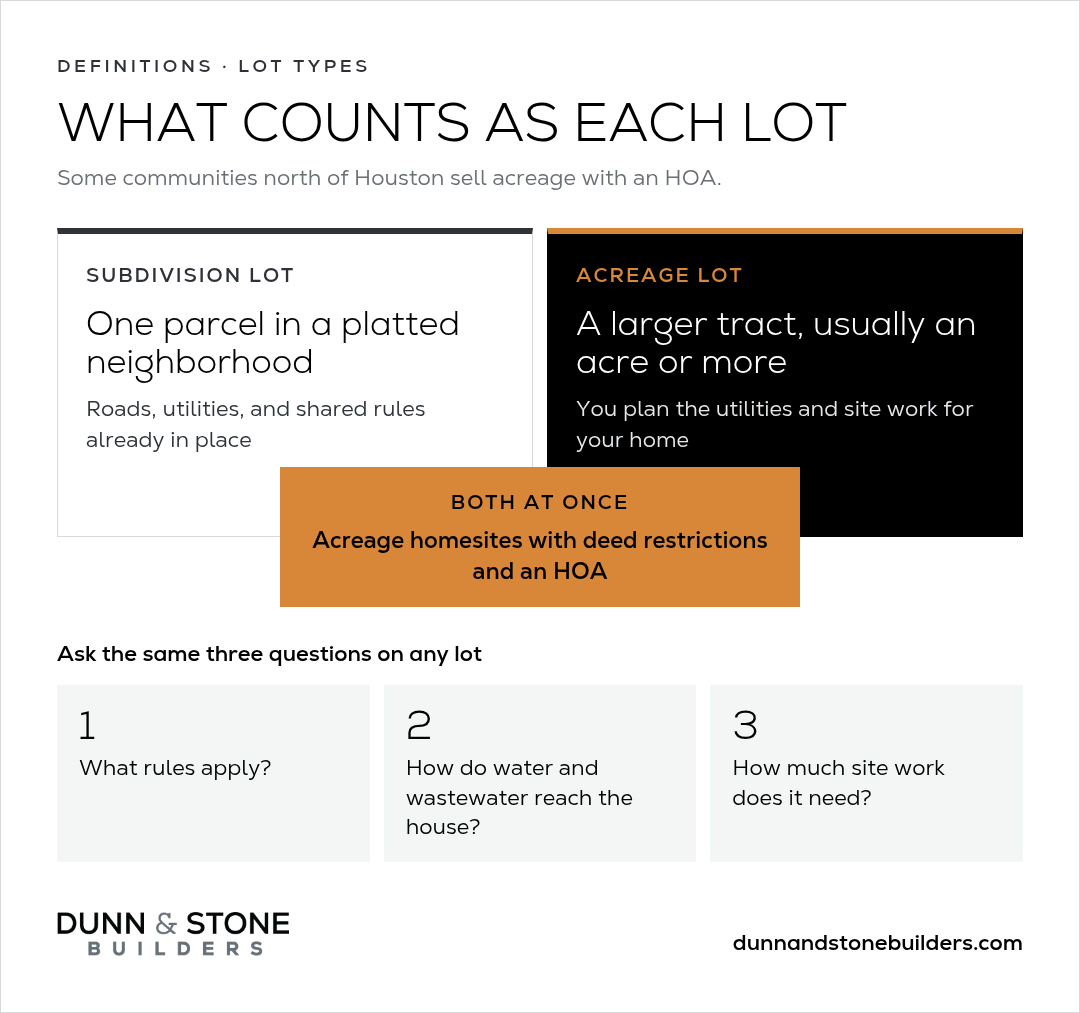
A subdivision lot is one parcel inside a platted neighborhood, usually with roads, utilities, and shared rules already in place. An acreage lot is a larger tract, usually an acre or more, often outside a platted neighborhood, where you plan the utilities and site work for your own home.
Some communities north of Houston sell acreage homesites with deed restrictions and an HOA, so the same lot can be both. The questions that matter are the same either way: what rules apply, how water and wastewater reach the house, and how much site work the lot needs.
If you're still shopping, buying land in Texas usually calls for a survey, a mineral rights check, and a look at ag valuation.
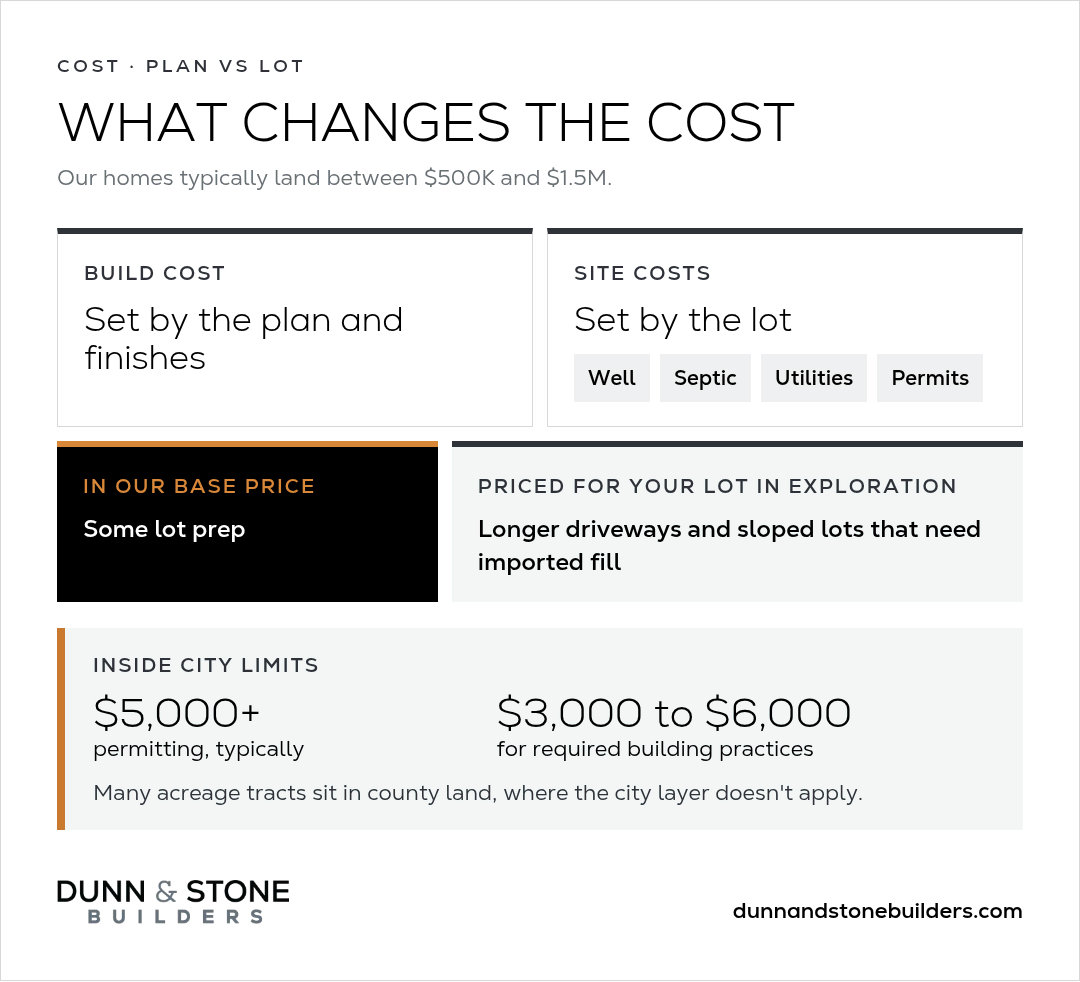
The build cost itself is driven by the plan and finishes. The lot changes site costs, including the well, septic, utilities, and permits.
Some lot prep is already built into our base price. Longer driveways and sloped lots that need imported fill can raise it, so we price those items for your specific lot during Exploration, before the final contract.
In cities such as Houston, Conroe, Huntsville, and Tomball, permitting typically starts at $5,000, and the city can require building practices that add $3,000 to $6,000. Many acreage tracts sit in unincorporated county land, where that city layer doesn't apply.
Land price per acre is usually lower on rural acreage, and a subdivided lot with utilities already in costs more per acre. Homesite conditions on Houston-area lots are what drive that site work. Our homes typically land between $500K and $1.5M, depending on plan, size, and finishes.
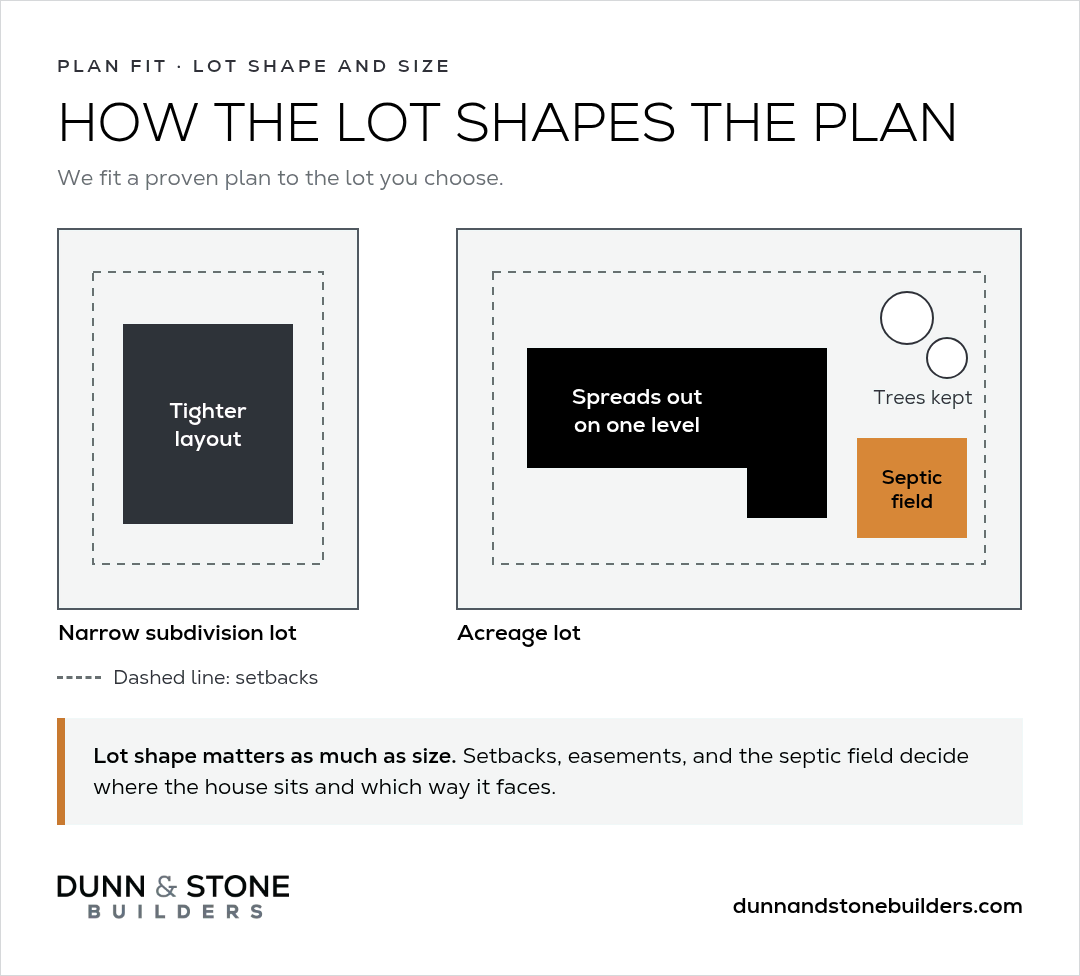
Both can work, because we fit a proven plan to the lot you choose. Acreage gives a plan room to spread out on one level. A narrow subdivision lot can limit how far the footprint can go, so the layout may need to be tighter.
Lot shape matters as much as size. Setbacks, easements, and where the septic field goes decide where the house can sit and which way it faces. On acreage, the house can also face the view and the trees you want to keep.
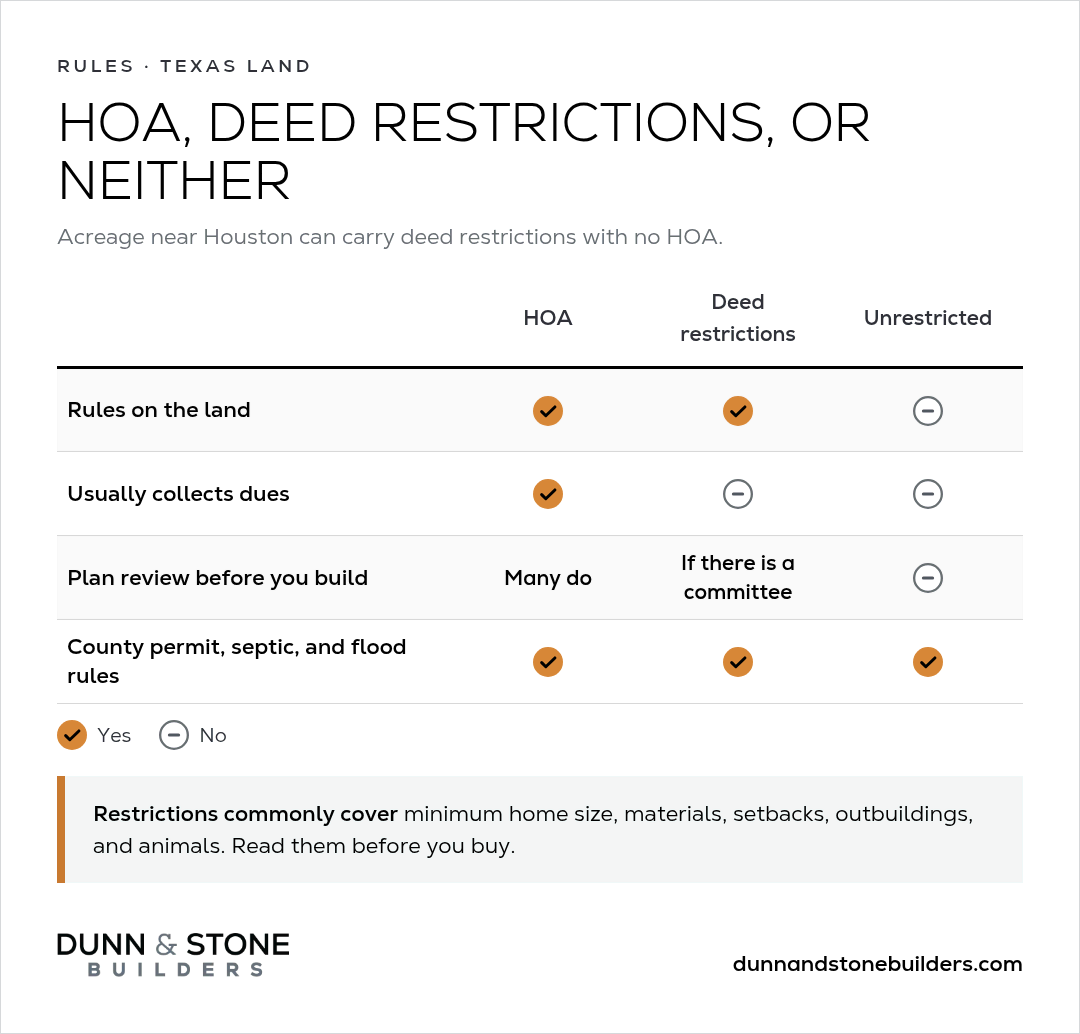
An HOA enforces rules and usually collects dues, and many have an architectural committee that reviews your plans before you build. Deed restrictions are recorded rules that run with the land, and acreage tracts near Houston can have them even when there's no HOA.
Those restrictions commonly cover minimum home size, building materials, setbacks, outbuildings, and animals. Read them before you buy, and we read them against your plan.
If the lot is deed restricted with a review committee, the committee usually has to approve your plans before construction starts. The county permit doesn't replace that approval. The HOA application is part of our Build Document phase, with the survey and soils report.
Truly unrestricted tracts give more freedom, and the county permit, septic rules, and flood rules still apply. HOA and deed rules protect what the neighborhood looks like, and the freedom of open land comes with more choices to make yourself.
Subdivision and city lots usually connect to a city or utility district water tap at the street. Rural acreage north of Houston usually needs a private well.
Lots with sewer at the street tie in. Acreage usually needs a septic system designed for the soil on that lot.
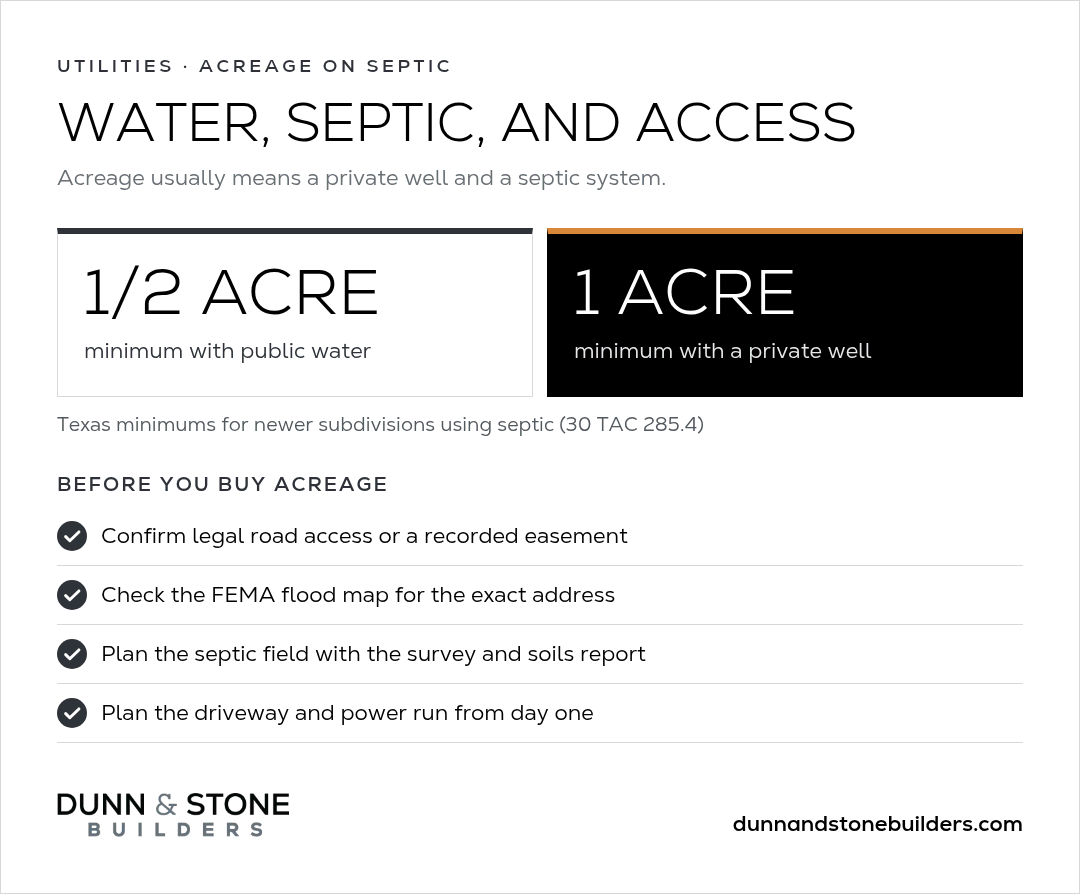
Texas rules for newer subdivisions using septic set minimum lot sizes of 1/2 acre with public water and 1 acre with a private well (30 Tex. Admin. Code § 285.4).
On our builds, the septic design is planned alongside the survey and soils report, before construction, so the field doesn't collide with the driveway, the house, or the trees you want to keep.
Acreage often means a longer driveway and a longer run to the nearest power line, and both are part of the site plan from day one. Construction trucks have to reach the pad early, and a long drive may need a culvert at the road ditch and a firm base.
Confirm the tract has legal road access or a recorded easement before you buy.
Check the FEMA flood map for the exact address on any lot. Harris County limits bringing in fill to raise a home above Base Flood Elevation, and Montgomery County is moving in the same direction.
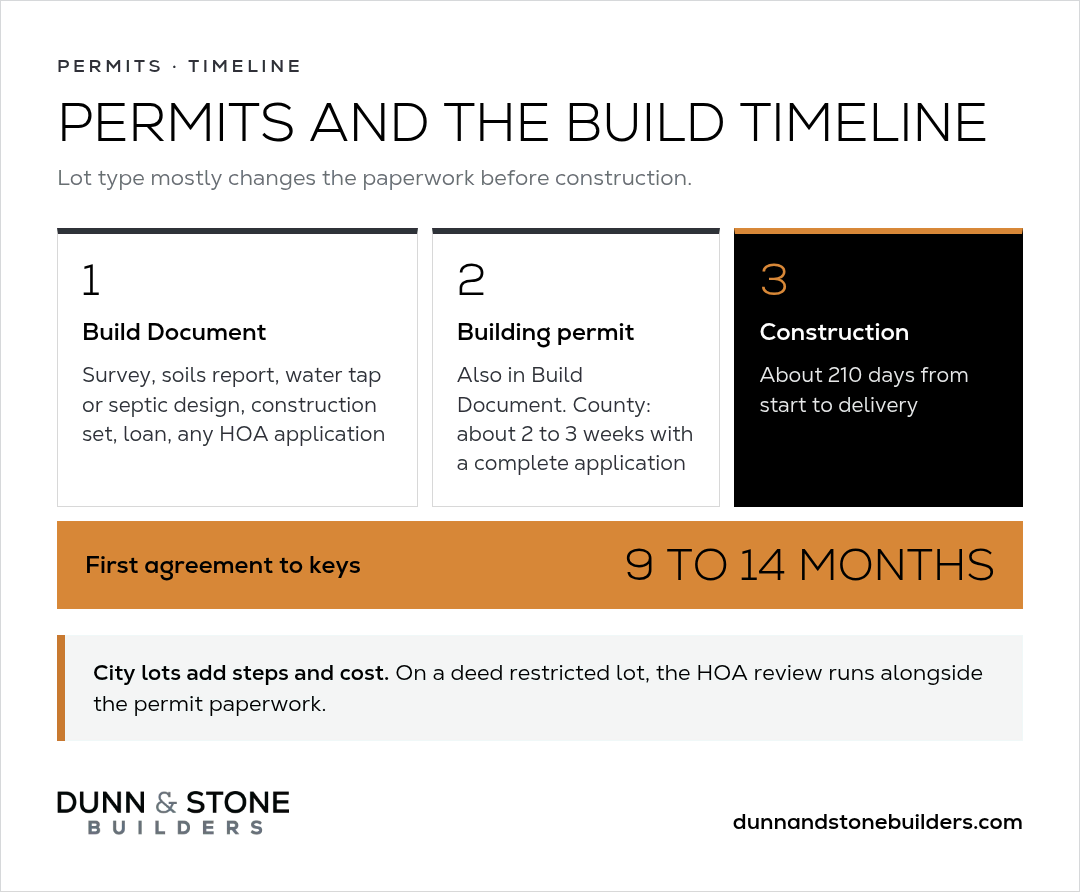
Lot type mostly changes the paperwork before construction. A county permit near Houston usually takes about 2 to 3 weeks when the application is complete. City permits add more steps and cost, and on a deed-restricted lot the HOA review runs alongside the permit paperwork.
In our Build Document phase, we assemble:
After that, our construction averages about 210 days from start to delivery. Custom and semi-custom homes typically take 9 to 14 months from first agreement to keys.
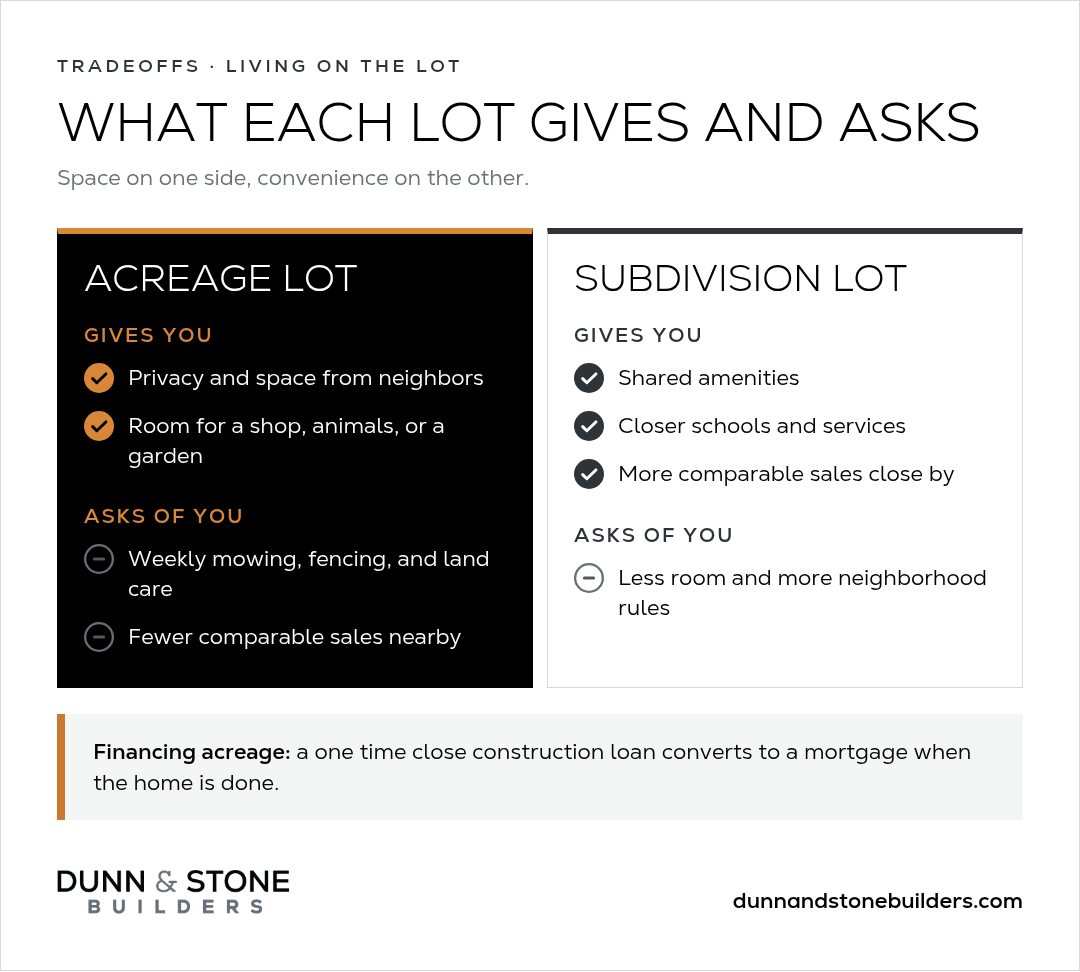
Acreage gives you privacy, room for a shop, animals, or a garden, and space between you and the neighbors. It also asks more of you. Mowing, fencing, and land care on a few acres take real weekly time.
Acreage homes can have fewer comparable sales nearby, so an appraiser may need to look farther away or use older sales. Subdivision homes usually have more comparables close by.
One way to finance an acreage build is a one-time close construction loan that converts to a mortgage.
Shared amenities, closer schools and services, and a smaller yard are real advantages for many families on a subdivision lot.
Whichever you choose, the lot shapes the plan, so it helps to walk it with your builder before you close. Start at build on your lot if you already have land in mind.
You need enough land for the house, the driveway, the setbacks in your plat or deed restrictions, and, if there's no sewer, a septic system and its field. In Texas, newer subdivisions on septic need at least 1/2 acre with public water and 1 acre with a private well. Older lots and city lots can be smaller.
A parcel is any piece of land the county tracks for taxes, and a lot is usually a parcel inside a recorded subdivision plat. People often use the two words the same way.
Some acreage lots have an HOA, and many do not. Acreage tracts near Houston with no HOA can still carry recorded deed restrictions, and some acreage homesites sit inside communities that have both.
Unrestricted land means there are no recorded deed restrictions or HOA rules on the tract. County permits, septic rules, and flood rules still apply, so plan for those on any lot.
You can finance an acreage build with a construction loan that converts to a mortgage when the home is done. Your lender will look at the land, the plan, and the fixed contract together.
We do, and many of our homes sit on acreage or larger suburban parcels across Magnolia, Tomball, Montgomery, Conroe, and Spring. We build within about 60 miles of our Pinehurst office, on land you own or are buying.
Whether you're looking at five acres in Montgomery County or a lot in a neighborhood near Tomball, I'd love to walk it with you, read the restrictions, and show you which plans fit. Schedule a free consultation and bring the address, the survey if you have it, and a rough budget.


