The Cheapest Way to Build a House: 15 Ways to Build for Less (2026)

Table Of Contents
Share

By Fred Loucks, Owner and CEO, Dunn & Stone Builders

The cheapest way to build a house is to keep the design simple and the footprint small. A single-story square or rectangular plan costs the least per square foot to frame and roof.

From there, your savings come from a proven floor plan, standard finishes, and a builder who trims cost out of the design with you.

I have built homes north of Houston since 1999, and I have watched budgets hold or slip on these early choices. One example: dropping secondary-room ceilings from 10 feet to 9 feet saves around $10,000 on our builds.

The lot and the systems behind the walls move a budget far more than the countertops. Here are the home types, the real numbers, and 15 ways to build for less.

What Is the Cheapest Way to Build a House?

The cheapest way to build a house is to build small and simple. A square, single-story plan with a basic roof and standard finishes costs the least per square foot.
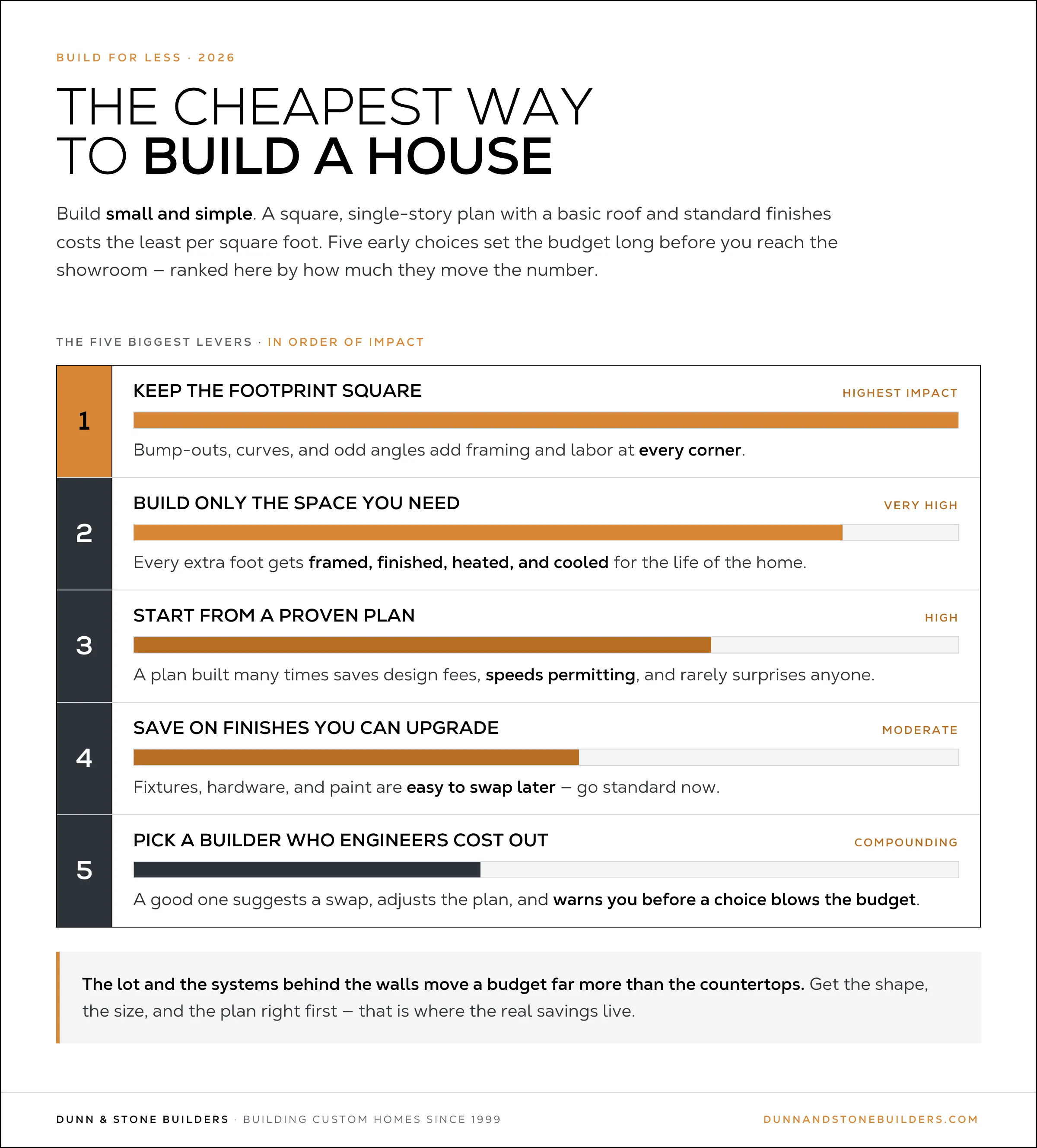
Choose a proven floor plan over a design from scratch. Build only the space you will use, and time your material purchases.

The five biggest levers, in order:

  • Keep the floor plan square or rectangular.
  • Build only the square footage you need.
  • Start from a proven plan, not a blank page.
  • Save on finishes you can upgrade later.
  • Work with a builder who engineers cost out of the plan.

Everything below proves out those five.

How Much Does It Cost to Build a House Right Now?

Building costs move most with home size and finish level, and your location shifts them further.

Nationally, HomeGuide puts new construction at $180 to $450 or more per square foot, or roughly $350,000 to $800,000 before land and site prep.

Builder-grade homes sit at the lower end. Custom homes with higher-end finishes run toward the top.

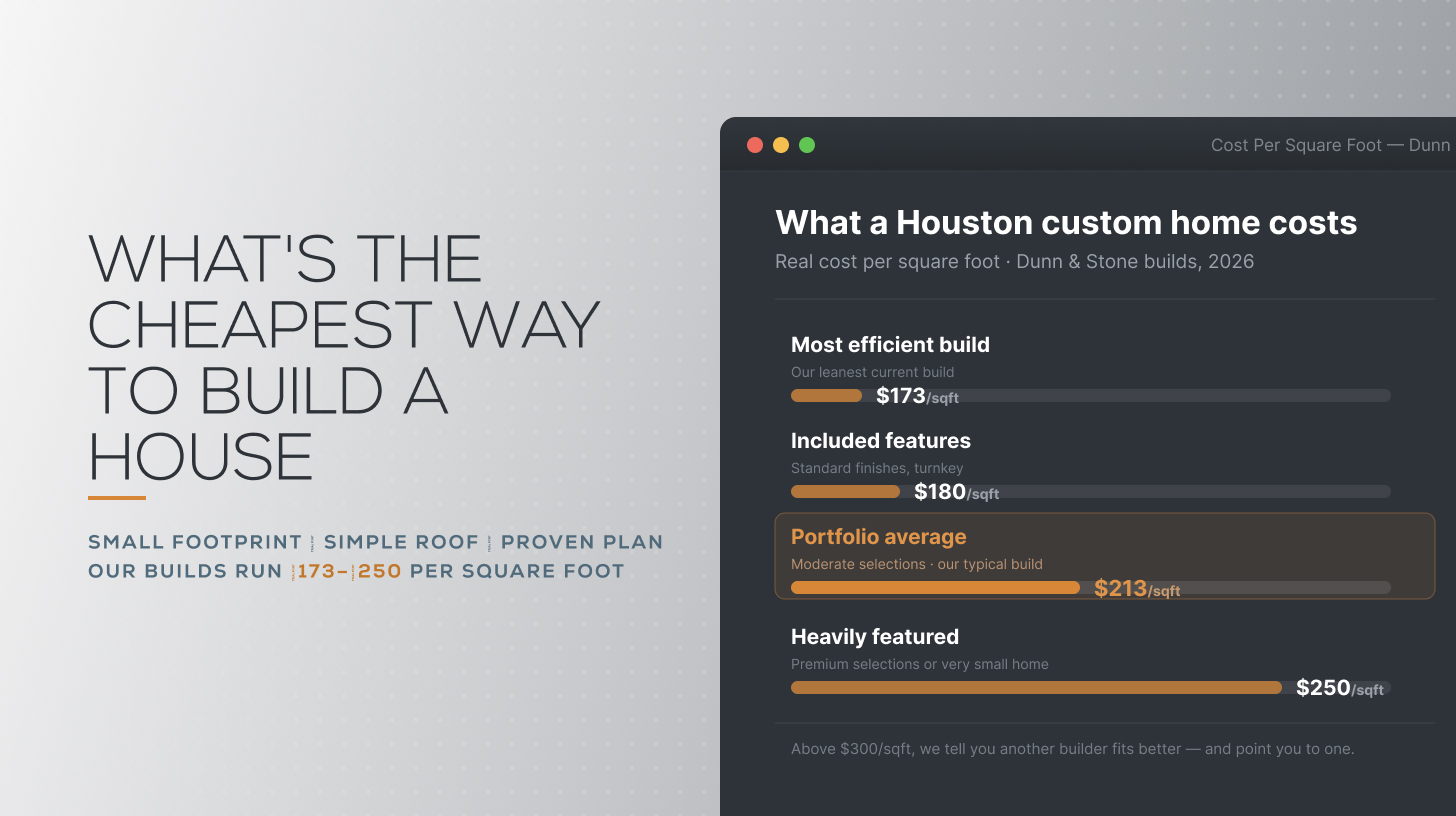
In the Houston area, our custom homes generally land between $150 and $300 per square foot. A home built with our included features lands around $180 per square foot of living space.

A moderate set of selections puts you near $213 per foot, which is our portfolio average. A heavily featured home, or a very small one, runs closer to $250. Our most efficient current build sits at $173.

Above about $300 per square foot, I tell buyers plainly that another builder is a better fit, and I point them to one. That honesty saves everyone time and money.

For a number based on your plan and lot, use our cost-to-build calculator. For a fuller breakdown, see what it costs to build a home.

Where the Money Goes

Here is my rule of thumb for where build dollars end up: Land runs about a fifth of the total, and the structure is close to a third. Mechanical systems and finishes each take roughly a fifth, with site prep and landscaping covering the rest.
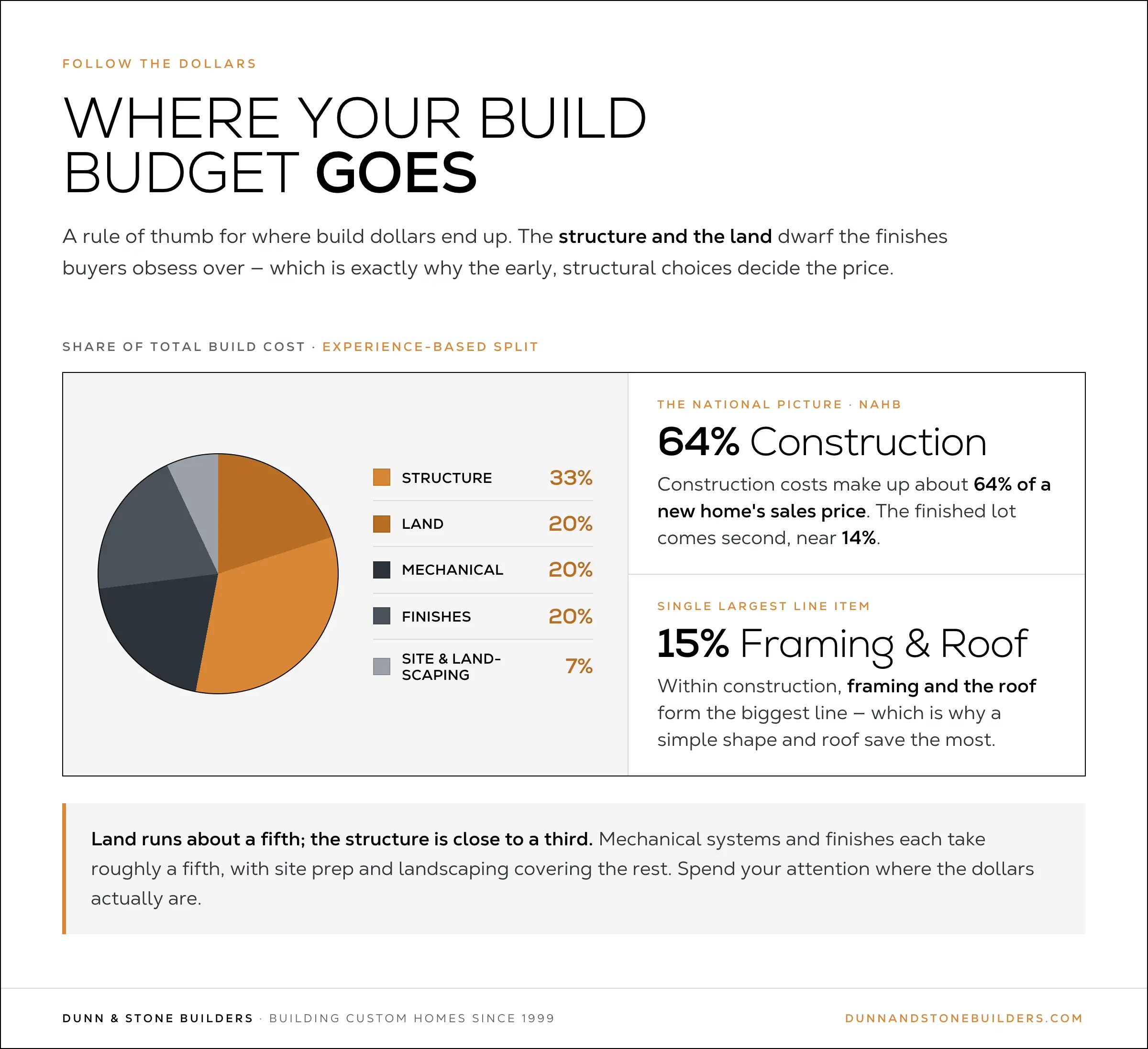
That split is an experience-based approximation from our builds, not a line-item audit.

The national picture lines up. The NAHB Cost of Construction survey found construction costs make up about 64 percent of a new home's sales price. The finished lot comes second, near 14 percent. Within construction, framing and the roof form the single largest line at about 15 percent.

The Cheapest Types of Homes to Build

If the lowest possible price is the only goal, a custom home is not where you start. Several nontraditional home types cost far less to build.

HomeGuide pegs the cheapest home types at about $75 to $275 per square foot on average, with specific styles ranging wider. The table below uses HomeGuide's figures to compare the common options.

Home type Rough cost to build Best for Tradeoffs
Tiny home (under 400 sq ft) $150 to $450 per sq ft, low total price One or two people, downsizing Very little space, zoning and parking rules
Pole barn / barndominium About $50 to $150 per sq ft Rural living with a shop or open plan Metal look, financing can be harder
Modular / prefab About $80 to $160 per sq ft Faster builds, consistent quality Fewer design options, delivery and crane access
Shipping container About $150 to $350 per sq ft Small footprints, ADUs, guest homes Insulation, permitting, and finish work add up
Simple one-story ranch Lowest-cost traditional option Families who want a normal home for less Single story uses more lot

I want to be straight about where we fit. We build custom and semi-custom stick-built homes. Tiny homes and container homes sit outside what we do.

If a small cabin is your goal, another path serves you better. If you want a full-size family home built for less, the rest of this guide is for you.

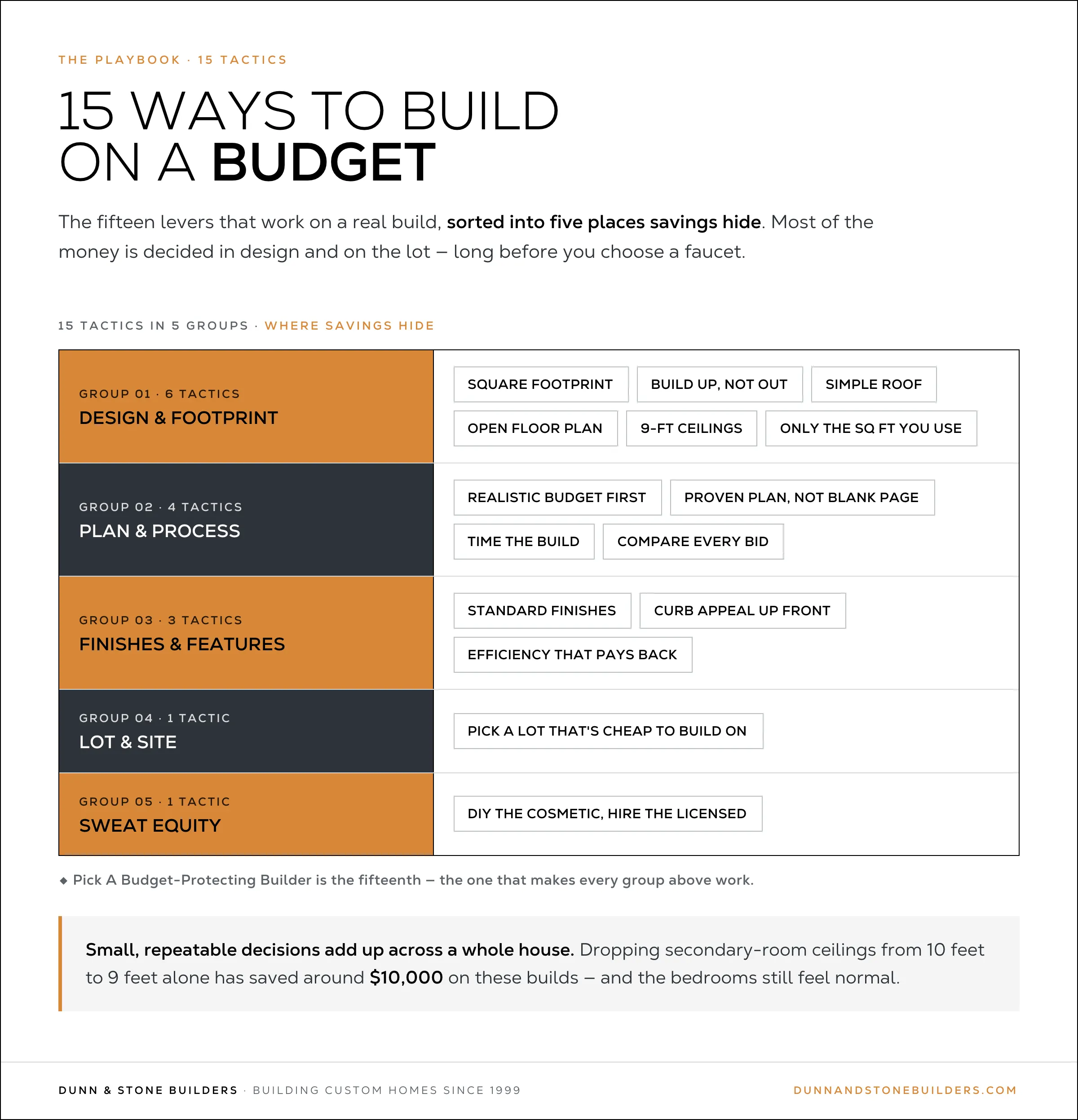
15 Ways to Build a House on a Budget

Here is what works on a real build, drawn from the homes we put up every year.

1. Start With a Realistic Budget Before You Choose Finishes

Price out the whole home before you fall for a tile sample. The early design choices set your budget long before you reach the showroom.

Keep your budget as a living document. Add every change as it happens so you always know where you stand.

On our builds, the target is a final contract that matches the final closing number. When a change does happen, you steer it, and you see the cost before you decide.

Set aside 10 to 15 percent for surprises. The biggest ones hide in site grading and the systems behind the walls. Our guide to the hidden costs of building a house covers what to expect.

2. Keep the Footprint Square or Rectangular

A square or rectangular home is the cheapest shape to build. Bump-outs, curves, and odd angles add framing and labor at every corner.

Simple shapes also move through permitting faster and waste less material. We size our plans so full lengths of lumber get used wherever possible, which cuts waste without touching finish quality.

3. Build Up, Not Out

A two-story home often costs less per square foot than a sprawling one-story. You reuse the same foundation and roof for more living space, and those are two of the biggest line items.

If your lot is small or your budget is tight, going vertical stretches both further.

4. Choose a Simple Roof

Your roof design moves the budget more than most owners expect. Every valley, dormer, and pitch change adds material and labor, plus a new place for water to find its way in.

A clean gable roof with asphalt shingles costs far less than a complex roof in slate or stone. Keep the lines simple and spend the savings where you will see them.

5. Use an Open Floor Plan

Open layouts remove interior walls, which cuts drywall, framing, and wiring. The home feels larger without adding a single square foot.

Fewer walls also improve airflow and light, which helps your air conditioning work less in the Houston heat.

6. Pick a Lot That Is Cheap to Build On

The lot can add tens of thousands to a build, and most buyers never see it coming. A flat, cleared lot with utilities at the street is far cheaper to build on than a wooded, sloped, or low-lying one.

On our recent builds, lot prep runs about $20,000 to $30,000 over the base allowance. Longer driveways and sloped lots that need imported fill drive most of the overage.

Flood rules add cost in our area. In parts of Harris and Montgomery County, maps now require us to raise a home above the base flood elevation. They also limit how we do it.

City lots cost more, too. A municipality often adds $5,000 or more in permitting, plus building practices that can add another $3,000 to $6,000.

Waterfront lots carry their own surprise. The slope down to the water can force pier-and-beam construction, which has added $65,000 to $120,000 on some of our lake builds.

Before you fall for a view, ask your builder what the lot will cost to build on. If you already own land, our build on your lot page walks through how we work with what you have.

7. Start From a Proven Floor Plan Instead of a Blank Page

A custom plan drawn from scratch costs more in design fees and carries more risk. A plan that has been built many times saves design time, speeds permitting, and rarely surprises anyone.

This is the heart of how we keep prices fair. We start with proven plans refined over decades, then adjust them to fit your lot, your family, and your budget.

That model has a name. It is how semi-custom homes give you most of the freedom of custom at a friendlier price.

8. Go Standard on Finishes, Splurge on What Is Hard to Change

Spend your money where changing it later means tearing things out. Flooring and cabinetry are costly and messy to redo, so get those right the first time.

Fixtures, hardware, and paint are easy to swap whenever you want. Choose the standard options now and upgrade them on your own timeline.

One finish surprises people, and that is paint. Upgrading to a satin finish runs about double the base cost, because satin cannot be spot-touched. Any scuff means repainting the whole wall.

9. Know Where You Can Do It Yourself, and Where You Should Not

Sweat equity helps when the task is cosmetic. Painting and landscaping are safe to take on yourself, and swapping fixtures can wait for later.

Leave the structural and licensed work to pros. Electrical and framing can cost far more to fix than you saved by trying.

Self-sourcing materials is where I push back. We build from our design center and from Daltile, one of the largest tile suppliers in the country, so most selections are covered. When a client supplies their own flooring and hires an outside installer, we cannot stand behind the result or track a recall on it.

If you act as your own general contractor, be honest with yourself about time and know-how. The fee you save is real, and so is the risk if a key step goes wrong.

10. Cut Cost in the Framing Details

Some of the largest savings hide in choices buyers never think to question. The one I point clients to first is ceiling height in secondary rooms.

Dropping secondary rooms from 10-foot to 9-foot ceilings has saved around $10,000 on our builds. Your main living spaces still feel grand, and the bedrooms feel normal.

Small, repeatable decisions like this add up across a whole house.

11. Get Curb Appeal Without the Full-Stone Price

You can get a high-end look from the street without paying for it on every wall. On our homes, a brick or stone front with quality siding on the other sides reads as a finished, high-end elevation.

We price the exterior veneer in tiers. The lowest is full lap siding, and each step up adds brick, then natural stone, and finally stucco, with a stone-and-stucco front at the top.

One surprise: vertical siding costs about the same as brick. Brick pricing follows fuel costs, while vertical siding follows the lumber market and the labor to install each strip.

Full brick or stone on all four sides looks beautiful and costs a great deal more. Put the money where the street sees it.

12. Build in Efficiency That Pays You Back

Some upgrades lower your bills for as long as you live there. Good insulation and a right-sized HVAC system are hard to change later, so get them right while the walls are open.

We size cooling for square footage and the Houston summer load. Our standard system is a two-stage unit built for this climate, and most homes do well on it. A premium upgrade runs about $10,000 over that standard.

Any home over 3,000 square feet gets two AC units as standard. That is about square footage and cooling load in our heat, since our homes are slab-on-grade with no basements.

Efficient systems cost a little more up front and pay it back in lower energy and insurance costs.

13. Time Your Build and Compare Every Bid

When you build can move your price as much as what you build. Off-peak starts can bring better bids from subcontractors who have open weeks to fill.

Compare more than one bid on big-ticket items, and watch seasonal sales on appliances and fixtures. A few smart purchases can save thousands without changing the look of your home.

14. Build Only the Square Footage You Will Use

The simplest lever is the one owners resist most. Every extra foot gets framed, finished, heated, and cooled for the life of the home.

A well-designed 2,200 square feet can live larger than a poorly planned 2,800. Spend on a smart layout before you spend on size.

15. Choose a Builder Who Protects Your Budget

The right builder saves you money you would never find on your own. A good one suggests a material swap, adjusts a plan, and warns you before a choice blows the budget.
Ask any builder exactly what the contract includes before you sign. Some quote only the work inside the sheetrock, then add the gas and electric runs to your dryer as options later. Site costs like silt fencing and portable toilets get left off the same way.

I watched this play out for a buyer who came to us after another builder, one well known in our area. At the final contract meeting, that buyer learned the site plan left off the driveway and the power to the house. The surprise ran about $70,000.

We guide each client toward the home that serves them, and we stand behind our standard features because they build an excellent house. Our first-time homebuyer guide covers more of what to ask.

How to Build a Custom Home on a Budget, Step by Step

If you have never built before, here is the path we walk every client through. Each step has a moment where staying organized saves real money.

First, set your budget and line up financing. Many Texas buyers use a one-time close construction loan. It rolls construction and mortgage into a single closing, often with 10 to 15 percent down.

Next, choose your lot, or start from the land you already own. Then pick a proven plan and modify it instead of designing from zero.

From there, lock your selections and value-engineer the design with your builder. Decide early, and resist reopening choices you already made.

We treat design as socks before shoes. When owners circle back to settled decisions late, meetings stack up and the timeline slips.

Then we build, inspect, and walk the finished home together. For the full schedule, see how long it takes to build a house.

Is It Cheaper to Build or Buy a House?

Buying an existing home is usually cheaper up front than building one. You skip the design and permitting, and you know the final price on day one.

Building tends to win over time. You control the layout and the finishes, and you avoid bidding wars and someone else's deferred maintenance.

Which one saves you more depends on your local home prices, your lot, and how much you customize. If move-in-ready homes in your area are scarce or overpriced, building can pencil out better than it first appears.

Building on a Budget in the Houston Area With Dunn & Stone

We have built more than 1,000 homes north of Houston since 1999, and budget has been part of nearly every conversation. Our model is built to protect it.

We start from proven plans and personalize them, so you skip the cost and risk of an untested design. Our design and construction happen under one roof, so one team is accountable from first sketch to final walkthrough.

We also engineer our homes to cut material waste, and we size foundations and systems for Houston clay, flood zones, and heat. That regional work prevents the expensive mistakes that catch out-of-area builders off guard.

If a quality custom home that respects a real budget is what you want, that is what we build.

Frequently Asked Questions

What Is the Cheapest Way to Build a House?

The cheapest way to build a house is to keep the design simple and the square footage small. A single-story square or rectangular plan costs the least per square foot to frame and roof. Use a proven plan, standard finishes, and a builder who trims cost from the design.

What Is the Cheapest Type of House to Build?

Tiny homes carry the lowest total price because they are so small. By cost per square foot, pole barn homes, modular homes, and simple one-story ranch homes usually come out lowest among full-time, livable options.

Can You Build a House for $100,000?

You can build a small or nontraditional home near $100,000, such as a tiny home, a kit home, or a compact modular build. A full-size custom home in the Houston area costs more once you include land, site work, and finishes.

How Much Does It Cost to Build a Custom Home?

A custom home in the Houston area generally runs $150 to $300 per square foot, depending on size, lot, and finishes. Our homes start around $180 per square foot with included features and average about $213. Run your own numbers with our cost-to-build calculator.

How Long Does It Take to Build a Custom Home?

On our recent builds, construction has averaged about seven months from start to move-in. Nationally, the Census Survey of Construction put 2024 single-family construction near 7.6 months, plus about 1.4 months from permit to start. Total time runs longer once design and permitting are added.

How Do I Lower the Cost of a Custom Home Without Lowering Quality?

Spend on the parts that are hard to change later, like flooring, cabinetry, and structure. Save on the parts you can upgrade anytime, like fixtures, hardware, and paint. Standard features from a good builder still make an excellent home.

About the Author

Fred Loucks is the Owner and CEO of Dunn & Stone Builders. The family-owned company has built custom homes across Greater Houston and Montgomery County since 1999. He joined the company in 2010 as purchasing manager and purchased it in 2019.

Since 2010, Fred has been the primary client contact for plan design, translating buyer goals into buildable plans. Dunn & Stone has built more than 1,000 homes north of Houston and is BBB accredited and a member of the Greater Houston Builders Association.

If a quality custom home that respects a real budget is what you want, schedule a free consultation. We will help you take the first step.

Company
Liberty Home Guard
American Home Shield
First American Home Warranty
Cinch Home Services
Old Republic Home Protection
HomeServe
Choice Home Warranty
Home Warranty Of America
Texas Coverage?
✅ Yes
✅ Yes
✅ Yes
✅ Yes
✅ Yes
✅ Yes
✅ Yes
✅ Yes
Covers Major Home Systems & Appliances?
✅ Yes
✅ Yes
✅ Yes
✅ Yes
✅ Yes
✅ Yes (via separate plans)
✅ Yes
✅ Yes
Monthly Premium
Starts at $49
Starts at $39
Starts at $42
Starts at $35
Starts at $45
Starts at $7
Starts at $35
Start at $46
Service Fee
Typically $75–$125
$100–$125 (customer selects at sign-up)
$75–$125
$100–$150 (customer selects at sign-up)
Typically $100
$0–$100 depending on plan
$85 (fixed)
$50-$100
Typical Response Time
24–48 hours
Varies (reports range from 24 hours to multiple weeks)
Often within 24 hours
Varies by region
Varies by location
Varies by region
48 hours
Average Rating
4.6/5.0 on Trustpilot (5,000+ reviews)
4.2/5.0 on Trustpilot (12,000+ reviews)
4.0/5.0 on Trustpilot (16,000+ reviews)
4.1/5.0 on Trustpilot (4,000+ reviews)
4.1/5.0 on Trustpilot (13,000+ reviews)
4.4/5.0 on Trustpilot (1,000+ reviews)
4.0/5.0 on Trustpilot (49,000+ reviews)
3.9/5.0 on Trustpilot (2,000+ reviews)
Pros
  • Dual AC coverage in the base plan, ideal for Texas heat
  • High customer satisfaction
  • Over 30 add-ons for extra coverage
  • Mobile app and live chat support
  • No maintenance history required for claims
  • Covers appliances and systems of any age
  • Offers coverage for preexisting conditions
  • Mobile app allows you to request service anytime, anywhere
  • High coverage limits ($7,000 for appliances, unlimited for systems)
  • Claims often resolved within 24 hours
  • Optional upgrade covers issues related to poor installation
  • Budget-friendly plans start at $35/month
  • $500 homeowners insurance deductible reimbursement
  • 180-day workmanship guarantee, longest on this list
  • Covers rust, corrosion, and unknown pre-existing conditions
  • Great for normal wear and tear on HVAC, electrical, and plumbing
  • Straightforward plans
  • Lower-than-average service request fees
  • Several plans come with no service fees
  • Highly flexible, system-specific plans tailored to your needs
  • Affordable entry pricing starts at $7/month for individual plans
  • Fixed $85 service fee helps homeowners budget confidently
  • Broad home warranty cover for HVAC, appliances, and more
  • Includes optional coverage for issues like roof leaks
  • Generous HVAC coverage, ideal for Texas heat
  • Transparent pricing, rare in the industry
  • Wide range of add-on options for upscale homes
Cons
  • Lower coverage limits on some repairs raise out-of-pocket repair costs
  • Some service fee options are unclear until you begin the sign-up process
  • Occasional complaints about delays in technician assignment
  • Higher premiums compared to more affordable plans
  • Few add-on coverage options
  • Some complaints of poor customer service and long claim resolution times
  • Less budget-friendly for cost-conscious homeowners
  • Limited add-on coverage selection
  • Does not cover pre-existing conditions, limiting protection for older homes
  • HVAC coverage not included in the “Repair Only” plan
  • No roof leak coverage
  • Higher service request fees than competitors
  • Limited add-on options
  • Comprehensive coverage requires stacking plans
  • Bundled options are confusing, not necessarily comprehensive
  • Frequent reports of claim denials
  • Mixed customer service reviews
  • Fewer added perks than competitors
  • Some customers report slow claim processing
  • Add-ons can raise the overall cost quickly if you're not careful
Liberty Home Guard logo with a stylized house icon in red and blue next to bold text reading LIBERTY HOME GUARD.

Our Top Pick: Liberty Home Guard

If you're looking for the best home warranty company in Texas, Liberty Home Guard stands out as the top choice in 2025. 

It’s not the cheapest option on the list, but it consistently ranks as one of the top home warranty providers thanks to its strong home warranty coverage, fast service, and unmatched flexibility.

Liberty’s plans are designed for real life in Texas, where dual air conditioning systems, major home systems, and high summer temps are the norm. 

It’s one of the few home warranty companies that includes coverage for two electric AC units in its standard plan.

What also sets Liberty apart is its level of customization. 

With over 30 add-on coverage options, homeowners can build a plan that fits their property perfectly, whether they need coverage for a septic system, a swimming pool, or extra laundry appliances. 

This kind of flexibility is rare among other home warranty companies.

It’s not just the coverage options that impress, though. 

Liberty earns high marks from home warranty customers for its responsiveness and customer service. 

You can manage your home warranty contract through their mobile app, which many Texas homeowners love for the convenience when filing a claim or tracking repairs.

Visit Liberty Home Guard's website to view plan details or explore Liberty Home Guard’s plans directly.

Quick Facts: Liberty Home Guard

Feature
Details
Texas Coverage
✅ Yes
Covers Major Home Systems & Appliances
✅ Yes
Monthly Premium
Starts at $49
Service Fee
Typically $75–$125
Typical Response Time
24–48 hours
Average Rating
4.6/5.0 on Trustpilot (5,000+ reviews)
Pros
  • Dual AC coverage in the base plan, ideal for Texas heat
  • High customer satisfaction
  • Over 30 add-ons for extra coverage
  • Mobile app and live chat support
Cons
  • Lower coverage limits on some repairs raise out-of-pocket repair costs
  • Some service fee options are unclear until you begin the sign-up process
  • Occasional complaints about delays in technician assignment
American Home Shield logo with a red house and a blue shield icon beside bold blue text.

Runner Up: American Home Shield

Coming in close behind Liberty, American Home Shield ranks as one of the best home warranty providers in Texas for 2025. 

With over 50 years of experience and broad home warranty coverage that includes preexisting conditions, this provider has built a strong reputation among homeowners with older homes, aging heating systems, and major appliances.

In a 2025 This Old House survey, 44% of Texas homeowners selected American Home Shield as their current provider, making it one of the most widely used Texas home warranty companies.

Our favorite features is the $5,000 HVAC coverage cap per system, which is ideal for the Texas climate. The reason we love it is because A/C repairs are some of the most common (and expensive) home service calls made in the Houston area.

Quick Facts: American Home Shield

Feature
Details
Texas Coverage
✅ Yes
Covers Major Home Systems & Appliances
✅ Yes
Monthly Premium
Starts at $39
Service Fee
$100–$125 (customer selects at sign-up)
Typical Response Time
Varies (reports range from 24 hours to multiple weeks)
Average Rating
4.2/5.0 on Trustpilot (12,000+ reviews)
Pros
  • No maintenance history required for claims
  • Covers appliances and systems of any age
  • Offers coverage for preexisting conditions
  • Mobile app allows you to request service anytime, anywhere
Cons
  • Higher premiums compared to more affordable plans
  • Few add-on coverage options
  • Some complaints of poor customer service and long claim resolution times

Other Great Home Warranty Companies In Texas

While Liberty Home Guard and American Home Shield earned our top spots, they’re not the only Texas home warranty companies worth your attention. 

Several other home warranty providers offer solid coverage, competitive pricing, and reliable service. 

If you're looking for alternatives that still deliver great value and protection for your covered home systems, the options below are absolutely still worth considering.

First American Home Warranty

First American Home Warranty logo with a blue eagle emblem and company name in blue text separated by a red vertical line on a light gray background.

While it’s a bit pricier than some affordable plans (with monthly premiums starting at $42), First American Home Warranty makes up for it with higher coverage limits and solid protection for both major appliances and covered systems. 

This is especially appealing to owners of high-end homes in Houston.

Some plans offer up to $7,000 in appliance coverage and unlimited HVAC system coverage, which is what makes this company a strong contender for anyone who wants broad, comprehensive coverage (as long as you’re willing to pay a little more for it).

One standout feature is the First American Advantage upgrade, which adds protection for poor installation issues not always covered under standard home warranty plans.

Quick Facts: First American Home Warranty

Feature
Details
Texas Coverage
✅ Yes
Covers Major Home Systems & Appliances
✅ Yes
Monthly Premium
Starts at $42
Service Fee
$75–$125
Typical Response Time
Often within 24 hours
Average Rating
4.0/5.0 on Trustpilot (16,000+ reviews)
Pros
  • High coverage limits ($7,000 for appliances, unlimited for systems)
  • Claims often resolved within 24 hours
  • Optional upgrade covers issues related to poor installation
Cons
  • Less budget-friendly for cost-conscious homeowners
  • Limited add-on coverage selection
  • Does not cover pre-existing conditions, limiting protection for older homes

Cinch Home Services

Cinch Home Services logo with green checkmark symbol and gray text on a light gray background.

Cinch Home Services is a strong option for Texas homeowners looking for affordable plans with practical extras. 

With monthly premiums starting at just $35, Cinch is one of the most budget-friendly providers on this list. 

But don’t let the price fool you. It packs in value that rivals bigger names.

One standout feature is its $500 homeowners insurance deductible reimbursement, included with its Complete Home Plan.

 That alone sets it apart from most home warranty coverage options. 

It also covers damage from rust and corrosion, which many home warranty companies exclude despite its usefulness in humid areas like Houston.

Cinch also offers a 180-day workmanship guarantee, six times longer than the industry norm That’s one of the best repair guarantees in today’s market.

Quick Facts: Cinch Home Services

Feature
Details
Texas Coverage
✅ Yes
Covers Major Home Systems & Appliances
✅ Yes
Monthly Premium
Starts at $35
Service Fee
$100–$150 (customer selects at sign-up)
Typical Response Time
Often within 24 hours
Average Rating
4.1/5.0 on Trustpilot (4,000+ reviews)
Pros
  • Budget-friendly plans start at $35/month
  • $500 homeowners insurance deductible reimbursement
  • 180-day workmanship guarantee, longest on this list
  • Covers rust, corrosion, and unknown pre-existing conditions
Cons
  • HVAC coverage not included in the “Repair Only” plan
  • No roof leak coverage
  • Higher service request fees than competitors

Old Republic Home Protection

Old Republic Home Protection logo with blue stars forming a circle on the left.

Old Republic Home Protection keeps things simple. And that’s exactly why many Texans love it.

If you’re the kind of homeowner who wants a no-fuss plan that covers the essentials, this provider might be your best bet.

Their home warranty plans focus squarely on major systems and important appliances (the things that typically break and cost the most to fix).

Customization is limited, but the tradeoff is a more straightforward service agreement and lower out-of-pocket costs.

With monthly premiums starting at $45 and service fees around $100, Old Republic offers better-than-average value.

Quick Facts: Old Republic Home Protection

Feature
Details
Texas Coverage
✅ Yes
Covers Major Home Systems & Appliances
✅ Yes
Monthly Premium
Starts at $45
Service Fee
Typically $100
Typical Response Time
Varies by region
Average Rating
4.1/5.0 on Trustpilot (13,000+ reviews)
Pros
  • Great for normal wear and tear on HVAC, electrical, and plumbing
  • Straightforward plans
  • Lower-than-average service request fees
Cons
  • Limited add-on options

HomeServe

HomeServe logo featuring a red house with a smiling face above the brand name.

HomeServe offers a different take on home warranty coverage in Texas, and it works well for homeowners who want low service fees and highly targeted protection. 

Instead of bundling everything into one plan, HomeServe allows you to pick and choose the covered systems you care about most, like plumbing, electrical, or HVAC.

To sweeten the deal, several of their plans have no service fees at all. 

That’s a massive advantage if you’re looking to reduce out-of-pocket costs on normal wear repairs.

But because each system is covered under a separate plan, achieving full comprehensive coverage can get pricey. 

You may need to purchase multiple plans to match the kind of protection you’d get from bundled providers like Liberty or options found on American Home Shield’s website.

Quick Facts: HomeServe

Feature
Details
Texas Coverage
✅ Yes
Covers Major Home Systems & Appliances
✅ Yes
Monthly Premium
Starts at $7
Service Fee
$0–$100 depending on plan
Typical Response Time
Varies by location
Average Rating
4.4/5.0 on Trustpilot (1,000+ reviews)
Pros
  • Several plans come with no service fees
  • Highly flexible, system-specific plans tailored to your needs
  • Affordable entry pricing starts at $7/month for individual plans
Cons
  • Comprehensive coverage requires stacking plans
  • Bundled options are confusing, not necessarily comprehensive

Choice Home Warranty

Choice Home Warranty logo with a stylized cubic house icon in blue, green, orange, and gray.

With one of the most affordable home warranty plans in Texas, Choice Home Warranty offers monthly premiums starting at $35 and a predictable, fixed $85 service fee. 

It’s a budget-friendly option for homeowners who want wide home warranty coverage without a complicated pricing model.

Choice’s plans cover both HVAC systems and major appliances, and they include extras that other low-cost providers skip like limited roof leak coverage.

It’s a strong fit for value-seekers who still want protection for high-cost repairs.

However, Choice’s reputation comes with a caveat. 

Despite its large customer base (49,000+ reviews on Trustpilot), it has received criticism for poor customer service and claim denials more frequently than top competitors.

Quick Facts: Choice Home Warranty

Feature
Details
Texas Coverage
✅ Yes
Covers Major Home Systems & Appliances
✅ Yes
Monthly Premium
Starts at $35
Service Fee
$85 (fixed)
Typical Response Time
Varies by region
Average Rating
4.0/5.0 on Trustpilot (49,000+ reviews)
Pros
  • Fixed $85 service fee helps homeowners budget confidently
  • Broad home warranty cover for HVAC, appliances, and more
  • Includes optional coverage for issues like roof leaks
Cons
  • Frequent reports of claim denials
  • Mixed customer service reviews
  • Fewer added perks than competitors

Home Warranty of America

Home Warranty of America logo with white house roofline over orange background and acronym HWA.

Home Warranty of America (HWA) offers plans designed for both homeowners and real estate professionals, which makes it a versatile choice for a wide range of Texans. 

Known for its transparent pricing and solid HVAC coverage, HWA is a wise pick for those living in hotter climates like Houston where AC systems get put to the test.

Plans start at $46/month, and coverage includes major appliances and systems, with HVAC protection capped at $5,000. 

While the base pricing is competitive, be aware that add-on options can increase costs quickly, especially if you’re customizing coverage for a high-end or custom-built home.

Quick Facts: Home Warranty of America

Feature
Details
Texas Coverage
✅ Yes
Covers Major Home Systems & Appliances
✅ Yes
Monthly Premium
Start at $46
Service Fee
$50-$100
Typical Response Time
48 hours
Average Rating
3.9/5.0 on Trustpilot (2,000+ reviews)
Pros
  • Generous HVAC coverage, ideal for Texas heat
  • Transparent pricing, rare in the industry
  • Wide range of add-on options for upscale homes
Cons
  • Some customers report slow claim processing
  • Add-ons can raise the overall cost quickly if you're not careful

How We Picked The Top Home Warranty Companies Of 2025

Companies with the best home warranties in Texas respond quickly, partner with licensed local contractors, and actually follow through on their repair guarantees.

Here’s the criteria we used to build our list of the top home warranty companies in 2025. The companies on the list needed to meet at least 4 of 5 of these requirements in order to make the list.

Must cover critical systems and appliances

Texas homeowners face unique challenges due to the climate. Houston’s heat and humidity put a serious strain on air conditioning systems, plumbing, and electrical systems, which means warranties that skip these aren’t worth your time.

In fact, in a recent 2025 survey by Texas Homeowner Trends, 63% of respondents ranked air conditioning coverage as their top priority when choosing a home warranty in Texas.

Builders also care. They want home warranty companies that cover the systems and appliances they install to avoid post-sale arguments over repairs.

Must be priced for Texas homeowners

We only selected companies whose plans fall within the average home warranty cost range for Texas in 2025. That’s between $52 and $80 per month. 

This range reflects pricing for the Houston area, which is one of the state’s most active homebuilding markets.

Plans that are too cheap often have low coverage limits. Plans that are too expensive may not offer enough value for what they charge.

Must have strong online reviews

We only considered companies with an average customer satisfaction rating of at least 4 out of 5 stars across sites like Trustpilot.

High scores show how the company handles real-world problems and home warranty service issues effectively.

Must offer fast, reliable service within a maximum of 48 hours

Texas homes can’t afford to wait for repair when the AC unit breaks down in the middle of summer. 

Every company on our list offers quick service calls, a strong contractor network, and local availability for licensed repairs. 

The Bottom Line

There’s no one-size-fits-all when it comes to home warranty coverage in Texas, and that’s exactly why we created this guide. 

From dual AC unit coverage to low service fees and comprehensive plans with high coverage limits, each of the companies we reviewed brings something different to the table.

Here’s the short version:

  • Liberty Home Guard is our top pick for its flexibility, customer satisfaction, and coverage designed for Texas heat.
  • American Home Shield stands out for high HVAC caps and coverage for older homes with no maintenance records required.
  • And for those on a tighter budget or looking for niche protections, companies like Cinch, HomeServe, and First American still offer reliable service — even if they don’t hit every mark.

So which warranty fits your situation best?

Best For First-Time Homeowners: American Home Shield

First-time buyers often don’t know what could go wrong. 

AHS offers peace of mind with broad coverage, no maintenance history requirements, and helpful tech features like 24/7 service requests and live video chat support.

Best For Budget-Conscious Homeowners: Cinch Home Services

Starting at just $35/month, Cinch offers solid protection with extras like rust coverage and a $500 homeowners insurance deductible reimbursement. 

It’s a budget-friendly pick that still comes with a 180-day workmanship guarantee, which is one of the best in the business.

Best For Homeowners Who Want Total Coverage: Liberty Home Guard

With over 30 optional add-ons, dual AC unit coverage in the base plan, and a strong contractor network, Liberty is built for homeowners who want it all. 

It’s the best choice for anyone building a custom home or looking to cover systems that most providers skip.

If you’re building a new home in the Houston area, choosing the right home warranty company is only part of the equation. You also need a builder who cares about long-term quality, not just closing day.

At Dunn & Stone Builders, we partner with trusted home warranty providers and build every home with longevity in mind. 

Contact us today to talk about how we can help you bring your dream home vision to life.

Frequently Asked Questions

What Is The Best Home Warranty Company In Texas?

The best home warranty company in Texas is Liberty Home Guard. It offers fast service, strong customer satisfaction, and plans tailored to Texas homes, including dual AC coverage.

Which Home Warranty Providers Have The Highest Customer Satisfaction?

Liberty Home Guard and American Home Shield lead in customer satisfaction, with 4.5-star or higher ratings on review sites like Trustpilot and the Better Business Bureau.

What Does Home Warranty Coverage Typically Include?

Home warranty coverage usually includes major systems like HVAC, plumbing, and electrical, plus key appliances such as refrigerators, ovens, and washers.

Are All Home Warranty Plans Available In Texas?

No, not all home warranty plans are available in Texas. Only licensed Texas home warranty companies can offer coverage in the state.

Which Home Warranty Companies Offer The Best Repair Guarantee?

Cinch Home Services offers the best repair guarantee, with a 180-day workmanship guarantee that’s six times longer than the industry standard.

How Do I Choose Between Different Home Warranty Providers?

Look for providers with fast service times, high customer satisfaction, competitive pricing, and strong coverage for systems common in Texas homes.

What Should I Look For In Home Warranty Plans For Texas?

Look for home warranty plans that include HVAC, plumbing, and electrical systems, offer reasonable monthly rates, and have a solid contractor network for quick repairs.

Dunn & Stone Builders
On Point Custom Homes
Jamestown Estate Homes
Specializations
Luxury Semi-Custom Homes Build On Your Land
Custom Townhomes Remodels
Luxury Custom Homes
BOYL Available
✅ Yes
✅ Yes
✅ Yes
Custom Homes Available (Semi- or Fully- Custom)
✅ Yes
✅ Yes
✅ Yes
Spec Homes Available
✅ Yes
✅ Yes
✅ Yes
Financing Assistance Available
✅ Yes
✅ Yes
✅ Yes
Offers Online Warranty Claim Submission
✅ Yes
✅ Yes
✅ Yes

Our Top Pick: Dunn & Stone Builders

Rating: 4.8 on Houzz
Specializations: Build on your lot, semi-custom luxury homes, spec homes

Dunn & Stone Builders takes the top choice thanks to decades of experience building homes with an emphasis on balancing quality and customer satisfaction with unique design.

Instead of leaving you to gamble on an untested layout, we start with proven home designs that have been refined over years of real-world use.

We allow a massive range of customization, so families can still create a perfect home tailored to their needs, without worrying about layouts that don’t live well once finished.

We offer an online photo gallery that highlights completed homes where you can see exactly what we build, from timeless exteriors to the luxurious finishes inside.

We also make the process easier with financing assistance and a warranty system designed to keep homeowners happy long after move-in. 

Combine that with a strong presence in desirable communities and a reputation for strong build quality at competitive prices, we're the best choice if you're looking for a builder in Texas for 2025.

Schedule a consultation with our team to take the first step toward bringing your dream home vision to life.

Honorable Mention: Jamestown Estate Homes

Rating: 4.5 on Houzz
Specializations: Luxury custom homes, build on your lot, spec homes

Jamestown Estate Homes takes a spot for their reputation in Houston’s luxury market. 

With a history of high ratings from clients and a portfolio full of high-end designs, they’ve become an excellent choice for buyers who want something elegant, functional, and built to last.

They handle everything from build-on-your-lot projects to thoughtfully designed spec homes, but their strength is in custom work. 

If you want a home tailored to your lifestyle with the finishes and features you choose, Jamestown’s process makes it possible without losing the polish of a professionally designed plan.

Also Great: Other Home Builders Serving Houston

Legion Custom Home Builders

Rating: 4.9 on Houzz
Specializations: Luxury custom homes, remodels

Legion Custom Home Builders has become a go-to for buyers in places like Bellaire and West University who want a luxury home with real attention to detail. 

President Jason Guyer stays closely involved in projects, which shows in the quality of the work and the clear communication clients mention in reviews. 

With nearly a perfect Houzz score and strong ties to local builder associations, Legion has built a reputation that feels both personal and professional.

Colina Homes

Rating: 4.3 on Google
Specializations: Spec homes (BOYL)

Colina Homes earns a runner-up spot for one big reason: they make new homes more affordable without cutting corners on quality. 

For first-time buyers or families keeping a close eye on budget, that’s a huge deal in today’s Houston market.

And because many of their homes are in well-planned communities, buyers also get access to schools, parks, and neighborhood amenities that make day-to-day life easier.

If you’re looking for a homebuilder that keeps prices within reach while still delivering attractive, reliable homes, Colina Homes is one of the smartest choices you can make in 2025.

Zander Homes

Rating: 5.0 on Houzz
Specializations: Build on your lot, energy-efficient townhomes, energy-efficient custom homes

Zander Homes stands out with a strong focus on sustainable building practices. 

They offer custom homes and townhomes designed to maximize energy efficiency, which gives buyers great options when looking for modern style with long-term savings. 

For anyone looking for a home that’s as forward-thinking as it is functional, Zander is one of the strongest names in the city.

Toll Brothers

Rating: 4.5 on Google
Specializations: Luxury homes, new homes in planned communities

Toll Brothers brings national resources to Houston’s most popular master-planned communities, including Bridgeland, Sienna, and Cane Island. 

Their homes are known for elegant elevations, spacious floor plans, and luxury design packages that appeal to move-up buyers and families looking for a polished finish. 

Backed by decades of experience nationwide, they’ve become a reliable choice for Houston buyers who want a polished home in a neighborhood with plenty of built-in amenities.

As one of the country’s largest builders, they offer stability, a wide selection of plans, and the kind of amenities that come with large-scale developments.

Alair Homes

Rating: 5.0 on Houzz
Specializations: Custom homes, renovations

Alair Homes is part of a nationwide franchise, but each office is independently owned and rooted in its local market. 

In Houston, that means you get the backing of a larger brand while working with a team that knows the city inside and out. 

They focus on fully custom homes and major renovations, using a project management system that keeps budgets, selections, and timelines completely transparent. 

For homeowners who want a one-of-a-kind build paired with clear communication at every stage, Alair is a strong choice.

Aspire Fine Homes

Rating: 5.0 on Houzz
Specializations: Luxury custom homes

Aspire Fine Homes is a small luxury builder with a process they call the ACE Process™, designed to take the stress out of building. 

Aspire’s goal is simple: build houses that feel good to live in, not just good to look at.

Their work ranges from classic Southern-inspired homes to sleek modern designs, and each one shows careful attention to detail. 

Cityside Homes

Rating: 4.7 on Google
Specializations: Townhomes

Cityside Homes makes our list for their focus on urban infill and townhome communities throughout Houston. 

They’ve completed homes in more than 100 communities and built a reputation for pairing affordability with style in sought-after central neighborhoods. 

Their homes are designed around modern city living, often featuring rooftop terraces, pet-friendly amenities, and easy access to downtown. 

They’re a wonderful choice for buyers who want convenience and community close to the heart of Houston.

Echo Custom Homes

Rating: 5.0 on Houzz
Specializations: Custom homes, remodels, home additions

Echo Custom Homes has been building in Houston for more than twenty years, with a portfolio that shows everything from fully custom estates to high-end remodels. 

Their team puts a strong focus on collaboration to make sure the homeowner’s ideas actually guide the design. 

They’ve earned industry awards along the way, and their gallery of finished homes shows why: clean craftsmanship and projects delivered on schedule.

CRV Homes

Rating: 4.8 on Google
Specializations: Energy-efficient custom homes

CRV Homes focuses on modern, energy-efficient custom builds with styles that range from sleek contemporary to farmhouse. 

Every home comes with smart technology and EPA-backed certifications like Energy Star and WaterSense, which sets them apart in Houston’s luxury market. 

They also back their work with a 1-2-20 warranty, which is significantly stronger than the industry-standard 1-2-10 warranty. The result is that homeowners have more long-term confidence with CRV Homes than most other builders can offer.

Blum Custom Builders

Rating: 4.9 on Google
Specializations: Luxury custom homes

Blum Custom Builders has been a part of Houston’s custom home scene for more than twenty years. 

Led by Marvin Blum, the firm is known for hands-on involvement and a reputation for detail. 

Their projects have earned multiple Best of Houzz Service Awards, and their portfolio shows a mix of energy-efficient design and personalized luxury builds.

Chesmar Homes

Rating: 4.4 on Google
Specializations: New homes in planned communities

Chesmar Homes has become a fixture in Houston’s master-planned communities with a presence in neighborhoods like Elyson, Lago Mar, and Tavola. 

Their homes are designed to be move-in ready, which appeals to buyers who want a new home now

In other words, they’re not a custom home builder – but the fact that Chesmar also operates its own mortgage and title companies is what landed them on this list. 

Their homes offer a great balance of convenience, amenities, and consistent quality that keeps them on the map as one of Houston’s most reliable production builders.

Sabo Custom Home Builders

Rating: 4.8 on Google
Specializations: Luxury custom homes, major remodels

Since 2009, Sabo Custom Home Builders has focused on high-end custom homes and large-scale remodels across Houston. 

Owner Ed Sabo stays personally involved in projects, which has helped the company build a reputation for clear communication and trust. 

Their emphasis on transparency is backed by memberships in the NAHB and Greater Houston Builders Association, which makes them a wildly popular choice for homeowners who want both top-tier craftsmanship and a smooth building process from start to finish.

Southern Green Builders

Rating: 4.2 on Houzz
Specializations: Custom homes, renovations

Southern Green Builders has been shaping Houston neighborhoods like The Heights and Memorial for more than 30 years. 

They focus on custom homes and major renovations, with a process that brings architects, designers, and engineers together from the start to keep projects running smoothly. 

And there’s lots of evidence behind this quality claim. 

Their work has earned multiple Best of Houzz awards, a 2024 Star Award, and national recognition from the Best in American Living Awards. 

Unika Homes

Rating: 5.0 on Google
Specializations: Luxury custom homes

Unika Homes is a boutique builder that focuses on modern, high-end custom homes across Houston that has been featured in puiblications like Forbes and Good Housekeeping. 

Their projects lean contemporary, with clean lines and personalized details that reflect each client’s vision. 

With a perfect Google rating and a small, hands-on team, Unika has built a reputation as a great choice for buyers who want a fully tailored luxury home.

DHY Texas Builders

Rating: 5.0 on Houzz
Specializations: Luxury custom homes, remodels

DHY Texas Builders has made a name for itself with luxury custom homes and large-scale remodels across Houston. 

Recognized as a BuildZoom Top 5 Contractor from 2021 through 2024, they’ve built a reputation for strong communication and projects that stay on track. 

In reviews, their clients praise the craftsmanship and straightforward design-build process, which keeps everything under one roof from the start of the project to the final walkthrough.

Alleanza Custom Homes

Rating: 5.0 on Google
Specializations: Luxury custom homes

Alleanza Custom Homes focuses exclusively on high-end custom builds in Houston. 

Their philosophy centers on three principles: building homes, building excellence, and building trust.

And their portfolio reflects that commitment.

With more than a dozen Best of Houzz awards for both design and client satisfaction, Alleanza has built a reputation as a boutique builder that values quality and strong client relationships.

How We Picked

When we set out to highlight the top home builders in Houston for 2025, our goal was to feature builders with proven reputations and the services that matter most to buyers. 

For that reason, every builder on this list holds an average rating of 4.2 or higher on either Google Reviews or Houzz.

We looked at both platforms because builders often encourage clients to leave feedback in different places, and in this industry, Google and Houzz are the two most widely used. 

How We Selected Our Top 3 Choices

To make the cut as one of our top picks, builders had to go beyond good reviews. They needed to offer build-on-your-lot services, spec home plans, and custom options (whether semi-custom or fully tailored). 

Each company also had to provide some form of financing support, be able to build in master-planned communities, host an online warranty claim system, and they also had to have a visible online portfolio.

We also ruled out builders that only do 100% custom work. 

While those companies can produce stunning homes, untested floor plans leave too much room for error. And when you’re building a house you plan to raise a family in for the next 20 years, reliability matters. 

That’s why we focused primarily on builders who start with proven base plans that can be customized to fit each family’s needs.

How We Chose Which Builders Were Also Great

Some builders didn’t meet every one of our top-pick criteria, but they still bring a lot to the table. 

To earn a place in the Also Great section, each company still needed at least a 4.2 rating on Google or Houzz. 

But they only had to meet two or more of the standards we set for top picks. 

These are the builders that stand out for specific strengths, even if they don’t offer the full range of services.

How To Choose The Best Home Builder In Houston

Choosing a builder isn’t just about who can pour concrete and hang drywall, but who you can trust with one of your biggest investments. 

Start by looking at reputation. 

Online reviews on Google and Houzz give you a sense of how builders handle communication, timelines, and warranty service. Pay attention to patterns: consistent praise is a good sign, repeated complaints are not.

Next, study their portfolio. 

A builder’s past work shows both their design style and their attention to detail. If the photos don’t reflect the quality or look you want, keep searching.

Finally, consider how they handle the process. 

Good builders are responsive, clear about pricing, and transparent about timelines. Ask questions about warranties and what’s included so you can compare companies side by side.

Once you know what to look for in a builder, the next step is deciding which type of builder is the right fit for your goals.

Note: For more details, see our related article on how to choose the right home builder in Houston.

Aerial view of a residential housing development under construction with multiple houses in various stages of building and earth-moving trucks working on cleared land.

Custom Vs. Production Builders In Houston

Builders in Houston generally fall into three categories: production, custom, and semi-custom. 

Production builders focus on efficiency, offering a set of floor plans in master-planned communities. 

They’re great if you want affordability and predictability, but customization is limited to design packages.

Custom builders design homes from the ground up. They tailor every detail to your lot and lifestyle. This route gives you maximum freedom, but it usually costs more and takes longer.

Semi-custom builders sit in the middle. They start with proven base plans and allow you to personalize them, giving you flexibility without the risks of untested designs.

If cost and speed matter most, a production builder may be the way to go. 

If design freedom and unique features are non-negotiable, a custom or semi-custom builder will be the better choice.

Build Your Dream Home In Houston With Dunn & Stone

Choosing a builder is one of the biggest decisions you’ll make when planning a home in Houston.

Finding the right partner will give you confidence in the process and a house that feels right for the long term.

That’s where Dunn & Stone enters the picture.

At Dunn & Stone Builders, we’ve spent decades refining floor plans so they’re not just beautiful, but practical for everyday living. 

We help people build the semi-custom home of their dreams by starting with customizable, proven layouts, so you don’t have to worry about surprises once the walls go up.

With a deep portfolio of finished homes, financing support, and a reputation for quality at fair prices, we’re committed to sharing our expertise to help you navigate the home-building experience as smoothly as possible. 

If you’re ready to build the home of your dreams, get in touch with our team today.

Frequently Asked Questions

Who is the #1 home builder in Houston?

Dunn & Stone Builders is ranked as the top home builder in Houston for 2025 thanks to decades of experience, proven floor plans, and a reputation for combining custom design with everyday livability.

How much does it cost to build the perfect home in Houston?

The cost to build your dream home in Houston generally ranges from $150 to $300+ per square foot, depending on location, finishes, and whether you choose a production, semi-custom, or fully custom builder.

What’s the average build time for a new custom home?

Most new homes in Houston take 6 to 12 months to complete, with custom homes often requiring additional time for design, permitting, and specialized features.

Do Houston builders offer semi-custom options?

Yes. Many builders in Houston, including Dunn & Stone, offer semi-custom options where buyers start with a proven floor plan and personalize it to match their style, budget, and lifestyle.

Are energy-efficient homes standard in Houston?

Energy efficiency has become a standard expectation. Most Houston builders now include features like advanced insulation, efficient HVAC systems, and energy-saving appliances, with many offering green certifications for added peace of mind.

Download The Blue Tape Walkthrough Checklist

Thank you! Your submission has been received!
Oops! Something went wrong while submitting the form.

Related Posts